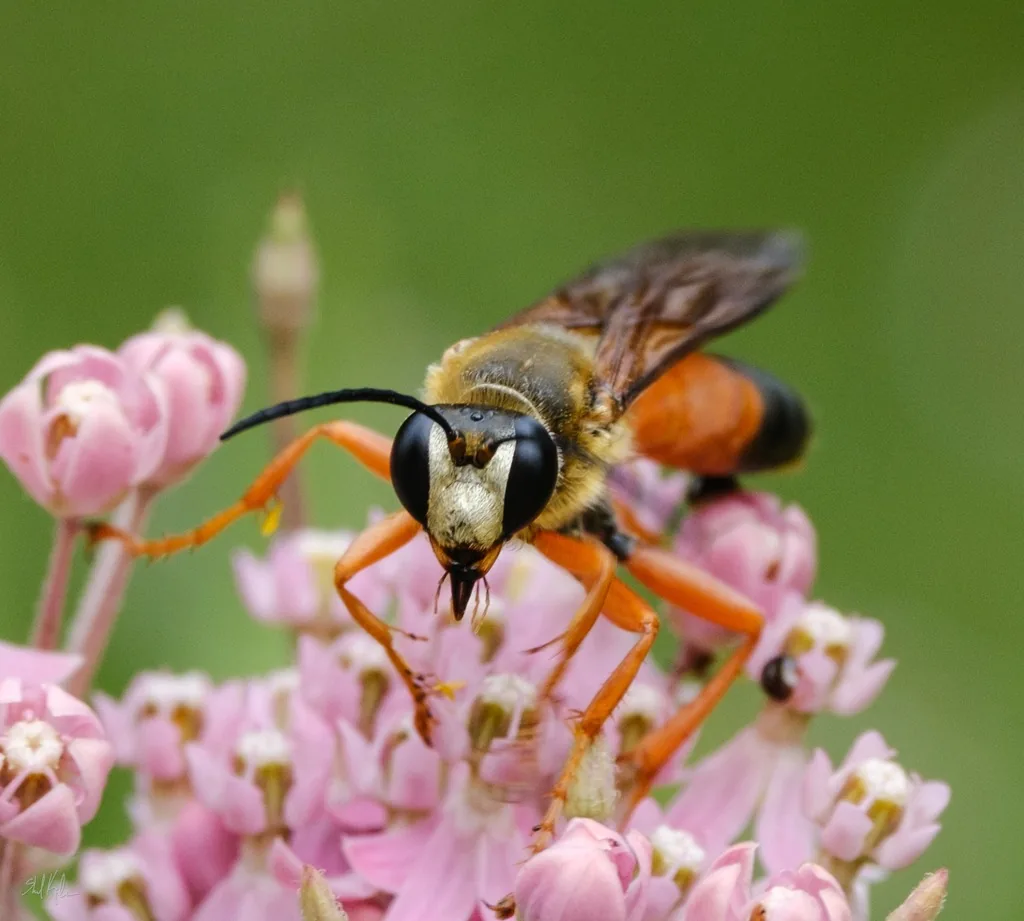
How to identify it
- About 1 inch long, up to roughly 1 1/2 inches; females are larger than males.[2][1]
- The black head and thorax are covered with short golden hairs.[2][1]
- The abdomen is orange to rusty red at the front and black toward the tip, and the legs are reddish orange.[2][1]
- Look for it feeding on flowers in gardens, fields and prairies, especially near sandy areas, throughout the summer.[2]
Look-alikes
| Look-alike | How to tell them apart |
|---|---|
| Cicada killer | Larger, 1 1/2 to nearly 2 inches, with a black abdomen marked by three light-yellow stripes; it stocks its burrows with cicadas rather than katydids and crickets.[4][1] |
Where it lives
Nests from southern Canada through the United States and south to Brazil and Peru; in Missouri it occurs statewide.[3][1]
Biology and life cycle
Each female digs a nearly vertical burrow 3 to 12 inches deep, with 2 to 7 side cells, and stocks each cell with paralyzed katydids, also called long-horned grasshoppers.[3]
She lays an egg on one of the prey insects; eggs hatch in 2 to 3 days and the larvae feed for 6 to 9 days.[3]
Although each nest has one female, nests are often clustered, from a few to rarely hundreds of females in open, sunny sites with the right soil.[1][3]
Young spend the winter underground in the burrows and emerge as adults the next year; there is one generation a year in cold areas and two or more where it's warmer.[1][3]
Adults live about 1 to 2 months and feed on flower nectar.[1]
Damage and signs
Health risk
It is a solitary wasp without the nest-defending behavior of yellowjackets. Solitary wasps sting only in self-defense when mishandled, and only females can sting.[1][5]
Control
Prevention
Usually none is needed: it isn't aggressive, preys on katydids and grasshoppers that feed on garden plants, and pollinates flowers.[1][2]
Burrowing solitary wasps look for sparse, sandy soil; thick, well-fertilized and watered turf can discourage them from digging in a lawn.[5]
Common questions
- Will a great golden digger wasp sting me?
- It's very unlikely. It isn't aggressive, and solitary wasps like it sting only in self-defense when handled; males can't sting at all.[1][5]
- Is it a cicada killer?
- No. Cicada killers are bigger, up to nearly 2 inches, with yellow-striped black abdomens, and they hunt cicadas. Great golden diggers have orange-and-black abdomens and hunt katydids and crickets.[4][2][1]
Sources
- Missouri Department of Conservation, “Great Golden Digger Wasp (Field Guide).” mdc.mo.gov/discover-nature/field-guide/great-golden-digger-wasp (accessed 2026-10-06)
- University of Minnesota Extension, “Great Golden Digger Wasp (What Insect Is This?).” apps.extension.umn.edu/garden/diagnose/insect/general-curiosity-insects/flies/medium/greatgoldendiggerwasp.html (accessed 2026-10-06)
- University of Arkansas Arthropod Museum, “Golden Digger Wasp, Great Golden Digger (Insect of the Week).” arthropod.uark.edu/golden-digger-wasp-great-golden-digger/ (accessed 2026-10-06)
- University of Kentucky Entomology, “ENTFACT-004: Cicada Killer Wasps.” entomology.mgcafe.uky.edu/ef004 (accessed 2026-10-06)
- University of Kentucky Entomology, “ENTFACT-411: Yard Wasps.” entomology.mgcafe.uky.edu/ef411 (accessed 2026-10-06)
- iNaturalist, “Sphex ichneumoneus taxon page (order and family).” www.inaturalist.org/taxa/85362 (accessed 2026-10-06)