How to identify it
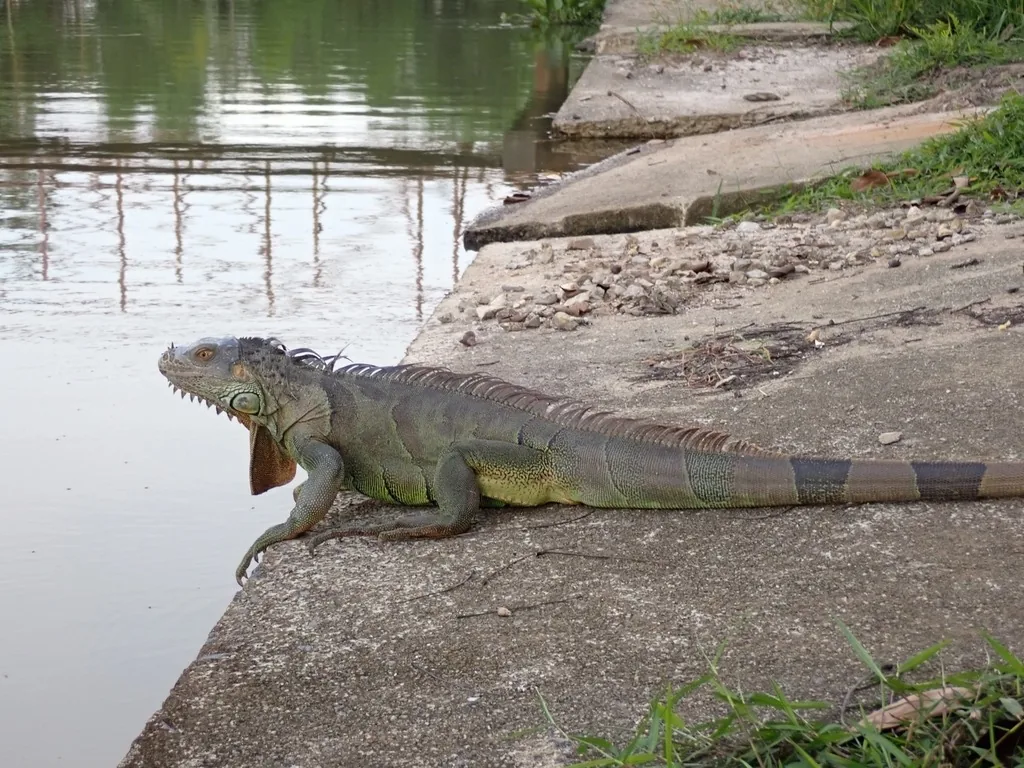
- A large lizard, usually green but sometimes brown or nearly black; some adults turn orange or pink at certain times of year, and hatchlings are bright green.[1]
- A row of spikes runs down the center of the neck, back and upper tail, and the tail has dark black rings.[1]
- Mature males grow heavy jowls and a large throat fan, or dewlap, that is much bigger than a female's.[1]
- Males can top five feet long and weigh up to 17 pounds; females can also reach five feet but usually stay under seven pounds.[1]
Look-alikes
| Look-alike | How to tell them apart |
|---|---|
| Spiny-tailed iguanas (black and Mexican) | Two spiny-tailed iguana species are also established in South Florida; they have reduced back spines and dark color, and big males are sometimes mistaken for alligators.[3] |
| Brown basilisk | The brown basilisk is a smaller introduced lizard, up to about 2 feet long, that lives in the same areas and is often mistaken for an iguana.[3] |
| Knight anole | Knight anoles are large green anoles, usually 12 to 18 inches long, that people in South Florida often call iguanas; they lack the iguana's tall spiny crest.[3] |
Where it lives
Native from Central America to tropical South America and some Caribbean islands. In Florida, populations are established in Miami-Dade, Broward, Palm Beach, Martin and Monroe counties and on the Gulf coast in Collier and Lee counties.[1]
Biology and life cycle
Iguanas live on the ground, in shrubs and in trees, including suburban neighborhoods, towns and farm areas, and they swim well in both salt and fresh water.[1]
Adults mostly eat leaves, flowers and fruit, and occasionally insects, small animals, bird eggs or nestlings; juveniles eat more insects.[3][1]
They like to bask on sidewalks, docks, seawalls, landscape timbers and open mowed areas, and when frightened they dive into water.[3]
Females typically mature at two to four years and dig nest tunnels in sandy areas, laying clutches of roughly 14 to 76 eggs.[1]
Along canal banks and vacant lots they shelter in burrows, culverts, drainage pipes and rock or debris piles, and canals help them spread to new areas.[1]
Freezes limit iguanas to the southern half of peninsular Florida; during cold snaps they can become stunned and fall from trees.[3]
Damage and signs
- They eat landscape plants, orchids and other flowers, and many dooryard fruits and vegetables; UF/IFAS notes that iguanas do not eat citrus.[3][1]
- Burrows can erode and collapse sidewalks, foundations, seawalls, berms and canal banks.[1][3]
- Droppings pile up on docks, moored boats, seawalls, porches, decks, pool platforms and even inside swimming pools, causing mess and odor complaints.[1][3]
- In parks, green iguanas have eaten tree snails and nickerbean, the host plant of the endangered Miami blue butterfly.[1]
Health risk
Iguana droppings can spread Salmonella bacteria through contaminated water or surfaces. Adults normally avoid people, but a cornered iguana can bite, scratch with sharp claws and lash with its tail.[1][3]
Control
Prevention
Never feed iguanas; feeding draws more of them, along with rats and raccoons, and creates problems for neighbors.[3]
Avoid planting iguana favorites such as hibiscus, orchids, roses and garden greens, and choose resistant plants like citrus, oleander, milkweed and tough, thick-leaved species.[3]
Keep them out
Protect prized plants with cages or screen enclosures, and wrap trees, palms and dock pilings with sheet metal guards so iguanas cannot climb.[3]
Sanitation
Remove dense thickets and piles of rocks or landscape timbers, and fill empty burrows during the day when the animals are likely away.[3][1]
Traps and physical control
Harass basking iguanas by spraying them with a hose, using loud noises, wind chimes or hanging reflective CDs that you move often.[1][3]
UF/IFAS describes live traps baited with fruit as a last-resort option; Florida law requires checking traps at least once every 24 hours.[3]
When to call a professional
If you cannot remove iguanas safely, FWC suggests hiring a professional nuisance wildlife trapper, and UF/IFAS also recommends a professional because humane euthanasia is hard for the public to do.[1][3]
What Florida law allows
Green iguanas are not protected in Florida except by anti-cruelty law, and FWC encourages landowners to remove them from private property.[1]
They can be humanely killed on private property year-round with the landowner's permission, and on 32 FWC-managed lands without a license or permit.[1]
Captured iguanas cannot be relocated and released anywhere else in Florida.[1][3]
A permit is required to keep live captured green iguanas, and since April 29, 2021, they have been on Florida's Prohibited species list.[1]
UF/IFAS notes that no poisons are registered or legal for iguanas, that steel leg-hold and body-gripping traps should not be used, and that local ordinances may limit options.[3]
Humane killing standards
FWC says there is an ethical and legal obligation to kill nonnative reptiles humanely.[2]
FWC follows the American Veterinary Medical Association's two-step approach: first cause immediate loss of consciousness, then destroy the brain so the animal cannot recover.[2]
UF/IFAS lists drowning and freezing without prior deep anesthesia as inhumane for iguanas, and says decapitation alone is inhumane too.[3]
UF/IFAS does not recommend euthanasia by homeowners and advises against shooting in suburban areas, where discharging firearms is not legal or safe.[3]
Pet iguanas
It is illegal to release iguanas in Florida, and escaped or released pets remain a main source of introduced species.[1][3]
Owners who can no longer care for a pet iguana can surrender it through FWC's Exotic Pet Amnesty Program with no penalty.[1]
Common questions
- Is it legal to kill an iguana in my yard in Florida?
- FWC says green iguanas can be humanely killed on private property year-round with landowner permission, but anti-cruelty law still applies and the method must be humane.[1][2]
- Can I trap an iguana and release it somewhere else?
- No. Captured iguanas cannot be released elsewhere in Florida, and keeping one alive requires a permit.[1][3]
- Do repellents or poisons work on iguanas?
- No poisons are registered or legal for iguanas in Florida. Habitat changes, plant guards and persistent harassment are the deterrents FWC and UF/IFAS describe.[3][1]
Sources
- Florida Fish and Wildlife Conservation Commission, “Green Iguana (Iguana iguana) species profile.” myfwc.com/wildlifehabitats/profiles/reptiles/lizards/green-iguana/ (accessed 2026-10-06)
- Florida Fish and Wildlife Conservation Commission, “Humane Killing Methods for Nonnative Reptiles.” myfwc.com/wildlifehabitats/nonnatives/python/humane-killing-methods/ (accessed 2026-10-06)
- University of Florida IFAS Extension (EDIS), “Dealing with Iguanas in the South Florida Landscape (EDIS publication IN528).” edis.ifas.ufl.edu/publication/IN528 (accessed 2026-10-06)
- iNaturalist, “Iguana iguana taxon page (order and family).” www.inaturalist.org/taxa/35342 (accessed 2026-10-06)