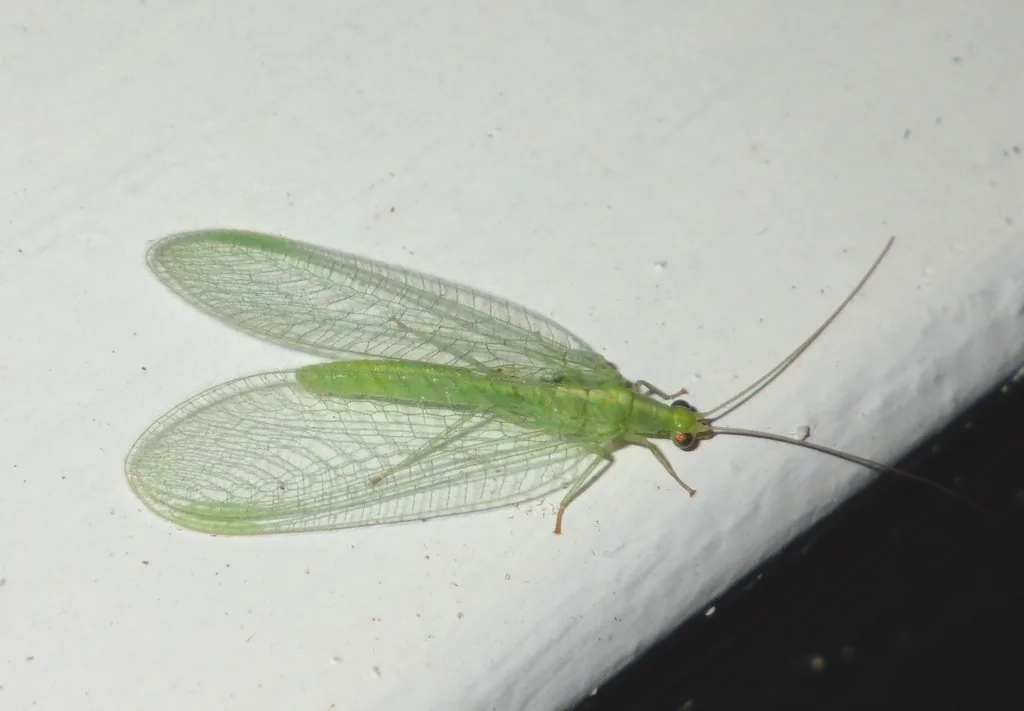
How to identify it
- Adults are about 3/4 inch long, soft-bodied and usually light green, with long antennae and lacy, finely veined wings held rooflike over the body.[1][2][3]
- Their eyes look like two shiny golden hemispheres.[2][1]
- Each egg sits on the tip of a slender, hairlike stalk attached to a leaf or stem, which keeps hatching larvae from eating their siblings.[1][2][3]
- Larvae grow to about 1/2 inch, are flattened and spindle-shaped like tiny alligators, and have large, curved, sickle-shaped jaws.[1][2][3]
- Pupae form inside round, loosely woven white silk cocoons about 1/8 to 1/4 inch across.[1][3]
Look-alikes
| Look-alike | How to tell them apart |
|---|---|
| Brown lacewings | Adults and larvae look similar, but green lacewings are about twice as long in California species; color alone isn't reliable, because some green lacewings turn brown or reddish in winter.[1] |
| Lady beetles | Lady beetles are a separate group of predators; released lady beetle adults fly away from the release area, while newly hatched lacewing larvae are wingless and stay to hunt.[2] |
Where it lives
Common in field and tree crops, gardens, landscapes and wildlands; at least 37 green lacewing species occur in California and 15 in east Texas.[1][3]
Biology and life cycle
Females lay about 100 to 300 eggs during a lifespan of several weeks, usually near food for the larvae.[1][2]
Larvae go through three instars in two to three weeks, then spin a cocoon on a plant or under loose bark.[1][3]
Egg to adult takes about 4 to 6 weeks in warm weather, and there are commonly several generations a year.[1]
In cold climates they overwinter mostly as last-stage larvae or pupae in cocoons, and some adults turn reddish brown in fall.[1][3]
Adults feed mainly on nectar, pollen and honeydew; adults of Chrysoperla species aren't predators, but some other lacewings are.[1][2]
Damage and signs
Health risk
Lacewing larvae rarely bite people; when they do, it usually causes nothing more than a small skin irritation.[2]
Control
Prevention
No control is needed; lacewings are beneficial natural enemies.[3][2]
Biological control
Protect resident lacewings by avoiding broad-spectrum, persistent insecticides and miticides, and by controlling ants and dust.[1]
Grow flowering plants that supply nectar and pollen for the adults, to make resident and released lacewings more effective.[1]
Lacewing eggs, larvae or adults are sold by biological control suppliers; eggs have been used with some success against aphids in greenhouses and plant beds.[1][2]
Common questions
- What are the tiny eggs on hairlike stalks on my plants?
- They are almost certainly green lacewing eggs, each perched on a slender stalk. Leave them alone, because the larvae that hatch will hunt aphids.[2][1]
- Do lacewings bite?
- Larvae can occasionally nip people, but it is rare and usually causes only a small skin irritation.[2]
- How many aphids can a lacewing larva eat?
- Larvae are extremely predatory and can consume more than 200 aphids or other prey a week.[3]
Sources
- University of California Statewide IPM Program, “Green Lacewings (Natural Enemies Gallery).” ipm.ucanr.edu/natural-enemies/green-lacewings/ (accessed 2026-10-06)
- University of Kentucky Entomology Extension, “Green Lacewing, ENTFACT-708 (revised November 2019).” entomology.ca.uky.edu/files/ef708.pdf (accessed 2026-10-06)
- Texas A&M AgriLife Extension, “Green Lacewing (Field Guide to Common Texas Insects).” texasinsects.tamu.edu/green-lacewing/ (accessed 2026-10-06)
- iNaturalist, “Chrysoperla carnea taxon page (order and family).” www.inaturalist.org/taxa/858297 (accessed 2026-10-06)