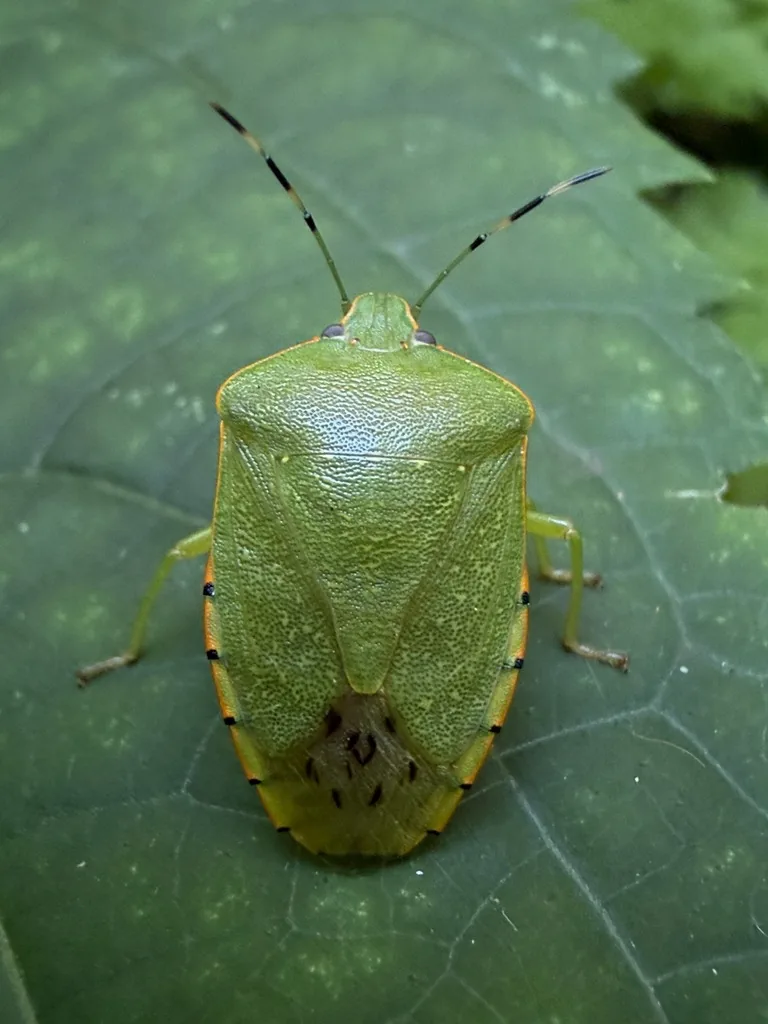
How to identify it
- Adults are shield-shaped and green, about 1/2 to 3/4 inch long, with a large triangle on the back and a strong odor when disturbed.[1][2][5]
- The green stink bug is solid light green, and its head and the area behind it are often edged with a narrow orange-yellow line.[1]
- The southern green stink bug is about 1/2 inch long and overall green, with dark eyes and small black dots along the sides of the abdomen.[2][5]
- Eggs are barrel-shaped and laid in tight clusters, usually under leaves; green stink bug eggs start yellow-green and turn pink to gray.[1][3][2]
- Young nymphs are rounder than adults and mostly black or reddish with pale spots or stripes, turning greener as they grow.[1][3][2][5]
Look-alikes
| Look-alike | How to tell them apart |
|---|---|
| Brown marmorated stink bug | Mottled brown or gray rather than green, with alternating dark and pale bands along the abdomen edge and white bands on the antennae.[5][4] |
| Green stink bug vs. southern green stink bug | The two are told apart by the scent gland opening on the underside, which is long and curved in the green stink bug but short and broad in the southern green stink bug.[2][1] |
Where it lives
The green stink bug occurs across much of North America; the southern green stink bug is mostly limited to the Southeast from Virginia to Florida and west to Texas, and is also established in California and Hawaii.[1][2]
Biology and life cycle
Both species overwinter as adults in leaf litter, under bark or in garden debris and become active in spring.[1][2][4]
Green stink bug egg clusters hold about 30 to 40 eggs; the southern green stink bug lays masses of 30 to 130 eggs.[3][2]
Newly hatched nymphs cluster around the empty egg shells and don't feed at first.[3][2]
The green stink bug has one generation a year in the North and two in the South; the southern green stink bug can have up to four in warm climates.[1][2]
Stink bug numbers often build in weedy areas and then fly into gardens and orchards.[5]
Damage and signs
- Feeding on tomatoes leaves dark pinpricks surrounded by a cloudy light spot that stays green or turns yellow, and the tissue below becomes firm and pithy.[5][4]
- On peaches, feeding causes catfacing, sunken corky areas surrounded by distorted tissue, or shallow dimples; the earlier in fruit development it happens, the worse the damage.[1][5]
- On beans and okra, feeding can cause wart-like bumps, dropped blossoms and pods, and the southern green stink bug can spread yeast-spot disease into lima beans.[4]
- On grapes, feeding collapses berries and can shrivel whole clusters.[3]
- Hosts include tomato, pepper, beans, corn, okra, eggplant, peach, apple, pear, cherry, grape and soybean.[1][4][3]
Health risk
Green stink bugs feed on plants, not people; their nuisance for gardeners is the bad-smelling fluid they release when disturbed or crushed.[4][5]
Control
Keep them out
Use row covers beginning in spring, and consider replacing thick organic mulch, which offers stink bugs shelter.[4]
Sanitation
Clean up crop debris after the season and remove weeds and groundcovers in early spring to reduce overwintering sites and early hosts.[4][5]
Traps and physical control
Handpick bugs and crush egg clusters on small plants; knock bugs into a container of soapy water, since they drop when startled.[5][4][3]
Biological control
Egg-parasitic wasps and a tachinid fly attack these stink bugs; avoid persistent broad-spectrum insecticides that kill natural enemies.[2][1][5]
Pesticides
UC IPM generally doesn't recommend insecticides for stink bugs in gardens; insecticidal soap, neem or pyrethrum work only on young nymphs.[5][4]
Common questions
- What are the cloudy spots on my tomatoes?
- Light, cloudy spots under the skin are a sign of stink bug feeding. The spot can be cut out and doesn't affect eating quality.[4][5]
- Are green stink bugs the same as brown marmorated stink bugs?
- No. Green stink bugs are green, while the brown marmorated stink bug is mottled brown or gray with banded antennae and abdomen edges.[5][4]
- When should I look for green stink bug eggs on grapes?
- Kansas State advises checking grape leaf undersides for egg masses weekly in May and June, then scouting leaves and clusters for nymphs and adults.[3]
Sources
- University of Florida IFAS Extension, “EENY-431: Green Stink Bug, Chinavia hilaris (Featured Creatures).” edis.ifas.ufl.edu/publication/IN794 (accessed 2026-10-06)
- University of Florida IFAS Extension, “EENY-016: Southern Green Stink Bug, Nezara viridula (Featured Creatures).” edis.ifas.ufl.edu/publication/IN142 (accessed 2026-10-06)
- Kansas State University Research and Extension, “MF3606: Green Stink Bug, Insect Pest of Grapes (June 2022).” bookstore.ksre.ksu.edu/pubs/MF3606.pdf (accessed 2026-10-06)
- University of Maryland Extension, “Stink Bugs on Vegetables (updated March 15, 2023).” extension.umd.edu/resource/stink-bugs-vegetables (accessed 2026-10-06)
- University of California Statewide IPM Program, “Stink Bugs (Pest Notes, Home and Landscape).” ipm.ucanr.edu/home-and-landscape/stink-bugs/ (accessed 2026-10-06)
- iNaturalist, “Chinavia hilaris taxon page (order and family).” www.inaturalist.org/taxa/485010 (accessed 2026-10-06)