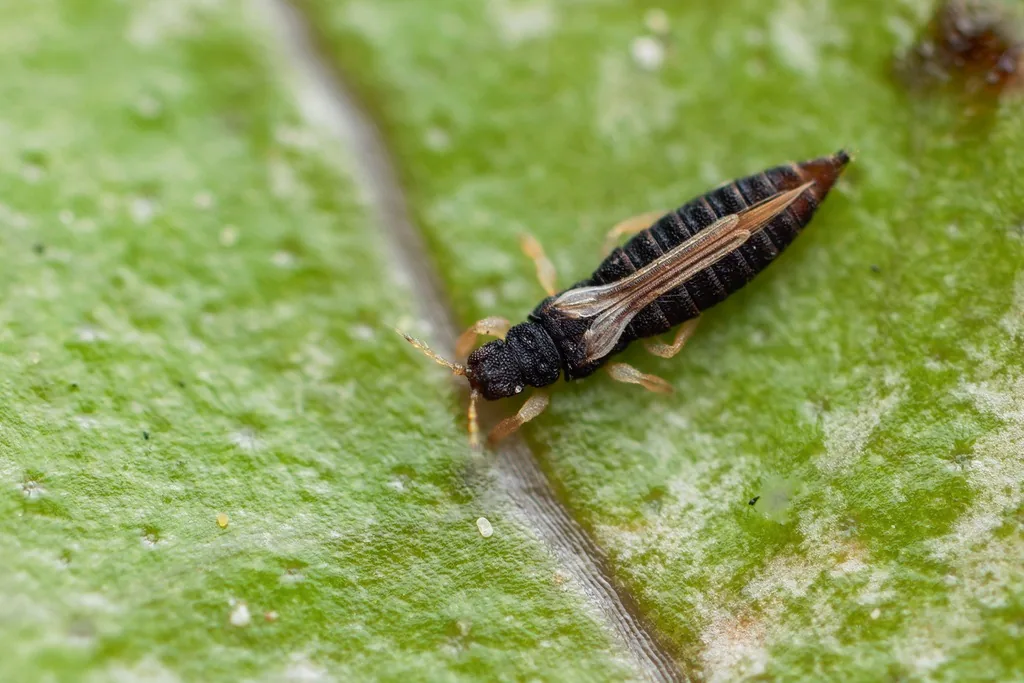
How to identify it
- Adults are about 1/16 inch long, dark brown to black with a lighter tail end, pale yellow legs and narrow, pale wings.[1][2]
- Larvae are white, then yellowish, with red eyes, and often carry a dark droplet of excrement at the tip of the abdomen.[1][2]
- Damaged leaves look silvery or bleached and may yellow and drop; dark specks of excrement dot leaves and fruit.[1]
Where it lives
In the US it lives outdoors in central and southern Florida and southern California and in greenhouses everywhere, sometimes escaping in warm months.[2]
Biology and life cycle
It reproduces without mating, and males are seldom seen; females insert single, white, banana-shaped eggs into leaves or fruit.[1][2]
Two larval stages are followed by prepupa and pupa stages that stay on the plant rather than dropping to the soil.[1][2]
Damage and signs
Health risk
Control
Biological control
The predatory bug Orius insidiosus and the predatory mite Neoseiulus cucumeris, sold by biological control suppliers, are relatively effective.[1]
Pesticides
Contact sprays such as horticultural oils, soaps and pyrethrins don't kill eggs inside leaves, so repeat applications about every two weeks may be needed.[1]
Common questions
- Why are my azalea leaves silvery with black specks?
- Greenhouse thrips feeding bleaches leaves and leaves dark specks of excrement.[1]
- Why do thrips come back after spraying?
- Eggs inside the leaves survive contact sprays and hatch up to two weeks later.[1]
- Do greenhouse thrips live outdoors?
- In the US, mainly in central and southern Florida and southern California.[2]
Sources
- NC State Extension, “Greenhouse Thrips.” content.ces.ncsu.edu/greenhouse-thrips (accessed 2026-10-15)
- University of Florida IFAS Extension (Featured Creatures), “Greenhouse Thrips, Heliothrips haemorrhoidalis (EENY-075).” ask.ifas.ufl.edu/publication/IN232 (accessed 2026-10-15)
- iNaturalist, “Heliothrips haemorrhoidalis taxon page (order and family).” www.inaturalist.org/taxa/330694 (accessed 2026-10-06)