How to identify it
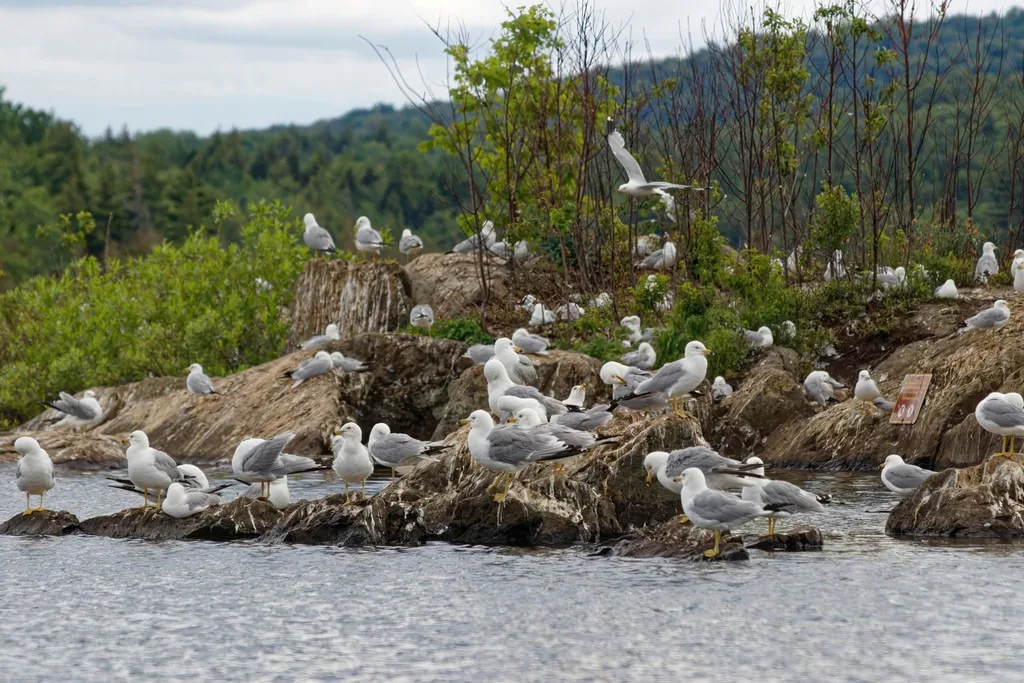
- Gulls are robust birds with webbed feet, long wings and a slightly hooked bill, often seen swimming as well as flying.[1]
- Adults are white with varying patterns of gray and black on the back, wings and head; males and females look alike.[1][5]
- Young birds of the larger species are grayish and take several years to reach adult plumage.[1]
- Sizes range from about 11 inches long in Bonaparte's gull to 24 inches and up to 4 pounds in the great black-backed gull.[5]
- Calls run from a deep growl or gaap to a short yek, often repeated; tracks show webbing between distinct toe marks.[1]
Look-alikes
| Look-alike | How to tell them apart |
|---|---|
| Other gull species | North America has 23 gull species with similar plumages, so species can be hard to tell apart. Herring and ring-billed gulls are the most common.[1] |
Where it lives
Herring and ring-billed gulls live throughout North America, on coasts and inland, in big cities and farm fields. Both have increased dramatically over the past century by feeding on trash, handouts and crops.[1][6]
Biology and life cycle
Most gulls nest in colonies on sand or gravel shorelines and islands, and increasingly on flat rooftops.[2][5]
Pairs usually lay 2 or 3 eggs and incubate them for about 24 to 26 days; the young stay near the nest for about 5 weeks before flying.[6]
Gulls are long-lived, surviving 10 to 30 years, and most do not breed until they are 2 to 3 years old.[5]
Adults and young return to the same nesting area year after year.[6]
They eat almost anything, including fish, insects, small animals, carrion and garbage, and steal food from each other and other birds.[2][5]
A gull can eat its whole daily food needs in as little as 15 minutes, so even brief access to garbage keeps a flock around.[6]
Gulls migrate away from areas when the water freezes.[2]
Damage and signs
- Nesting material from rooftop colonies clogs roof drains, keeping water from draining and damaging the roof and building.[5]
- Gulls peck at roofs, pull out insulation and drop rocks and clams onto roofs and cars.[3]
- Droppings foul docks and boats and can destroy polyurethane roofing, boat covers and pool covers.[3][6]
- Gulls that link people with food become bold, harassing diners and sunbathers at outdoor spots.[5][6]
- Nesting gulls may dive at and strike people who come too close, often while defecating or vomiting on them.[5][6]
- They raid crops such as cherries, blueberries, grapes and strawberries, and are the birds most often involved in aircraft strikes.[3][6]
Health risk
Gulls can carry salmonella, campylobacter and listeria, and their droppings have been linked to E. coli and Salmonella contamination of water and beaches.[3][5]
Control
Keep them out
Spikes, coils, sloped surfaces, gels or electric strips keep gulls off ledges, signs and parapets, but they are not practical for a whole roof.[6][5]
Parallel wires or monofilament lines strung over a flat roof or other open area keep gulls from landing; ring-billed gulls need closer spacing than herring gulls.[5][6][4]
Sanitation
Do not feed gulls. Remove garbage promptly, keep dumpsters and trash cans closed, and don't leave pet food outside.[5][6]
Where gulls are a problem, stop feeding other animals such as feral cats too, since gulls take that food.[5]
Traps and physical control
Start harassing gulls before egg-laying, mixing noise, effigies, lasers or trained dogs and changing them often so gulls don't get used to them.[6][5]
Pesticides
Methyl anthranilate fogging can repel gulls, and sticky polybutene coatings keep them off beams and posts until dust builds up.[4]
When to call a professional
Removing nests with eggs, treating eggs or killing gulls requires federal and often state permits; contact your state wildlife agency or USDA Wildlife Services.[5][4]
Gulls and the law
All gulls are migratory birds protected by the Migratory Bird Treaty Act and, in most cases, state law.[6][1]
No federal permit is needed to frighten gulls or keep them out with barriers outside the nesting season.[1][5]
Once egg-laying begins, disturbing the birds, eggs or nests without a federal permit is illegal, so rooftop harassment must start before eggs appear.[6][5]
Permits to kill gulls are issued only after frightening and barriers have been tried and judged ineffective, and some states require their own permit too.[1]
Some states also require a pesticide applicator license for egg oiling, and pyrotechnics and noisemakers may be limited by local rules. Check state and local requirements first.[4][6][5]
What doesn't work well
Netting stretched over rooftops has failed in some cases, with gulls nesting on top of the net.[6]
Ultrasonic devices have not proven effective against gulls and are not recommended.[4][6]
Scare devices used alone lose their effect quickly once gulls learn they are harmless.[6][4]
Common questions
- Can I remove a gull nest from my roof?
- Not once it holds eggs, unless you have a federal permit. Clear nesting material and harass gulls before laying starts.[5][6]
- Why do gulls keep coming back to my building?
- Gulls return to the same nesting areas year after year and stay wherever food is easy. Cut off food and start deterrents early in the season.[6]
- Are gulls dangerous?
- Nesting gulls may dive at people near their nests, and their droppings can carry bacteria such as salmonella. Keep your distance from active nests.[5][3]
Sources
- Internet Center for Wildlife Damage Management, “Gulls: Identification.” icwdm.org/species/birds/gulls/ (accessed 2026-10-06). Run by university wildlife damage specialists (maintained at the University of Wisconsin-Stevens Point); species modules are based on Prevention and Control of Wildlife Damage (University of Nebraska Cooperative Extension, 1994).
- Internet Center for Wildlife Damage Management, “Gull Biology.” icwdm.org/species/birds/gulls/gull-biology/ (accessed 2026-10-06). Run by university wildlife damage specialists (maintained at the University of Wisconsin-Stevens Point); species modules are based on Prevention and Control of Wildlife Damage (University of Nebraska Cooperative Extension, 1994).
- Internet Center for Wildlife Damage Management, “Gull Damage Identification.” icwdm.org/species/birds/gulls/gull-damage-identification/ (accessed 2026-10-06). Run by university wildlife damage specialists (maintained at the University of Wisconsin-Stevens Point); species modules are based on Prevention and Control of Wildlife Damage (University of Nebraska Cooperative Extension, 1994).
- Internet Center for Wildlife Damage Management, “Gull Damage Prevention and Control Methods.” icwdm.org/species/birds/gulls/gull-damage-prevention-and-control-methods/ (accessed 2026-10-06). Run by university wildlife damage specialists (maintained at the University of Wisconsin-Stevens Point); species modules are based on Prevention and Control of Wildlife Damage (University of Nebraska Cooperative Extension, 1994).
- USDA APHIS Wildlife Services, “Gulls, Wildlife Damage Management Technical Series (Lowney, Beckerman, Barras and Seamans, May 2018).” www.aphis.usda.gov/sites/default/files/Gulls-WDM-Technical-Series.pdf (accessed 2026-10-06)
- Minnesota Department of Natural Resources, “Living with Wildlife: Gulls (Gull Damage Management guide).” files.dnr.state.mn.us/assistance/backyard/livingwith_wildlife/gulls/full_doc.pdf (accessed 2026-10-06). Same content as the DNR's Living with gulls web pages.
- iNaturalist, “Larus delawarensis taxon page (order and family).” www.inaturalist.org/taxa/4364 (accessed 2026-10-06)