How to identify it
- Adults are 1/8 to 3/16 inch long and look like gnats at a glance; up close they resemble a miniature cicada.[1][4]
- Their mottled brownish wings carry small black and white spots, extend past the abdomen, and are held tent-like over the body.[1]
- They are also called jumping plant lice, because they jump and fly away quickly when disturbed.[1][2][3]
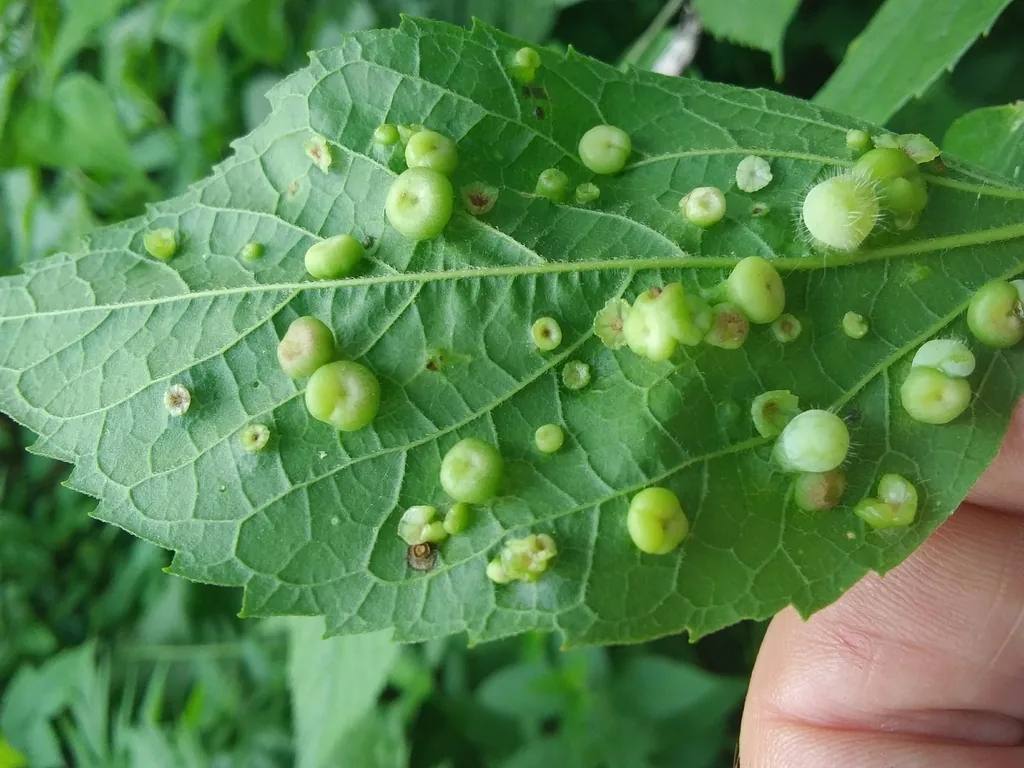
- The galls are the clearest clue: 1/8 to 1/4 inch swellings on hackberry leaves or leaf stems, with a pale developing psyllid inside.[4]
- The hackberry nipple gall maker forms nipple-shaped galls on the underside of leaves; a related species makes flat blister galls on the upper surface.[1]
Where it lives
Hackberry psyllids occur wherever hackberry trees grow; Texas A&M notes that probably every hackberry tree is infested by one of the gall-forming species.[4]
Biology and life cycle
Adults overwinter in bark cracks and other sheltered spots, including buildings, then fly to hackberry trees in early spring to lay eggs on the expanding leaves.[1][4]
Egg-laying stretches over several weeks starting when new leaves unfold, and nymphs hatch in about 10 days.[2][4]
Nymph feeding makes the leaf tissue swell into a gall around each insect, which feeds and develops inside it for the rest of the summer.[1][2]
Adults leave the galls in late summer and fall, around September in Texas; there is one generation a year.[1][4]
Large swarms can appear on sunny, warm autumn afternoons, and they usually disappear after a killing frost.[2]
Damage and signs
- The galls make leaves look unsightly and occasionally cause early leaf drop, but they don't harm the health of a mature hackberry.[1][2][4]
- Indoors they are only a nuisance; they can't reproduce inside, and they don't attack houseplants, stored food or furnishings.[1][2]
- Insects seen indoors in winter or spring got in the previous fall.[1]
Health risk
They don't feed on people or pets, but psyllids that land on skin may probe it and cause a small, harmless bite sensation.[2][1]
Control
Prevention
Purdue suggests simply keeping windows closed during the short period in fall when the adults are active.[3]
Psyllids are attracted to lights at night, so turn off outdoor lights or switch to yellow bulbs that draw fewer insects.[1]
Minnesota Extension advises against cutting down a healthy hackberry, since psyllids can still fly in from neighboring trees.[1]
Keep them out
Install storm windows and fine 18-mesh screens, repair damaged window, door and vent screens, and seal gaps around doors, windows, fascia boards and utility entries.[1]
Traps and physical control
Remove any that get inside with a tissue or a vacuum; insecticides aren't needed indoors.[1]
Pesticides
Spraying the house exterior usually isn't practical, but when very high numbers are entering in fall, Minnesota Extension says a residual insecticide such as permethrin, beta-cyfluthrin or deltamethrin around windows and doors can help.[1]
Treating the hackberry tree isn't recommended: it takes several sprays timed to egg hatch, large trees are hard to cover, and summer or fall sprays don't work.[1][2]
Common questions
- What are the tiny bugs coming through my window screens in fall?
- If you live near hackberry trees, they are likely hackberry psyllids. Adults leave their leaf galls in fall, gather on windows, and are small enough to pass through most screens.[1][3]
- Do hackberry psyllids bite?
- Not really. They may briefly probe your skin, which feels like a tiny bite, but they don't feed on people or pets.[2][1]
- Will the bumps on my hackberry leaves hurt the tree?
- No. The galls look bad and can cause some early leaf drop, but they don't harm a healthy tree.[1][4]
Sources
- University of Minnesota Extension, “Western Conifer Seed Bug and Hackberry Psyllids (reviewed 2024).” extension.umn.edu/nuisance-insects/western-conifer-seed-bug-and-hackberry-psyllids (accessed 2026-10-06)
- University of Kentucky Entomology, “Hackberry Psyllids and Other Jumping Plant Lice (ENTFACT-413).” entomology.ca.uky.edu/files/ef413.pdf (accessed 2026-10-06)
- Purdue Extension Entomology, “Hackberry Nipple Gall-making Psyllid (Hot News HN-82).” extension.entm.purdue.edu/publications/HN-82.pdf (accessed 2026-10-06)
- Texas A&M AgriLife Extension, “Hackberry Gall Psyllid (Field Guide to Common Texas Insects).” texasinsects.tamu.edu/hackberry-gall-psyllid/ (accessed 2026-10-06)
- iNaturalist, “Pachypsylla celtidismamma taxon page (order and family).” www.inaturalist.org/taxa/1624188 (accessed 2026-10-06)