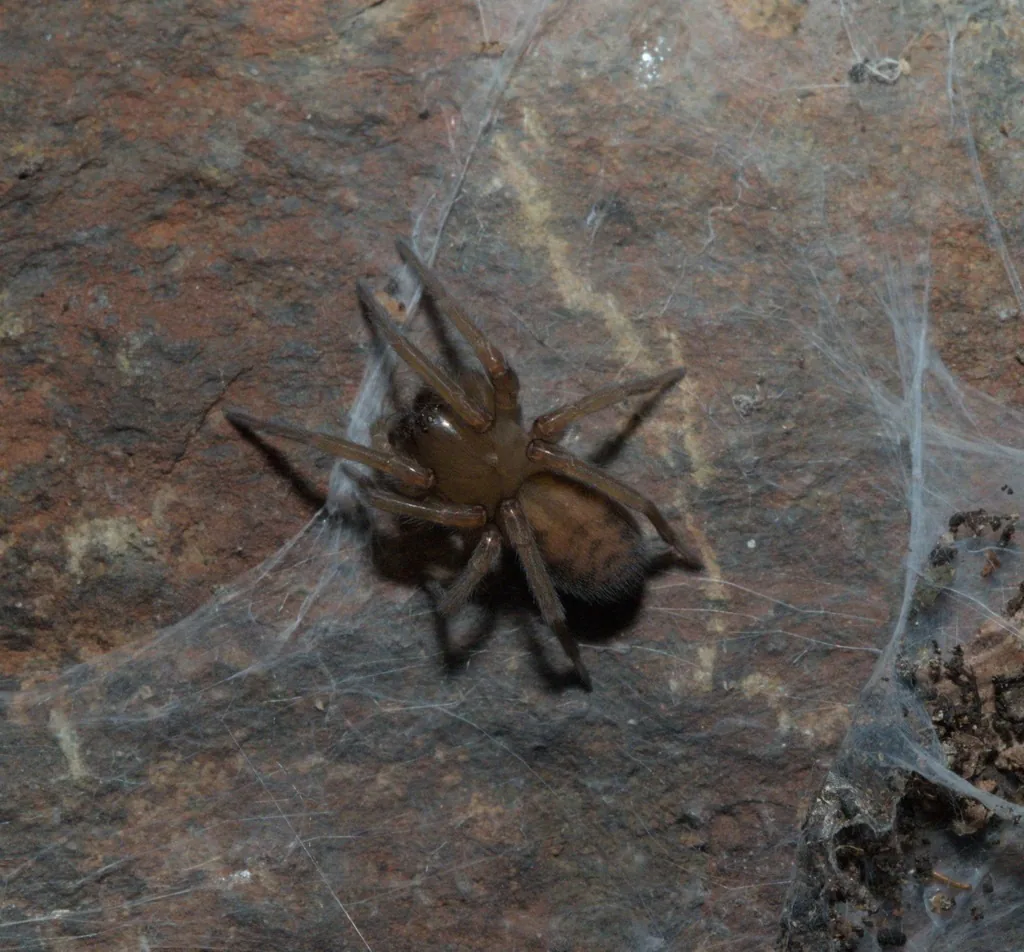
How to identify it
- Females are 5 to 14 mm long and males 5 to 12.5 mm.[1]
- The front body section is reddish mahogany brown, darkest around the eyes and jaws, and the legs are lighter.[1]
- The abdomen is usually gray, from pinkish to charcoal, with lighter spots and often chevron marks toward the rear.[1]
- The web is an irregular mesh with a poorly defined tube retreat.[1]
Where it lives
Penn State Extension covers them in Pennsylvania, where they live under bark, leaf litter and stones and in woodpiles.[1]
Biology and life cycle
Males overwinter as immature spiders, molt twice in spring, become adults in April and die after mating.[1]
Females turn up in every season and probably live at least two years.[1]
Egg sacs holding 73 to 175 eggs are laid where the spiders live, often in the web.[1]
Damage and signs
- Penn State Extension mentions no damage; they're frequently found in damp basements and other parts of the home in autumn.[1]
Health risk
They rarely bite, and bites aren't known to be medically important; the one verified bite, by a young Callobius, caused pain, itching, swelling, redness and nausea.[1]
Control
Keep them out
Seal foundation cracks and gaps around windows and doors to keep spiders out.[2]
Sanitation
Clear clutter in basements and storage areas, and set boxes off the floor and away from walls, sealed with tape.[2]
Traps and physical control
Vacuum or sweep basements, corners and seldom-used areas regularly; the tumble through the hose usually kills spiders.[2]
Common questions
Sources
- Penn State Extension, “Hacklemesh Weaver Spiders.” extension.psu.edu/hacklemesh-weaver-spiders (accessed 2026-10-06)
- University of California Statewide IPM Program, “Spiders (Pest Notes, Home and Landscape).” ipm.ucanr.edu/home-and-landscape/spiders/ (accessed 2026-10-06)
- iNaturalist, “Callobius bennetti taxon page (order and family).” www.inaturalist.org/taxa/215765 (accessed 2026-10-06)