How to identify it
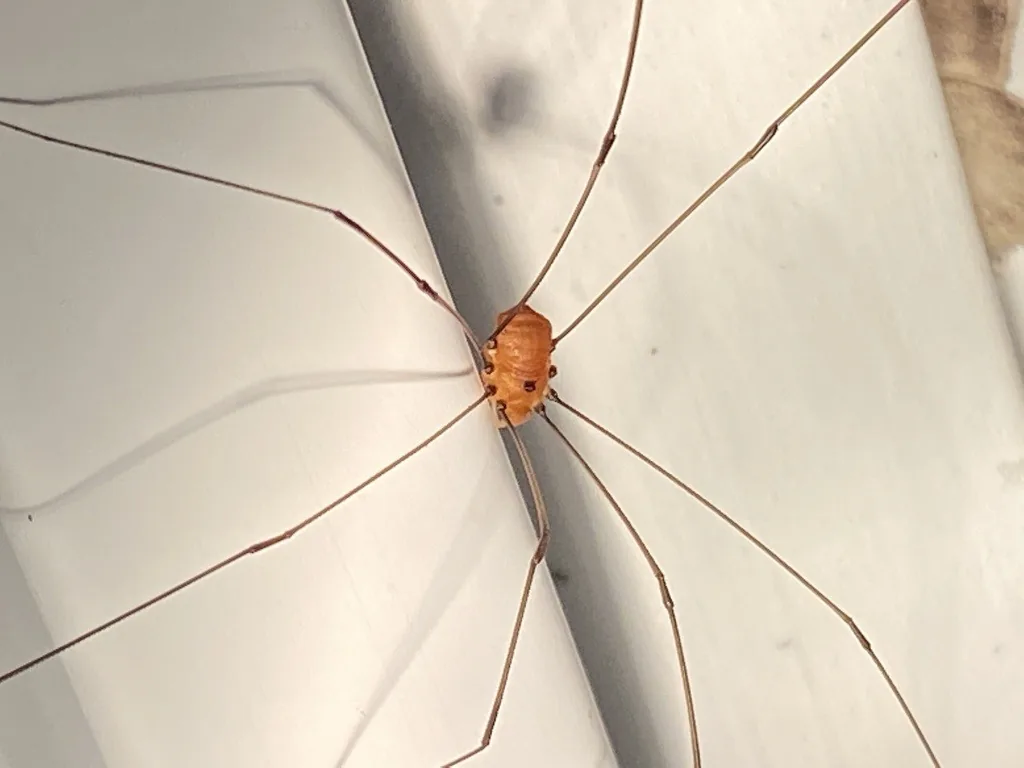
- The body is small and oval, about 1/16 to 1/2 inch long, carried on eight very long, slender legs.[1][3]
- Unlike a spider, the body looks like one oval piece because the two body regions don't narrow where they join.[2][4]
- Harvestmen have just two eyes, set on a raised bump on top of the body; spiders have six to eight.[2][4]
- The second pair of legs is the longest and is waved about as a sensory tool, much as insects use antennae.[1][2]
- They make no silk and spin no webs, because they lack the spinnerets spiders have.[1][3]
Look-alikes
| Look-alike | How to tell them apart |
|---|---|
| Cellar spiders | Cellar spiders are true spiders, also nicknamed daddy longlegs, with a distinct two-part body and messy mesh webs; harvestmen have a single oval body and make no webs.[5][2] |
Where it lives
More than 6,500 species occur worldwide, and they live in forests, fields and urban yards across the United States; Texas alone reports 18 species.[1][3][4]
Biology and life cycle
They eat small insects, including aphids and other plant pests, and also scavenge dead insects, carcasses, droppings and other organic matter.[1][2]
Females lay eggs in soil, under stones or bark, or in cracks in wood; eggs laid in autumn hatch in spring.[1][2]
In northern states most live only a year, while in the Southeast adults can overwinter and live up to two years.[1]
They dry out easily, so they shelter under rocks, mulch and logs and are mostly active at night.[2]
When grabbed, a harvestman can drop a leg that keeps twitching to distract the predator; lost legs do not grow back.[2][1]
Scent glands release a strong-smelling defensive fluid that most predators find distasteful.[1][2]
Damage and signs
- In fall they can become a nuisance when they gather in large clusters on trees and houses, usually around eaves and windows.[1]
- They do not damage structures, and the fall clustering lasts only a short time.[1]
- They turn up in damp crawl spaces, unfinished basements and garages but are rarely found in finished living areas.[1]
Health risk
Harvestmen are harmless to people: they have no venom glands and do not bite.[1][3][2]
Control
Prevention
Because they are beneficial predators, control is rarely needed; Ohio State also advises avoiding broad-spectrum insecticides in gardens.[1][2]
Traps and physical control
Remove harvestmen from walls and structures with a vacuum or a broom.[1]
Pesticides
If large numbers outdoors are truly unwanted, an insecticide spray labeled for exterior use on spiders can be applied directly to them, though Clemson says this is almost never necessary.[1]
The venom myth
A popular legend claims daddy longlegs are the most venomous spiders in the world but can't bite through human skin.[1][2]
Both Clemson and Ohio State Extension call this untrue: harvestmen have no venom glands at all and are not spiders.[1][2]
Instead of venom, they grab prey with crab-like mouthparts and tear it apart to eat it.[1][2]
Common questions
- Are daddy longlegs poisonous?
- No. Harvestmen have no venom glands and cannot bite people, despite the popular myth.[1][2]
- Why are there so many daddy longlegs on my house in fall?
- Harvestmen often gather in clusters on homes around eaves and windows in fall; it is brief and causes no damage.[1]
- Is a daddy longlegs a spider?
- A harvestman is an arachnid but not a spider; it has two eyes, one oval body section, and makes no silk or venom.[2][1]
Sources
- Clemson Cooperative Extension, Home & Garden Information Center, “Daddy Longlegs, HGIC 2418 (revised June 17, 2026).” hgic.clemson.edu/factsheet/daddy-longlegs/ (accessed 2026-10-06)
- Ohio State University Extension, “Ohio's Natural Enemies: Harvestmen (also known as daddy longlegs), ENT-68.” ohioline.osu.edu/factsheet/ent-68 (accessed 2026-10-06)
- University of Minnesota Extension, “Harvestmen (daddy longlegs), What insect is this?.” apps.extension.umn.edu/garden/diagnose/insect/general-curiosity-insects/relatives/medium/harvestmen.html (accessed 2026-10-06)
- Texas A&M AgriLife Extension, “Harvestmen (Opiliones) (Field Guide to Common Texas Insects).” texasinsects.tamu.edu/opiliones/ (accessed 2026-10-06)
- Penn State Extension, “Longbodied Cellar Spider (updated January 19, 2026).” extension.psu.edu/longbodied-cellar-spider (accessed 2026-10-06)
- iNaturalist, “Leiobunum vittatum taxon page (order and family).” www.inaturalist.org/taxa/1071047 (accessed 2026-10-06)