How to identify it
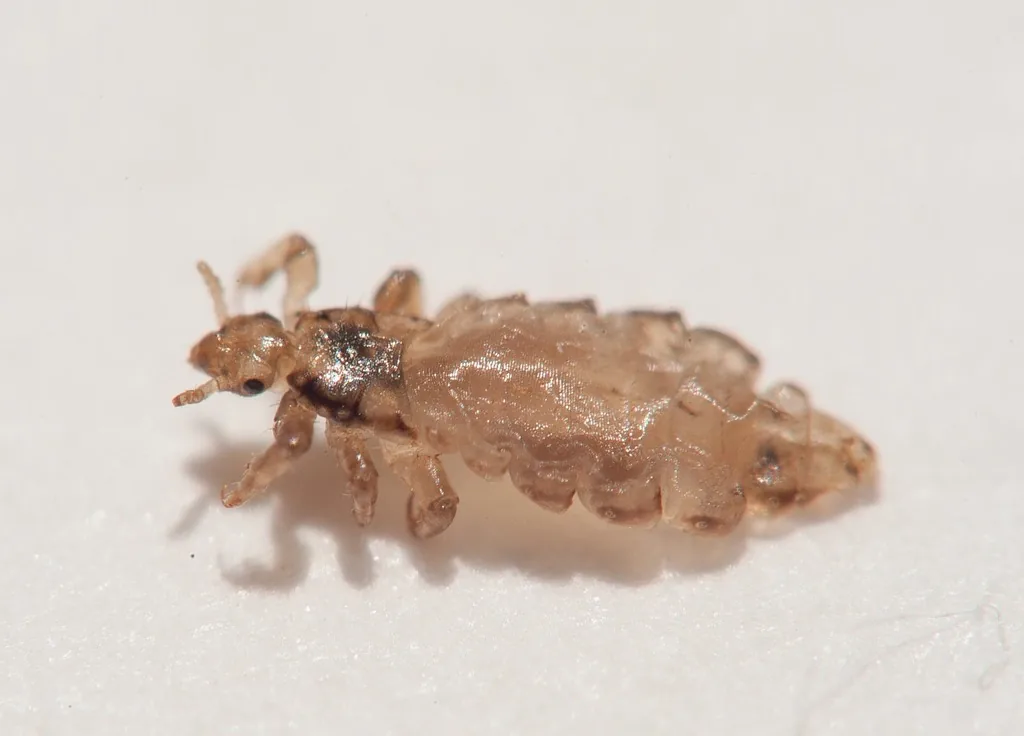
- Adults are about 2 to 3 mm long, roughly the size of a sesame seed, and beige to gray.[1][3]
- Each of the six legs ends in a claw for gripping hair; lice crawl quickly but can't hop, jump or fly.[3][1]
- Nits are tiny oval eggs, about 1/32 inch, glued to the hair shaft close to the scalp; nymphs look like small adults.[3][1]
- A nit sticks firmly to the hair, while dandruff or other flakes brush or wash off.[3]
Look-alikes
| Look-alike | How to tell them apart |
|---|---|
| Dandruff and hair debris | Flakes lift off easily; an empty nit casing stays cemented to the hair shaft, so use a magnifier to check.[3] |
| Old, hatched nits | Nits more than 1/4 inch from the scalp have probably hatched or are dead; finding a live, crawling louse is what confirms an active infestation.[3] |
Where it lives
Head lice live only on people; in the U.S. most infestations involve preschool and elementary-age children and their household members.[1][3]
Biology and life cycle
Females glue about five or more eggs a day to hairs near the scalp, mostly at night, and eggs hatch in 7 to 10 days.[3]
Nymphs need a blood meal within minutes of hatching and mature in about 7 to 10 days; adults live about 3 to 4 weeks on the head.[3][1]
Because the scalp stays warm, they breed all year.[3]
Off the head, lice die within about two days and nits usually die within a week.[1][3]
Damage and signs
Health risk
Head lice don't transmit any disease. Itching, an allergic reaction to the bites, may not begin for several weeks, and heavy scratching can lead to infected sores.[1][3]
Control
Prevention
Do not use fumigant sprays or fogs in the home; they can be toxic if inhaled or absorbed through the skin, and insecticide sprays on furniture or bedding don't control head lice.[2][3]
Sanitation
Wash bedding, clothes and towels the person used in the previous two days in 130 degrees F water and a hot dryer, or seal unwashable items in a plastic bag for two weeks.[2][3]
Vacuum the floor and furniture where the person sat or lay; the chance of catching lice from carpet or furniture is very small.[2]
Traps and physical control
Comb wet hair section by section with a metal nit comb every two to three days for two to three weeks; combing is key no matter which product is used.[2][3]
Pesticides
Treat every infested person in the household, and anyone sharing a bed, at the same time with an over-the-counter or prescription lice medication used exactly as the label directs.[2][3]
Products that kill lice but not eggs need a second treatment 7 to 10 days later, after remaining eggs hatch.[2][3]
Lice are widely resistant to permethrin, pyrethrins, malathion and lindane; UC IPM points to products containing benzyl alcohol, spinosad or dimethicone instead.[3]
What not to put on a child's head
Never use household bug sprays, pet flea or tick shampoos, or kerosene to treat lice; serious injuries have occurred from chemicals not meant for lice.[3]
CDC also advises against mayonnaise, olive oil and similar home remedies.[2]
Common questions
- Do I need to spray or fog my house for head lice?
- No. CDC says not to use fumigant sprays or fogs; washing recently used bedding and clothing and vacuuming where the person rested is enough.[2][3]
- Can my dog or cat give us head lice?
- No. Animals do not get or spread head lice.[1][3]
- Should my child stay home from school?
- Generally no. UC IPM notes that the CDC and American Academy of Pediatrics advise against excluding children for lice or nits; treat that evening and return the next day.[3]
Sources
- U.S. Centers for Disease Control and Prevention, “About Head Lice.” www.cdc.gov/lice/about/head-lice.html (accessed 2026-10-06)
- U.S. Centers for Disease Control and Prevention, “Treatment of Head Lice.” www.cdc.gov/lice/treatment/index.html (accessed 2026-10-06)
- University of California Statewide IPM Program, “Pest Notes: Head Lice, UC ANR Publication 7446.” ipm.ucanr.edu/home-and-landscape/head-lice/ (accessed 2026-10-06)
- iNaturalist, “Pediculus humanus capitis taxon page (order and family).” www.inaturalist.org/taxa/413842 (accessed 2026-10-06)