How to identify it
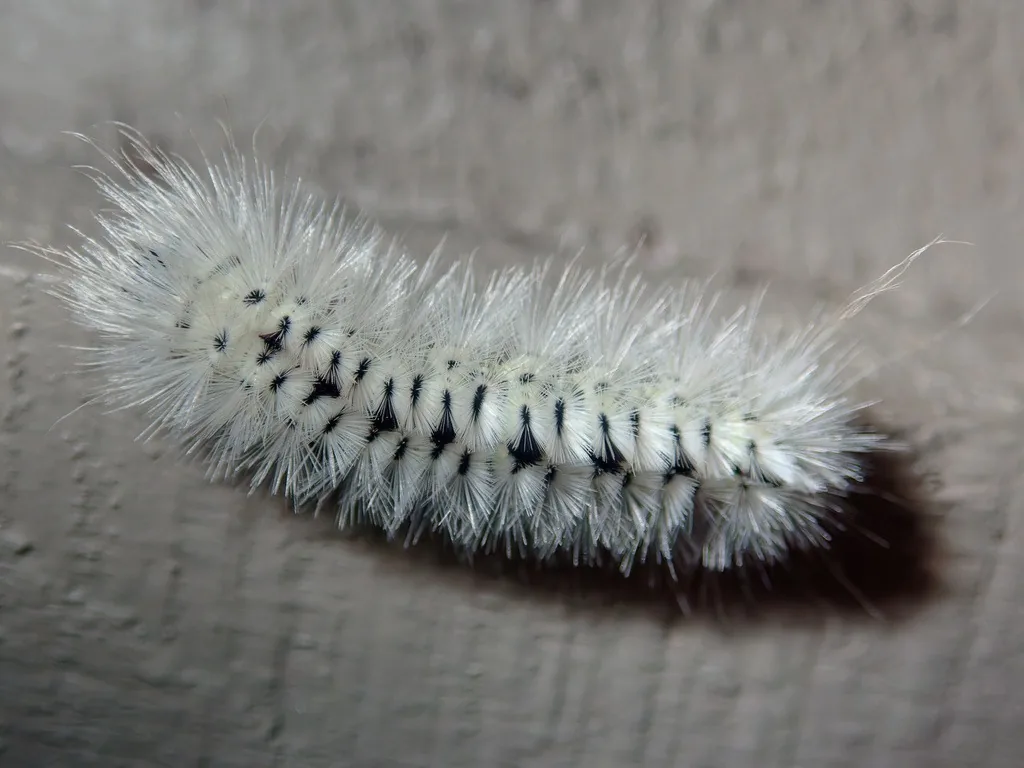
- Young caterpillars are white with black spots; older ones reach 1.7 inches and are covered in white and black hairs.[1]
- Tufts of black hairs run along the back, and black hair 'pencils' often stick out at the front and back.[1]
- Adult moths are tan to light brown with rows of cream-colored spots on the wings.[1]
Where it lives
It's found mainly in northeastern North America, from Maine and New Brunswick to North Carolina and west to Wisconsin and Illinois, and less often southwest into Texas.[1]
Biology and life cycle
There's one generation a year: moths fly in May and June, and caterpillars feed from July to September.[1]
Eggs are laid in clusters of 100 or more under leaves; young caterpillars feed in groups, older ones alone or a few together.[1]
Mature caterpillars wander in search of sheltered places to spin cocoons, which include their hairs and can be found year-round.[1]
Hickory, walnut, pecan and American hornbeam are preferred, but they can likely feed on most deciduous hardwoods.[1]
Damage and signs
- Outbreaks occasionally defoliate trees locally, but most feeding comes a few weeks before leaf drop, so trees generally aren't harmed long term.[1]
Health risk
The barbed hairs can lodge in skin, eyes or mouth and cause an itchy rash; get medical care right away if hairs are swallowed or in an eye, or an allergic reaction follows.[1]
Control
Traps and physical control
Prune out egg masses or clusters of young caterpillars, or drop them into a bucket of soapy water; wear gloves to hand-pick older caterpillars.[1]
Biological control
Natural enemies usually keep this native moth in check, and control is rarely warranted once caterpillars are large.[1]
Pesticides
For many young caterpillars on trees under about 15 feet tall, Penn State lists Bt or spinosad; spinosad is toxic to many pollinators.[1]
Common questions
- What should I do if a hickory tussock caterpillar touched my skin?
- Wash with soap and water; use tape, then fine tweezers, to remove any embedded hairs.[1]
- Are hickory tussock moth caterpillars poisonous?
- Their hairs cause local rashes and itching; Penn State knows of no systemic allergic reactions to this species.[1]
- Do I need to spray for them?
- Rarely. Most feeding comes just weeks before leaf drop, so trees aren't harmed long term.[1]
Sources
- Penn State Extension, “Hickory Tussock Moth Caterpillar.” extension.psu.edu/hickory-tussock-moth-caterpillar (accessed 2026-10-06)
- iNaturalist, “Lophocampa caryae taxon page (order and family).” www.inaturalist.org/taxa/82225 (accessed 2026-10-06)