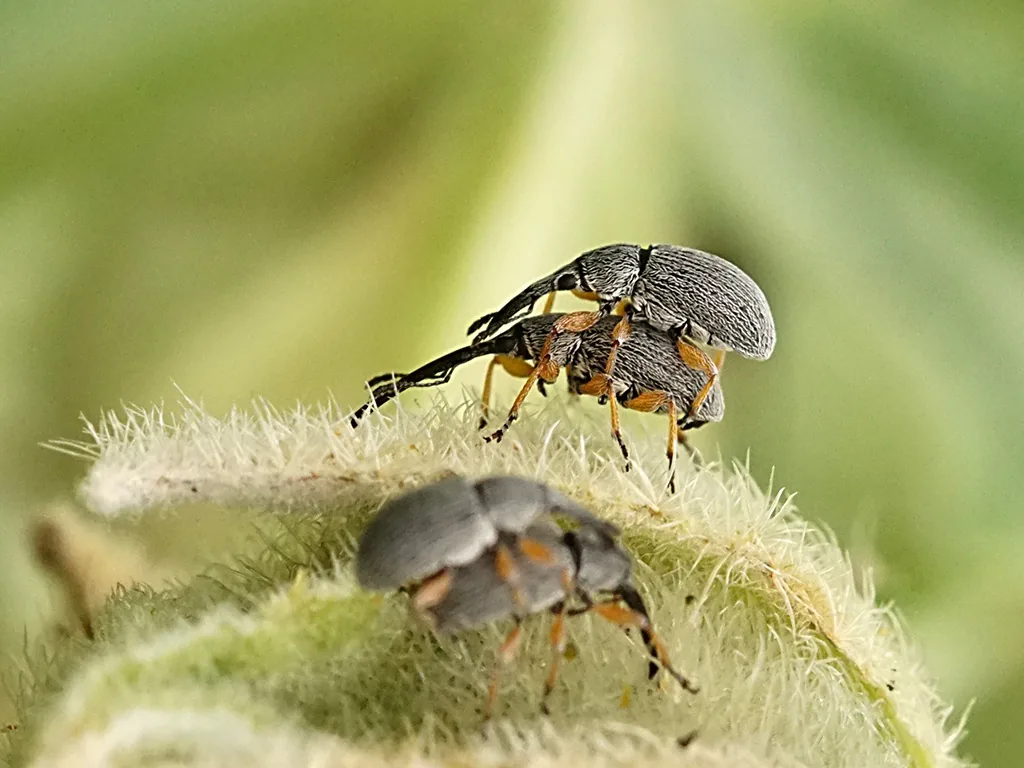
How to identify it
Where it lives
Native to southern and southeastern Europe and Asia Minor, it was found in Georgia in 1914 and is now well distributed across the US.[1]
Biology and life cycle
Adults mate in July and August, and females drill deep into developing buds to lay eggs.[1]
Larvae develop in 4 to 6 weeks and pupate in August; most overwinter as adults in duff and litter.[1]
Damage and signs
- Weevils reduce flowering and may cut natural reseeding, though their feeding damage to hollyhock is relatively minor.[1]
Health risk
It feeds on plants; the PNW Insect Management Handbook mentions no risk to people.[1]
Control
Prevention
Watch for the first holes in leaves, or for paired weevils around flowers and buds.[1]
Sanitation
Remove and destroy buds before adults emerge in late summer, or through winter to catch adults that emerge in spring.[1]
Traps and physical control
Bend flower heads over a box and strike the stem sharply to knock adults off, or pick them off; they cling tightly.[1]
Common questions
Sources
- Pacific Northwest Pest Management Handbooks (OSU, WSU, University of Idaho), “Hollyhock (Alcea rosea): Hollyhock weevil (Insect Management Handbook).” pnwhandbooks.org/insect/hort/landscape/hosts-pests-landscape-plants/hollyhock-alcea-rosea-hollyhock-weevil (accessed 2026-10-06)
- iNaturalist, “Rhopalapion longirostre taxon page (order and family).” www.inaturalist.org/taxa/455182 (accessed 2026-10-06)