How to identify it
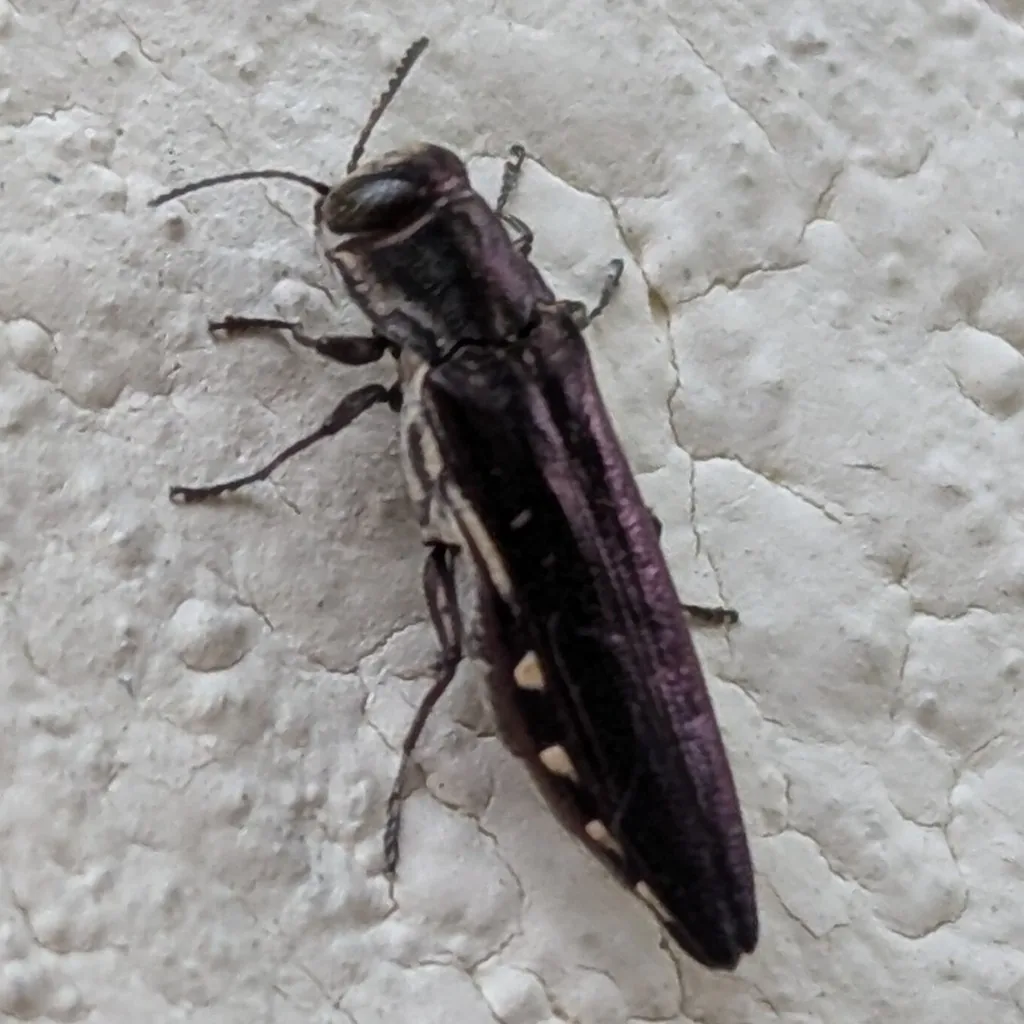
- Adults are slender beetles, 1/4 to 3/4 inch long, black with greenish-purple reflections and yellow spots on the abdomen below the wings.[1]
- Larvae are creamy white with an enlarged head area, giving a tapeworm-like look; they make serpentine galleries under the bark.[1]
- Signs include wet, weeping spots and oozing at bore holes, and small D-shaped or oval exit holes in the bark.[1][2]
Look-alikes
| Look-alike | How to tell them apart |
|---|---|
| Emerald ash borer | Its larvae look similar to honeylocust borer larvae, but it attacks ash, not honeylocust.[1] |
Where it lives
Utah State and Colorado State Extension both report it on landscape honeylocusts.[1][2]
Biology and life cycle
Larvae overwinter under the bark or in the sapwood.[1]
Adults are present from late May through September in Utah; CSU says most lay eggs in June, singly or in groups under bark flaps.[1][2]
Damage and signs
- It can develop only in trees already stressed by drought, root pruning, disease or injury, and most activity is around existing cankers or sun-scalded bark.[1][2]
- Feeding can cause canopy dieback and contributes to honeylocust decline, but borers are rarely the root cause and rarely kill a tree outright.[1][2]
Health risk
Control
Prevention
Proper watering, site choice and wound prevention are the most important controls; limiting stress is usually enough.[1][2]
Pesticides
Where needed, CSU suggests keeping a protectant insecticide such as permethrin on the trunk during egg laying and hatch in early summer, or a spring imidacloprid soil drench on trees not already badly damaged.[2]
Common questions
- What are the oozing holes in my honeylocust trunk?
- Weeping bore holes and D-shaped exit holes are signs of honeylocust borer.[1][2]
- Will honeylocust borers kill my tree?
- Rarely on their own; they attack trees already stressed or injured.[1][2]
- How do I prevent honeylocust borer?
- Water properly, choose good sites and avoid wounding the trunk.[1][2]
Sources
- Utah State University Extension, “Honeylocust Borer (Ornamental Pest Guide).” extension.usu.edu/planthealth/ipm/ornamental-pest-guide/arthopods/wood-borers/honeylocust-borer.php (accessed 2026-10-15)
- Colorado State University Extension, “Insect and Mite Pests of Honeylocust.” extension.colostate.edu/resource/insect-and-mite-pests-of-honeylocust/ (accessed 2026-10-15)
- iNaturalist, “Agrilus difficilis taxon page (order and family).” www.inaturalist.org/taxa/492654 (accessed 2026-10-06)