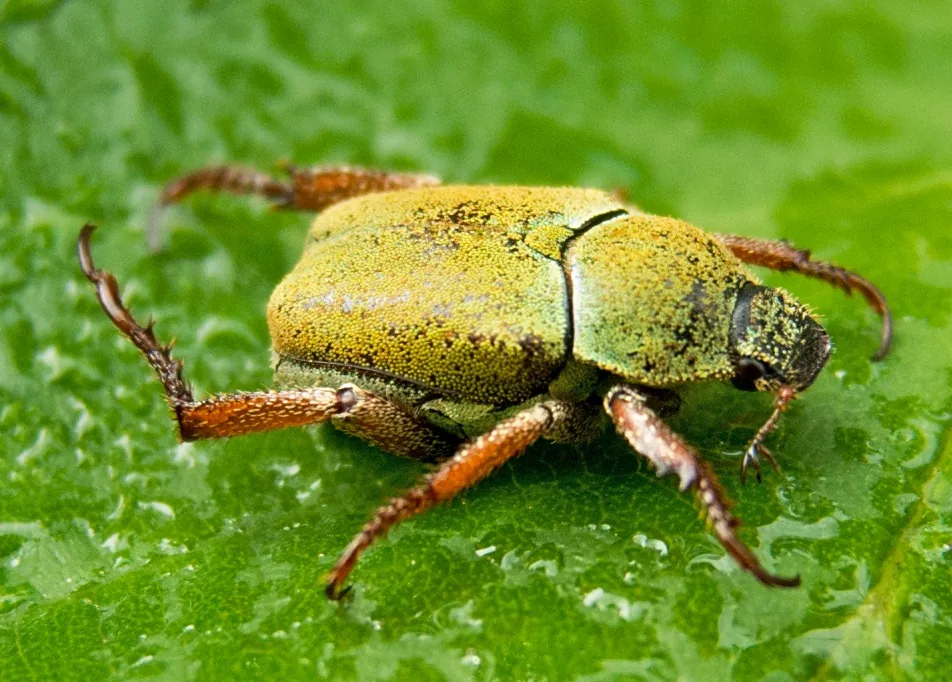
How to identify it
Look-alikes
| Look-alike | How to tell them apart |
|---|---|
| Japanese beetle | Sometimes mistaken for it, but there are no known Japanese beetle populations in California.[1] |
| Rose chafer | Often misidentified as rose chafer, which doesn't occur in California.[1] |
Where it lives
It's common in many parts of California, especially the Central Valley.[1]
Biology and life cycle
Grubs feed on decaying vegetation and roots without harming woody roots, overwintering in the soil.[1]
Adults are active from late March to early May, then return to egg-laying sites; one generation a year.[1]
Damage and signs
Health risk
It feeds on flowers; UC IPM mentions no risk to people.[1]
Control
Prevention
Where beetles are common, plant darker roses such as reds.[1]
Sprays generally aren't recommended; blossoms shield the beetles and systemics don't reach them in flowers.[1]
Traps and physical control
Pick beetles off or shake them into soapy water regularly, or clip off infested blooms.[1]
White 5-gallon buckets of water with a little detergent may attract and drown some beetles.[1]
Common questions
Sources
- University of California Statewide IPM Program, “Pest Notes: Hoplia Beetle (Publication 7499).” ipm.ucanr.edu/PMG/PESTNOTES/pn7499.html (accessed 2026-10-06)
- iNaturalist, “Hoplia taxon page (order and family).” www.inaturalist.org/taxa/81486 (accessed 2026-10-06)