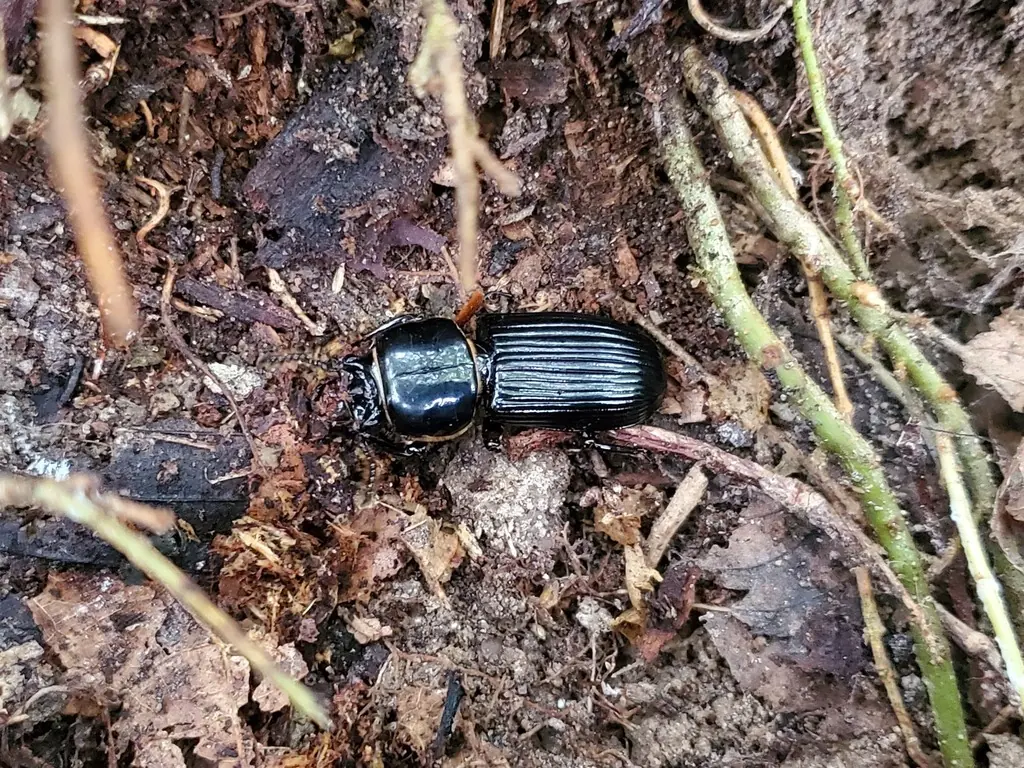
How to identify it
Where it lives
Bess beetles live in decaying hardwood logs; NC State and Clemson describe them in North and South Carolina forests and yards.[1][2]
Biology and life cycle
A male and female pair up in early spring, tunnel into a decaying log and raise their young together; females lay 30 to 70 eggs, and each pair may raise 20 to 35 new beetles.[1][2]
Adults and grubs eat rotting wood and their own feces, which is enriched by microbes; grubs depend on their parents for food and reach adulthood in about three months.[1][2]
New adults stay in the log until the following spring, and adults can live up to a year or more.[1][2]
Adults and grubs communicate with audible squeaks, and adults squeak when picked up.[1][2]
Damage and signs
Health risk
None; they are harmless to people.[1]
Control
Prevention
No control is needed; they are beneficial recyclers of dead wood.[1][2]
Common questions
- What is the big shiny black beetle in my firewood?
- Often a horned passalus (betsy beetle), which lives in decaying hardwood logs.[1][2]
- Do betsy beetles damage houses?
- No. They only decompose decaying logs and are not a pest of structures.[1]
- Why does the beetle squeak?
- Adults rub a rough spot on the abdomen against the wing covers; families communicate with these squeaks.[1][2]
Sources
- NC State Extension, “Betsy Beetle or Horned Passalus (PDIC Factsheet).” content.ces.ncsu.edu/horned-passalus-or-betsy-beetles (accessed 2026-10-15)
- Clemson Cooperative Extension, Home & Garden Information Center, “Bess Beetles (HGIC factsheet).” hgic.clemson.edu/factsheet/bess-beetles/ (accessed 2026-10-15)
- iNaturalist, “Odontotaenius disjunctus taxon page (order and family).” www.inaturalist.org/taxa/122214 (accessed 2026-10-06)