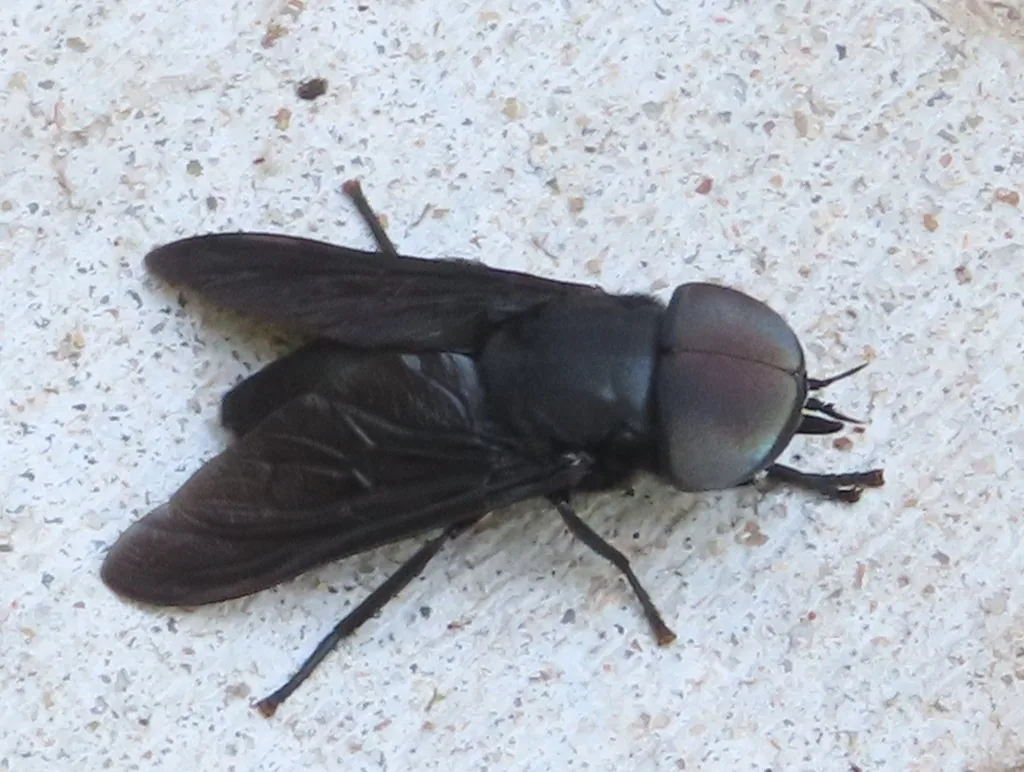
How to identify it
- Large, broad-bodied flies, about 3/8 inch to 1 inch long, with big bulging eyes.[1]
- Horse flies are black to dark brown, with green or black eyes.[1]
- A male's eyes meet at the top of the head; a female's eyes are widely separated.[1]
- The hind legs lack the small spurs at the tips that deer flies have.[1]
- There are many horse fly species; the photo shows the black horse fly, Tabanus atratus, one member of the genus.[3]
Look-alikes
| Look-alike | How to tell them apart |
|---|---|
| Deer fly | Smaller, about 3/8 inch, yellow to black with a striped abdomen and wings blotched with dark patches; it has spurs at the tips of the hind legs.[1] |
| Stable fly | About the size and color of a house fly, with stiff piercing mouthparts sticking forward from the head; both males and females bite.[2] |
| Yellow fly | A Florida biter shaped like a deer fly but yellowish, with dark eyes crossed by fluorescent green lines.[1] |
Where it lives
Found worldwide except Hawaii, Greenland and Iceland. They are most plentiful where large wet, undeveloped areas give the larvae a place to grow.[1]
Biology and life cycle
Females lay masses of 100 to 1,000 eggs in layers on plants, rocks or sticks overhanging water or wet ground. The eggs hatch in five to seven days and the larvae drop below.[1]
Horse fly larvae live in somewhat drier mud and soil than deer fly larvae. They are predators, eating insect larvae, crustaceans, earthworms and even each other.[1][2]
Larvae move into the top inch or two of soil to pupate, and adults emerge two to three weeks later.[1][2]
Most species take a year to develop and spend the winter as larvae; some larger species need two or three years. Adults live 30 to 60 days.[1]
Males feed on pollen and nectar; females need a blood meal.[1]
Damage and signs
- They wait in shade under trees and bushes and find hosts mostly by sight, along with carbon dioxide and odor; moving, dark-colored targets draw the most attacks.[1]
- Attacks are heaviest for about three hours from sunrise and again from about two hours before sunset, and slow on cloudy days or when it is cooler than about 72°F or hotter than about 90°F.[1]
- On livestock, as many as 100 flies may feed on one animal at once. Twenty to thirty flies feeding for six hours can take about 3.4 fluid ounces of blood, lowering weight gain and milk production.[1]
Health risk
Bites are painful wounds made by blade-like mouthparts, and saliva keeps the blood flowing. Wounds can become infected, many people are allergic to bites, and interrupted feeders can carry germs between animals; horse flies are known to transmit anthrax.[1][2]
Control
Prevention
Wear a long-sleeved shirt and long pants, and put a repellent containing DEET, citronella or geraniol on exposed skin and clothing before going out.[1][2]
Habitat changes have been suggested to cut breeding sites, such as removing unnecessary woody plants from residential areas or draining wet ground.[1]
Traps and physical control
Traps can help in small areas such as yards, campsites and pools. Shiny black ball traps and sticky blue cylinders on a hat or slow-moving mower reduce nearby flies.[1]
Pesticides
Spraying for adult horse flies is ineffective, and their wetland breeding sites are hard to treat. Ask your local mosquito control district about area programs.[1][2]
For livestock, pyrethroid pour-ons act only as limited repellents; insecticide-treated ear tags and head collars have had some success.[1]
Common questions
- Do horse flies bite at night?
- No. Horse flies feed during daylight, with the most activity early in the morning and toward evening.[1][2]
- Why does a horse fly bite hurt so much?
- Instead of piercing with a fine needle, the female cuts the skin with scissor-like mouthparts and laps up the blood that flows.[1][2]
- Do male horse flies bite?
- No. Males feed on flower nectar and pollen; only females take blood.[1][2]
Sources
- University of Florida IFAS Extension, Featured Creatures, “Deer Flies, Yellow Flies and Horse Flies, Chrysops, Diachlorus, and Tabanus spp. (IN155).” ask.ifas.ufl.edu/publication/IN155 (accessed 2026-10-06)
- University of Florida IFAS Extension, “Biting Flies (IG081, excerpted from SP486 Pests in and around the Southern Home).” edis.ifas.ufl.edu/publication/IG081 (accessed 2026-10-06)
- iNaturalist, “Tabanus atratus taxon page (order and family).” www.inaturalist.org/taxa/116680 (accessed 2026-10-06)