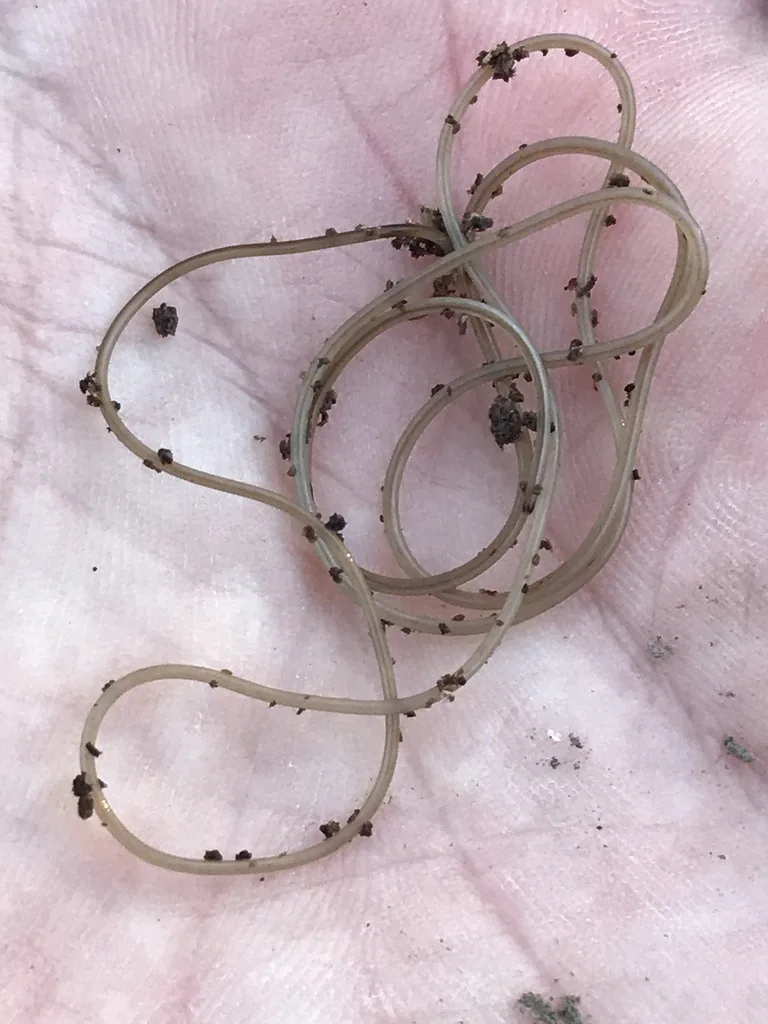
How to identify it
Where it lives
They turn up wherever their insect hosts live near water, especially farm areas with ponds and irrigation.[1]
Biology and life cycle
Females lay strings of eggs 12 to 24 inches long in water in spring, and larvae hatch three to four weeks later.[1]
Larvae develop inside insects such as crickets, mantids, ground beetles or millipedes, sometimes after riding in an aquatic insect.[1]
About three months later the host is driven to water, where the adult worm emerges; adults don't feed and overwinter in water or mud.[1]
Damage and signs
- They don't infect plants and parasitize too small a share of insects to matter much as biological control.[1]
Health risk
They're harmless to people, pets, livestock and birds. Swallowing one may cause mild intestinal discomfort, but infection never occurs.[1]
Control
Keep them out
Seal and caulk entry points so crickets, a known host, can't get indoors; worms in showers and toilets usually come from dead crickets.[1]
Traps and physical control
Remove worms from swimming pools by hand or with a net, and flush livestock troughs routinely.[1]
When to call a professional
If worms appear in household water, have the supply filtered, treated and inspected for repairs.[1]
Common questions
- Are horsehair worms dangerous to my dog or kids?
- No. They can't parasitize people, pets, livestock or birds.[1]
- Why is there a worm in my toilet?
- Crickets that carry horsehair worms seek water; the worm emerges when an infected cricket ends up in a toilet or shower.[1]
- Do they come from horse hairs?
- No. That's an old misconception; they develop as parasites inside insects.[1]
Sources
- University of California Statewide IPM Program, “Pest Notes: Horsehair Worms (Publication 7471).” ipm.ucanr.edu/PMG/PESTNOTES/pn7471.html (accessed 2026-10-06)
- iNaturalist, “Nematomorpha taxon page (order and family).” www.inaturalist.org/taxa/63142 (accessed 2026-10-06)