How to identify it
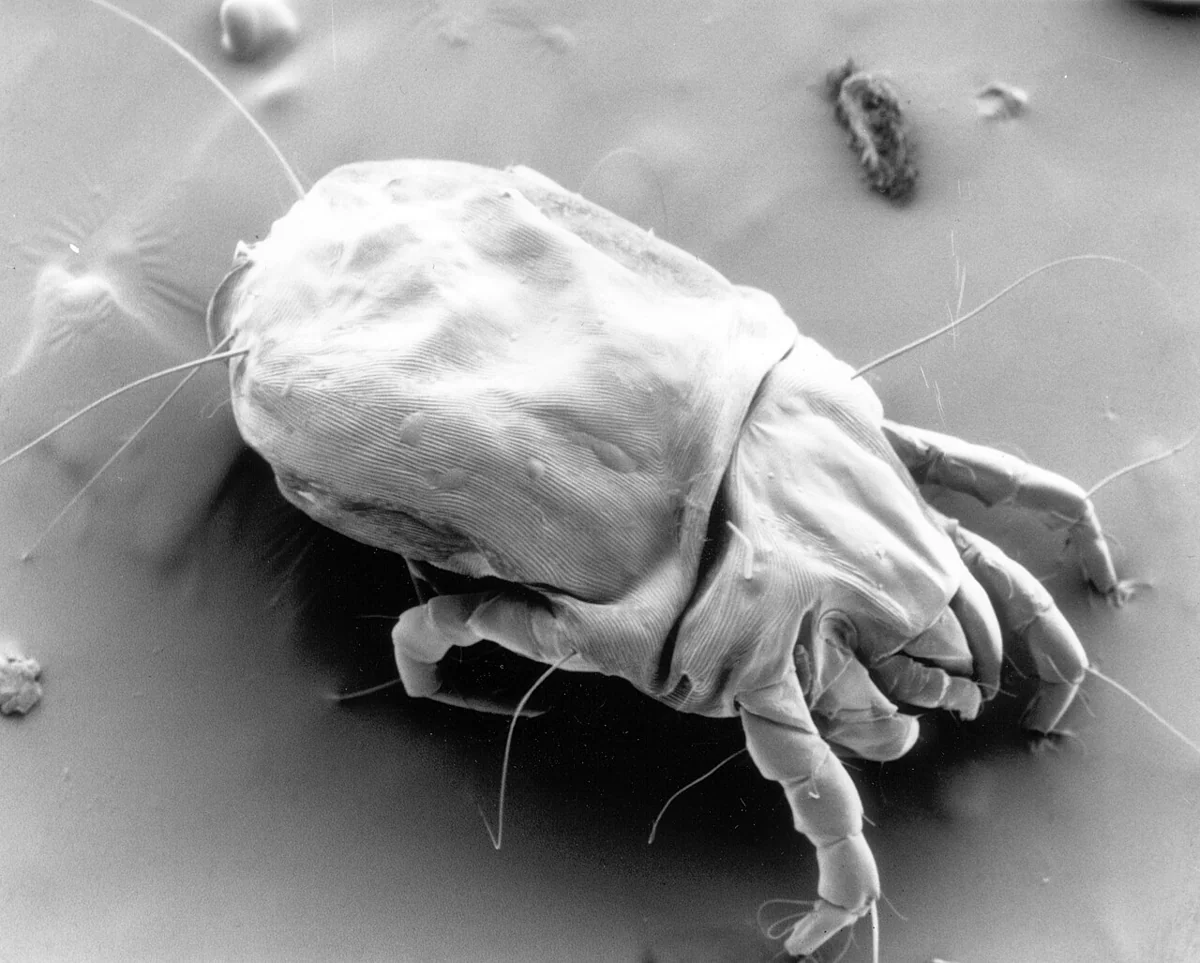
- Adults are only about 0.5 mm long, and the young are smaller still, so they can generally be seen only with a microscope.[1]
- Under magnification they are globular, clear to creamy white, with a finely ridged skin and hairs on the legs and body.[1][4]
- Two species are common in U.S. homes: the American house dust mite, Dermatophagoides farinae, and the European house dust mite, D. pteronyssinus.[1][4]
- You won't spot them by looking; a dust sample under a microscope confirms mites, and an allergist can confirm a mite allergy with skin or blood tests.[1]
Where it lives
Found nearly worldwide in house dust and bird nests. Most U.S. homes probably have detectable levels, though numbers tend to be lower in dry climates.[4][1]
Biology and life cycle
They do best at about 75 to 80 degrees F and 70 to 80 percent relative humidity, and they absorb and lose water through their skin.[1]
Below about 50 percent relative humidity they dry out and don't survive well, which is why humidity control matters so much.[1][2]
They are most numerous in beds, overstuffed sofas and chairs, and nearby carpet, where skin flakes and moisture from sleeping and sitting people build up.[1]
Egg to adult takes roughly 19 to 30 days depending on temperature and humidity, and mated females live about two months.[4][1]
Thousands of mites can be found in a single gram of dust, and an infested mattress can hold millions.[1]
Damage and signs
- They aren't parasites and can't bite or sting; their importance comes from allergens in their bodies, shed skins, secretions and especially their droppings.[1]
Health risk
Dust mite body parts and droppings trigger asthma in allergic people, and exposure can lead to asthma in children. Symptoms such as sneezing, runny nose and watery eyes often last year-round.[3][1]
Control
Prevention
Encase mattresses, box springs and pillows in zippered dust-proof, allergen-impermeable covers.[1][2][3]
Keep indoor humidity at or below 50 percent with a dehumidifier or air conditioner, and improve ventilation.[2][1]
Especially in bedrooms, swap wall-to-wall carpet, fabric curtains and upholstered furniture for hard, easy-to-clean surfaces, and choose washable stuffed toys.[1][2][3]
Sanitation
Wash sheets, blankets and pillowcases weekly in hot water, 130 to 140 degrees F, and dry completely; NIEHS says non-washable bedding can be frozen overnight.[2][3][1]
Traps and physical control
Vacuum carpets and fabric furniture weekly with a HEPA or double-layer filter bag and dust with a damp cloth. Allergic people should leave the room during and after vacuuming.[3][2][1]
HEPA filters in the heating and cooling system or in portable bedroom air cleaners can trap airborne particles, though Kentucky notes the benefit of portable units may be marginal.[1]
Pesticides
Mite-killing carpet treatments with benzyl benzoate exist, but clinical trials show little improvement in allergy symptoms; use them only as a supplement to bedding covers and furnishing changes.[1]
When to call a professional
An allergist can confirm a dust mite allergy and may prescribe medicines or allergy shots or tablets (immunotherapy) for longer-term relief.[1][2]
Common questions
- Can I get rid of dust mites completely?
- No. NIEHS says dust mites can't be completely eliminated from any home, no matter how clean, but their numbers can be reduced.[2]
- Do dust mites bite?
- No. House dust mites aren't parasites and can't bite or sting. They cause problems only through the allergens they leave behind.[1]
- Will air duct cleaning get rid of dust mites?
- Probably not. Air ducts are unlikely to be humid enough for dust mites to breed, so duct cleaning is secondary to bedding covers, humidity control and furnishing changes.[1]
Sources
- University of Kentucky Entomology, “ENTFACT-646: House Dust Mites (revised March 2026).” entomology.ca.uky.edu/ef646 (accessed 2026-10-06)
- National Institute of Environmental Health Sciences, NIH, “Dust Mites and Cockroaches (Allergens).” www.niehs.nih.gov/health/topics/agents/allergens/dustmites (accessed 2026-10-06)
- U.S. Environmental Protection Agency, “Asthma Triggers: Gain Control (Cockroaches and Pests; Pets; Chemical Irritants).” www.epa.gov/asthma/asthma-triggers-gain-control (accessed 2026-10-06)
- University of Florida/IFAS Extension, “House Dust Mites, Dermatophagoides spp. (Featured Creatures, EENY-PUB IN216).” edis.ifas.ufl.edu/publication/IN216 (accessed 2026-10-06)
- iNaturalist, “Dermatophagoides farinae taxon page (order and family).” www.inaturalist.org/taxa/262970 (accessed 2026-10-06)