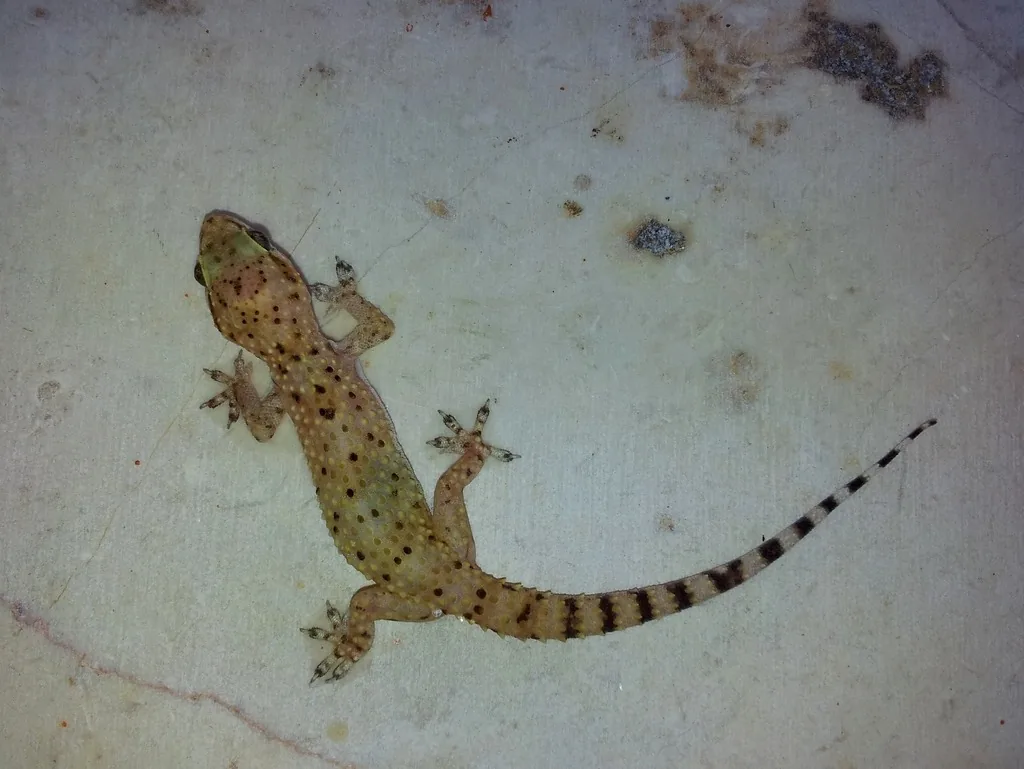
How to identify it
- House geckos have large, bulging eyes without eyelids, vertical pupils, and sticky toe pads that let them climb walls and windows.[1][2]
- The Mediterranean house gecko reaches about 4 to 5 inches, with a rounded snout and small bumps over the head, body, legs and tail.[1][2]
- It is pale tan, light gray or whitish with darker mottling, and its tapering tail is banded with brown.[1][2]
- They may squeak or give a high-pitched call when alarmed.[1][2]
Look-alikes
| Look-alike | How to tell them apart |
|---|---|
| Common house gecko | The other introduced house gecko in Texas grows 3 to 6 inches, has a longer snout, and is pinkish to grayish with darker marbling and a creamy-white underside.[1] |
Where it lives
Introduced to many areas by people; common in suburban and urban parts of Texas and the southern U.S., and spreading north, with records in southern Illinois.[1][2]
Biology and life cycle
They are nocturnal and gather at porch lights, lit windows and window screens to catch moths, cockroaches and other insects.[1][2]
By day they shelter in cracks and crevices on and around buildings; the Mediterranean gecko is nearly always found around human structures.[1][2]
Females lay several clutches of two white, oval eggs over the summer in crevices, under bark or in soil, sometimes sharing a nest site with other females.[1][2]
They are most active from spring through fall.[1]
Damage and signs
- Geckos that move indoors leave elongated brown droppings, often tipped with white, that can stain carpets, rugs, walls and curtains.[1]
Health risk
Texas A&M AgriLife Extension describes house geckos as beneficial insect predators; the problems it lists are nuisance and staining from droppings.[1]
Control
Keep them out
Replace worn weatherstripping on doors and windows and seal cracks around soffits and plumbing or electrical openings with silicone caulk or expanding foam.[1]
Seal the poorly closed gaps on the outside of the house where geckos hide during the day.[1]
Traps and physical control
Catch an indoor gecko with a plastic tub or jar and release it outside, after sealing the gaps that let it in.[1]
Glue boards near lights and windows will catch geckos, but Texas A&M notes they kill slowly and don't allow humane release.[1]
Pesticides
No pesticides are registered for gecko control; general insect sprays may slightly reduce their food, but the effect on geckos is probably minimal.[1]
Common questions
- Should I get rid of geckos around my house?
- Many people leave them alone because they eat insects; the usual goal is just to keep them out of the house by sealing gaps.[1]
- What do gecko droppings look like?
- They are elongated and brownish, often with a white tip, and are found near where geckos rest or enter.[1]
- Is there a spray that kills geckos?
- No pesticide is registered for geckos, so management relies on exclusion and removal.[1]
Sources
- Texas A&M AgriLife Extension Service, “House geckos (Insects in the City fact sheet ENT-2006).” citybugs.tamu.edu/factsheets/household/misc-house/ent-2006/ (accessed 2026-10-06)
- Illinois Department of Natural Resources, “Mediterranean gecko (Hemidactylus turcicus).” dnr.illinois.gov/education/wildaboutpages/wildaboutlizards/walzmediterraneangecko.html (accessed 2026-10-06)
- iNaturalist, “Hemidactylus turcicus taxon page (order and family).” www.inaturalist.org/taxa/34435 (accessed 2026-10-06)