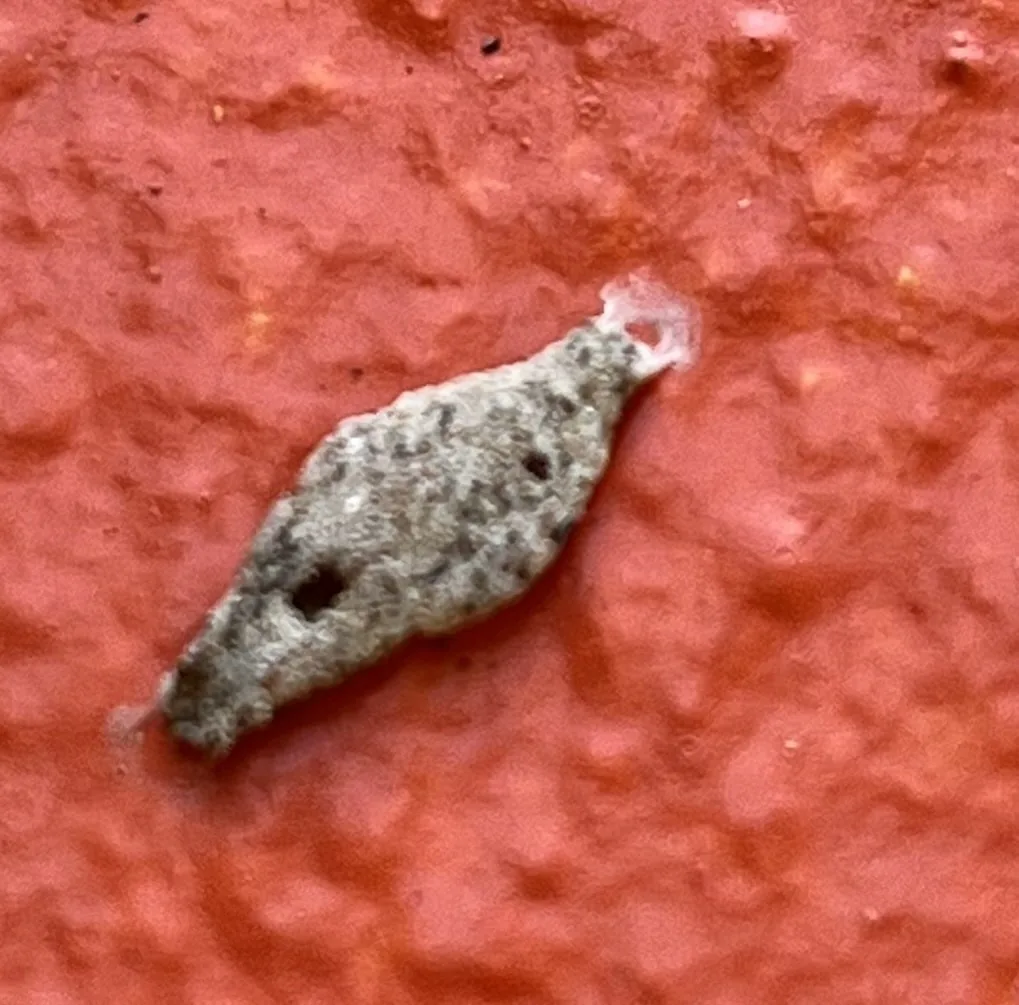
How to identify it
- The larval case is slender, flat and spindle-shaped, like a cantaloupe or pumpkin seed, silk-lined and open at both ends.[1]
- Cases turn up under spider webs, in bathrooms, bedrooms, garages, on curtains, wool rugs and shaded exterior walls.[1]
- Adults are small moths that hold their wings tented over the body.[1]
Look-alikes
Where it lives
It needs high humidity and is known from Florida and Louisiana, with records from Mississippi and North Carolina.[1]
Biology and life cycle
A female lays about 200 eggs in cracks and floor edges over a week; larval life lasts about 50 days in warm conditions.[1]
Damage and signs
- Larvae can feed on woolens, silks, felt and spider web debris, making it a potential household pest.[1]
Health risk
UF/IFAS describes it as a potential household pest of fabrics, with no risk to people.[1]
Control
Prevention
Regular cleaning and air conditioning have reduced problems with this species.[1]
Traps and physical control
Pick off or vacuum cases and remove spider webs.[1]
Common questions
Sources
- University of Florida IFAS Extension (Featured Creatures), “Household Casebearer, Phereoeca uterella (EENY-003).” edis.ifas.ufl.edu/publication/IN129 (accessed 2026-10-06)
- iNaturalist, “Phereoeca uterella taxon page (order and family).” www.inaturalist.org/taxa/363376 (accessed 2026-10-06)