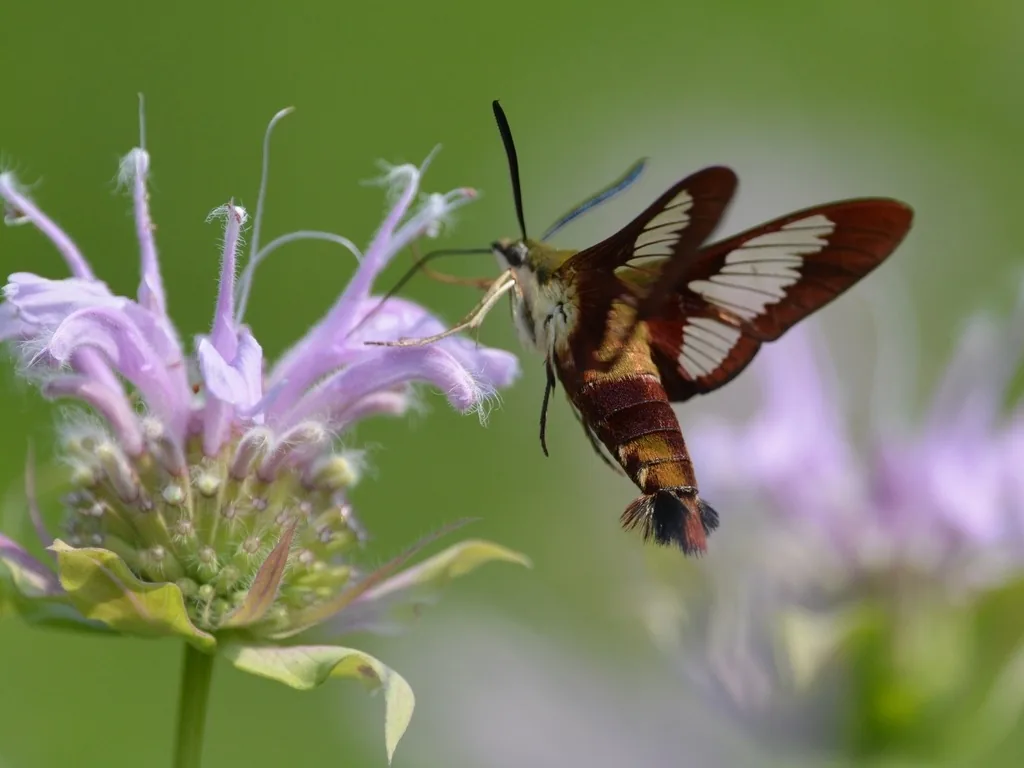
How to identify it
- The snowberry clearwing or bumblebee moth (Hemaris diffinis) has clear wing patches edged with mostly black scales and black legs, and resembles a bumble bee.[1][2]
- The hummingbird clearwing (Hemaris thysbe) has pale legs and rusty scales on the wings and vaguely resembles a hummingbird in flight.[1]
- The caterpillars are typical hornworms: pale green with a black horn, black spots along each side and a pair of pale lines down the back.[1]
- Other sphinx moths are also called hummingbird moths; in Colorado the whitelined sphinx is the one most often seen feeding this way, mostly in late afternoon and at dusk.[2]
Look-alikes
| Look-alike | How to tell them apart |
|---|---|
| Whitelined sphinx | A larger sphinx moth with strong white bands on the wings; it is the most commonly seen “hummingbird moth” in Colorado and flies mostly at dusk.[2] |
| Bumble bees | Bumble bees, carpenter bees and Hemaris moths often visit the same flowers; the moths can't sting.[1] |
| Tomato hornworm moth | The caterpillar is the tomato hornworm; this sphinx moth is also called a hummingbird moth and is out late in the day.[3] |
Where it lives
NC State reports at least two generations a year in North Carolina, and the snowberry clearwing is among the hornworms recorded in Colorado.[1][2]
Biology and life cycle
The caterpillars spin cocoons and pupate in leaf litter or in the soil.[1]
The moths visit just about anything in bloom, while the caterpillars feed on dogbane, snowberry, honeysuckle and dwarf bush honeysuckle.[1]
Colorado State lists honeysuckle, viburnum, hawthorn, snowberry, cherry and plum as hosts of the snowberry clearwing.[2]
Sphinx moths have very long tongues and can be good pollinators.[3]
Damage and signs
- The caterpillars are rarely noticed and almost never submitted for identification; they cause no meaningful damage.[1]
Health risk
None. Although they look like stinging insects, Hemaris moths are completely harmless.[1]
Control
Prevention
No control is recommended, because the caterpillars are rarely noticed.[1]
Common questions
- Is that a hummingbird or a moth?
- If it hovers at flowers in daylight and is the size of a large bumble bee with clear wing patches, it's likely a Hemaris clearwing moth, a type of sphinx moth.[1][3]
- Do hummingbird moths sting?
- No. They resemble bumble bees, which may protect them from predators, but they are completely harmless.[1]
- Should I get rid of hummingbird moths?
- No. They are pollinators, and their caterpillars are rarely noticed, so no control is recommended.[1][3]
Sources
- NC State Extension, “Bumblebee Moth and Hummingbird Moth (PDIC Factsheet).” content.ces.ncsu.edu/bumblebee-moth-and-hummingbird-moth (accessed 2026-10-15)
- Colorado State University Extension, “Hornworms and “Hummingbird” Moths (Fact Sheet 5.517).” extension.colostate.edu/resource/hornworms-and-hummingbird-moths/ (accessed 2026-10-15)
- University of Arkansas Division of Agriculture Cooperative Extension Service, “Hummingbird Moth.” www.uaex.uada.edu/yard-garden/in-the-garden/reference-desk/insects/hummingbird-moth.aspx (accessed 2026-10-15)
- iNaturalist, “Hemaris thysbe taxon page (order and family).” www.inaturalist.org/taxa/82379 (accessed 2026-10-06)