How to identify it
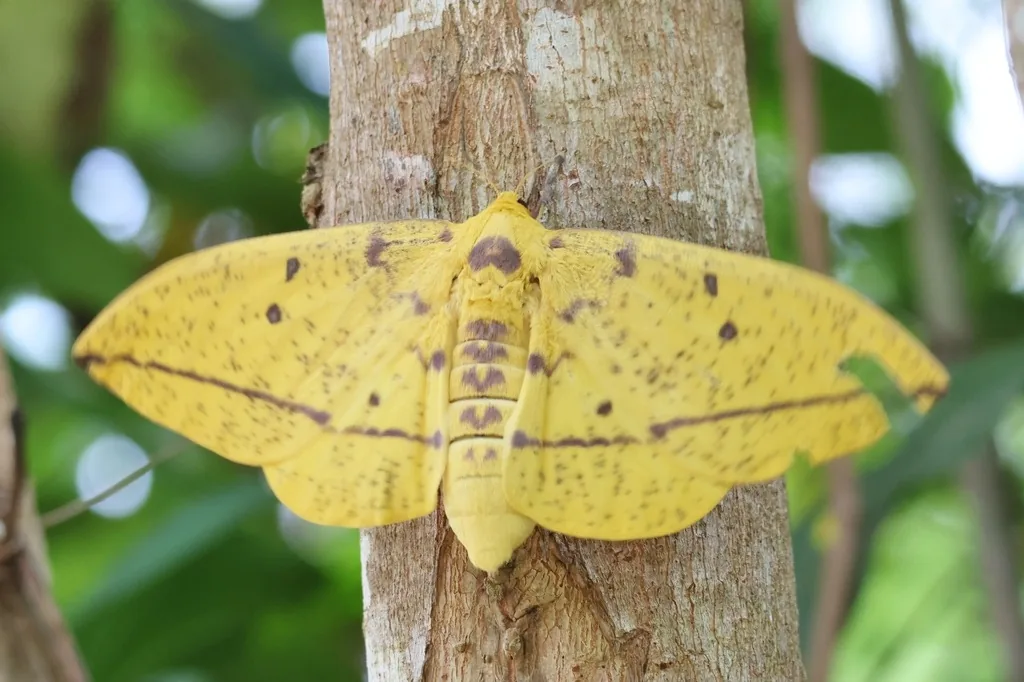
- Adults are large, mostly yellow moths with light to dark brown spots, lines and blotches; males have more feathery antennae, and they usually fly at night.[1]
- Mature caterpillars are fat, green to brown or nearly black, 3 to 5 inches long, covered in fine hair, with knobs behind the head and spots down each side.[1]
- Newly hatched caterpillars are orange with conspicuous black spines.[1]
Where it lives
It is one of the largest moths in the Southeast; NC State notes one generation further north and possibly two in North Carolina.[1][2]
Biology and life cycle
Moths emerge from the soil in late spring, and females lay hundreds of eggs on many kinds of trees.[1]
Full-grown caterpillars climb down and burrow into the soil to pupate; the pupae spend the winter there.[1][2]
Few survive: caterpillars feeding in the open are eaten by birds and attacked by parasites and diseases.[1]
Damage and signs
Health risk
NC State and Clemson describe it only as a leaf feeder and note no health concerns.[1][2]
Control
Prevention
NC State says it seems a pity to use an insecticide on such usually rare caterpillars.[1]
Common questions
- What is the huge yellow moth on my wall?
- Likely an imperial moth, one of the largest moths in the Southeast.[1][2]
- What is the giant green caterpillar walking across the driveway?
- Possibly a full-grown imperial moth caterpillar climbing down to burrow into the soil and pupate.[1][2]
- Do I need to kill imperial moth caterpillars?
- Usually not; they are rare and seldom do noticeable damage.[1]
Sources
- NC State Extension, “Imperial Moth (PDIC Factsheet).” content.ces.ncsu.edu/imperial-moth (accessed 2026-10-15)
- Clemson Cooperative Extension, Home & Garden Information Center, “What Is It? Wednesday – Imperial Moth Caterpillar (Nov. 9, 2022).” hgic.clemson.edu/what-is-it-wednesday-imperial-moth-caterpillar/ (accessed 2026-10-15)
- iNaturalist, “Eacles imperialis taxon page (order and family).” www.inaturalist.org/taxa/81590 (accessed 2026-10-06)