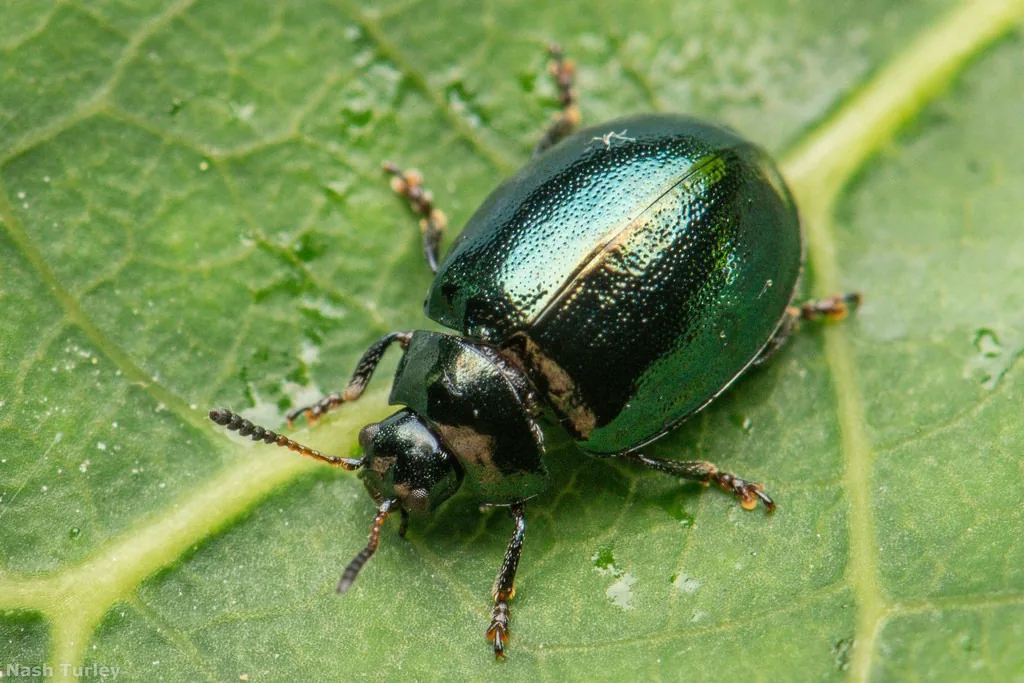
How to identify it
- Adults are about 3/16 inch long, convex and oval, nearly black to metallic greenish blue.[2]
- They resemble an all-black lady beetle, but lady beetles are in a different family and black ones usually have orange spots.[1]
- Larvae are small and dark, up to about 1/4 inch, and feed in groups on leaf undersides.[1][2]
Where it lives
It was first detected in the United States in 1911; UMass notes there may be four generations a year in parts of Virginia and North Carolina.[2]
Biology and life cycle
Adults overwinter in loose bark or other sheltered spots near the tree and emerge in spring shortly after leaves open.[1][2]
Females lay tiny yellow eggs in clusters on leaf undersides; larvae hatch in a few days and skeletonize leaves, pupating after three to four weeks.[1][2]
At least two generations occur each year, so all stages can be found together.[1]
Damage and signs
Health risk
Control
Prevention
Keep pyrethroids away from pools, ponds and streams, since they are very toxic to fish.[1]
Pesticides
Treatments may seem to fail because eggs survive and hatch afterward and beetles don't all leave their winter shelters on the same day; NC State lists several landscape insecticides labeled for leaf beetles.[1]
Common questions
- What are the small shiny blue beetles on my willow?
- Likely imported willow leaf beetles; their larvae skeletonize the leaves.[1][2]
- Are they black lady beetles?
- No. They resemble black lady beetles but belong to a different family, and black lady beetles usually have orange spots.[1]
- Why do the beetles come back after spraying?
- Eggs may survive and hatch later, and adults leave their winter shelters over several days.[1]
Sources
- NC State Extension, “Imported Willow Leaf Beetle (PDIC Factsheet).” content.ces.ncsu.edu/imported-willow-leaf-beetle (accessed 2026-10-15)
- UMass Extension Landscape, Nursery and Urban Forestry Program (Landscape Insect & Mite Guide), “Plagiodera versicolora (Imported Willow Leaf Beetle).” www.umass.edu/agriculture-food-environment/landscape/publications-resources/insect-mite-guide/plagiodera-versicolora (accessed 2026-10-15)
- iNaturalist, “Plagiodera versicolora taxon page (order and family).” www.inaturalist.org/taxa/83839 (accessed 2026-10-06)