Pest profile

Indian Walking Stick

Carausius morosus · Phasmida: Lonchodidae[2]

The Indian walking stick is a pet-trade insect now living wild along coastal California, where it chews leaves of many garden plants.[1]

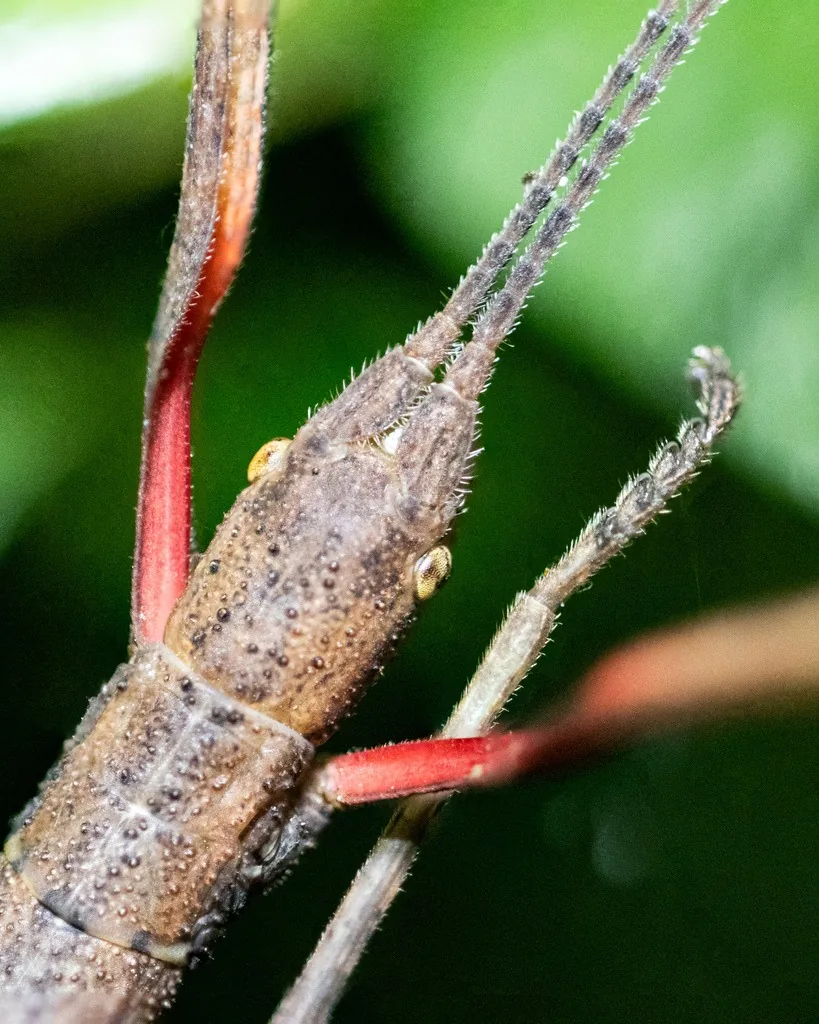
Indian walking stick close-up showing the brown twig-like body and a red patch at the base of a front leg
Indian walking stick close-up showing the brown twig-like body and a red patch at the base of a front leg. (c) Diego González Dopico, some rights reserved (CC BY) — via iNaturalist, CC BY 4.0

How to identify it

  • Adults are wingless, usually brownish, 2 3/4 to 4 inches long, and can tuck their legs along the body to look like a twig.[1]
  • When roughly handled, females flash bright red patches at the base of the front legs.[1]
  • Eggs look like grayish brown seeds with a small pale cap.[1]

Look-alikes

Look-alikeHow to tell them apart
Native California walking sticksNative species feed on grasses and scrub in wild areas; Indian walking stick females have red marks at the front leg bases.[1]

Where it lives

First found in San Diego County in 1991, it now lives along the California coast as far north as Humboldt County (2021).[1]

US map: state where the cited source reports it established (coastal california).

Biology and life cycle

Females lay eggs without mating, dropping them while they feed or rest; males are rare.[1]

Eggs hatch in 10 to 12 weeks at room temperature; nymphs mature in 4 to 6 weeks, and there are several summer generations.[1]

Damage and signs

  • The worst damage comes in spring, when nymphs feed on new growth; they favor small-leaved ivy and privet.[1]
  • Leaf edges become tattered, and residents often find them on windows, doors or indoors on warm summer nights.[1]

Health risk

It feeds on plants; UC IPM mentions no risk to people, though its size can alarm some.[1]

Control

Prevention

Never release pet walking sticks; bag cage debris and freeze it for a week before trashing it, since eggs look like droppings.[1]

Traps and physical control

Hand-pick them from plants and freeze before discarding; this reduces numbers over time.[1]

Pesticides

Pesticides generally aren't recommended; there's no research on their effectiveness against walking sticks.[1]

Common questions

Where did the walking sticks in my yard come from?
Escaped or released pets, or eggs tossed out with cage debris, established them in California.[1]
Are Indian walking sticks harmful?
They're mostly a nuisance, though some years they can seriously defoliate valued plants.[1]

Sources

  1. University of California Statewide IPM Program, “Indian Walking Stick (Pest Notes).” ipm.ucanr.edu/home-and-landscape/indian-walking-stick/ (accessed 2026-10-06)
  2. iNaturalist, “Carausius morosus taxon page (order and family).” www.inaturalist.org/taxa/53592 (accessed 2026-10-06)

Updated 2026-10-14. Built from sourced records. Spot an error? Tell us.