How to identify it
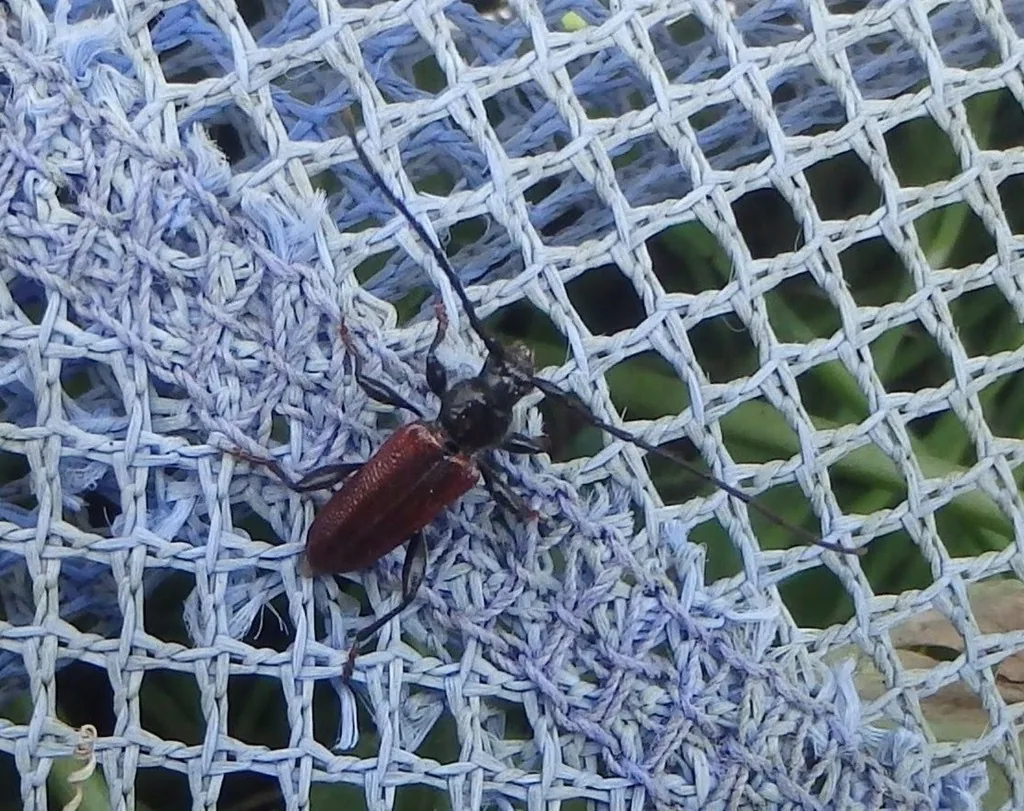
- Adults are small longhorned beetles, about 1/4 to 5/8 inch long.[1][2]
- Males are shiny blue-black with antennae slightly longer than the body; females have reddish-brown wing covers and shorter antennae.[1][2]
- Grubs are pale, slender and legless; young grubs pack tunnels under the bark with dark frass, and adults leave oval exit holes.[1]
Where it lives
It was first detected in the United States in Washington State in 1954; NC State and UMass Extension both cover it as a pest of cypress-family trees.[1][2]
Biology and life cycle
There is one generation a year; adults overwinter in the tree and chew out through the bark in early spring.[1][2]
Females live about 20 days and lay eggs in bark crevices, starting one to three days after emerging.[1]
Larvae feed under the bark, then bore into the wood to pupate.[1]
Damage and signs
Health risk
Control
Prevention
Pyrethroids are very toxic to fish, so keep them away from pools, ponds and streams.[1]
Pesticides
Spraying infested trees is unlikely to kill grubs inside; to prevent new attacks, NC State suggests a pyrethroid on cypress-family plants in early March and again in early April.[1]
Common questions
- What is boring into my arborvitae?
- One possibility is the Japanese cedar longhorned beetle, whose grubs tunnel under the bark of cypress-family trees.[1][2]
- Can I spray to kill the grubs?
- Not reliably; grubs inside packed tunnels are protected, so sprays are used to prevent new egg laying in spring.[1]
- When are the beetles active?
- Adults chew out of trees in early spring and live only about three weeks.[1]
Sources
- NC State Extension, “Japanese Cedar Longhorned Beetle (PDIC Factsheet).” content.ces.ncsu.edu/japanese-cedar-longhorned-beetle (accessed 2026-10-15)
- UMass Extension Landscape, Nursery and Urban Forestry Program (Landscape Insect & Mite Guide), “Callidiellum rufipenne (Japanese Cedar Longhorned Beetle).” www.umass.edu/agriculture-food-environment/landscape/publications-resources/insect-mite-guide/callidiellum-rufipenne (accessed 2026-10-15)
- iNaturalist, “Callidiellum rufipenne taxon page (order and family).” www.inaturalist.org/taxa/447560 (accessed 2026-10-06)