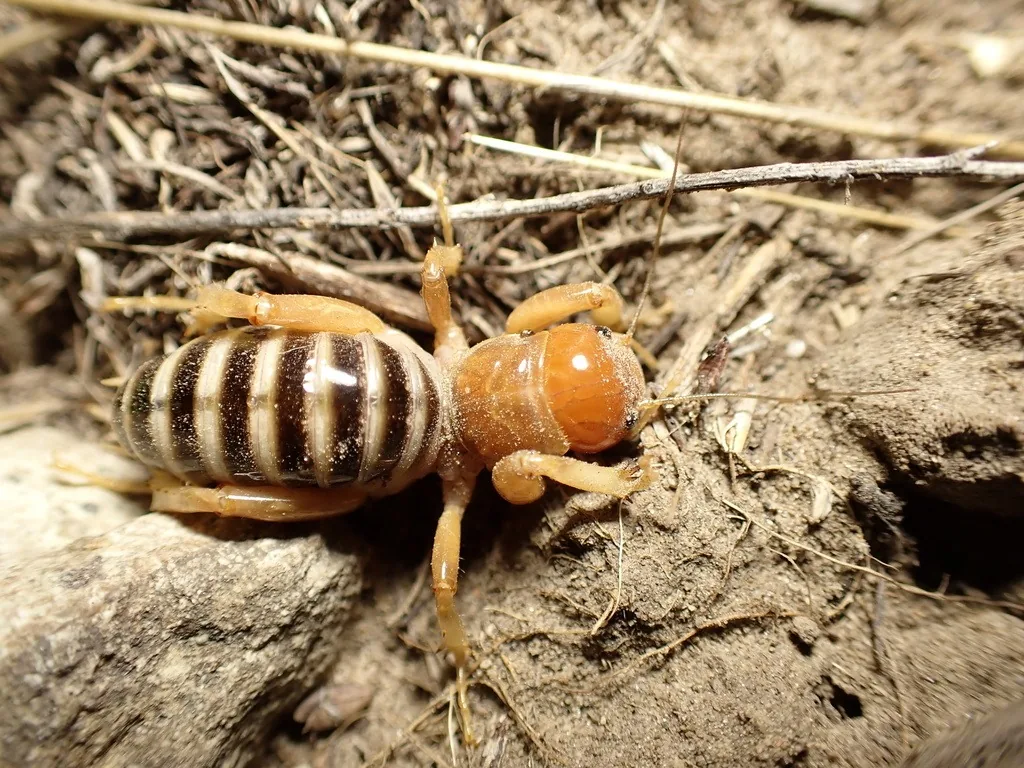
How to identify it
Look-alikes
| Look-alike | How to tell them apart |
|---|---|
| Pillbugs and sowbugs | They share the confusing nickname potato bug; none of these is a true bug, so check for the Jerusalem cricket's bald, round head and banded abdomen.[1] |
| Colorado potato beetle | Also called potato bug; the Jerusalem cricket is instead a large, wingless cricket that lives mostly underground.[1] |
Where it lives
In North America they are found only west of the Rocky Mountains; the most widespread species in California is Ammopelmatus fuscus, the species this profile centers on.[2]
Biology and life cycle
They feed and tunnel underground by day and come aboveground mostly at night or twilight, often after heavy rain or irrigation.[1][2]
In summer they hide under rocks, logs and boards during the day.[2]
They eat insects, nonwoody roots and tubers, and sometimes dead animal matter.[1][2]
Eggs are laid in soil; nymphs molt up to about 10 times and can live up to about 2 years.[1]
They make sound by rubbing a hind leg against the abdomen, and females sometimes kill males after mating.[2]
Damage and signs
Health risk
They are harmless to people, but their strong jaws can bite, so handle them with care.[1][2]
Control
Traps and physical control
No control is necessary; if one is somewhere unwanted, scoop it into a box and move it.[1]
Biological control
Leave them be where possible: they are important food for barn and burrowing owls, kestrels and other predators.[2][1]
Common questions
Sources
- University of California Statewide IPM Program, “Jerusalem Cricket (Pest Notes, Home and Landscape).” ipm.ucanr.edu/home-and-landscape/jerusalem-cricket/ (accessed 2026-10-06)
- Bohart Museum of Entomology, University of California, Davis, “Information Sheet No. 008: Jerusalem Crickets.” bohart.ucdavis.edu/sites/g/files/dgvnsk4616/files/media/documents/note_08_jerusalem_cricket.pdf (accessed 2026-10-06)
- iNaturalist, “Ammopelmatus fuscus taxon page (order and family).” www.inaturalist.org/taxa/1193580 (accessed 2026-10-06)