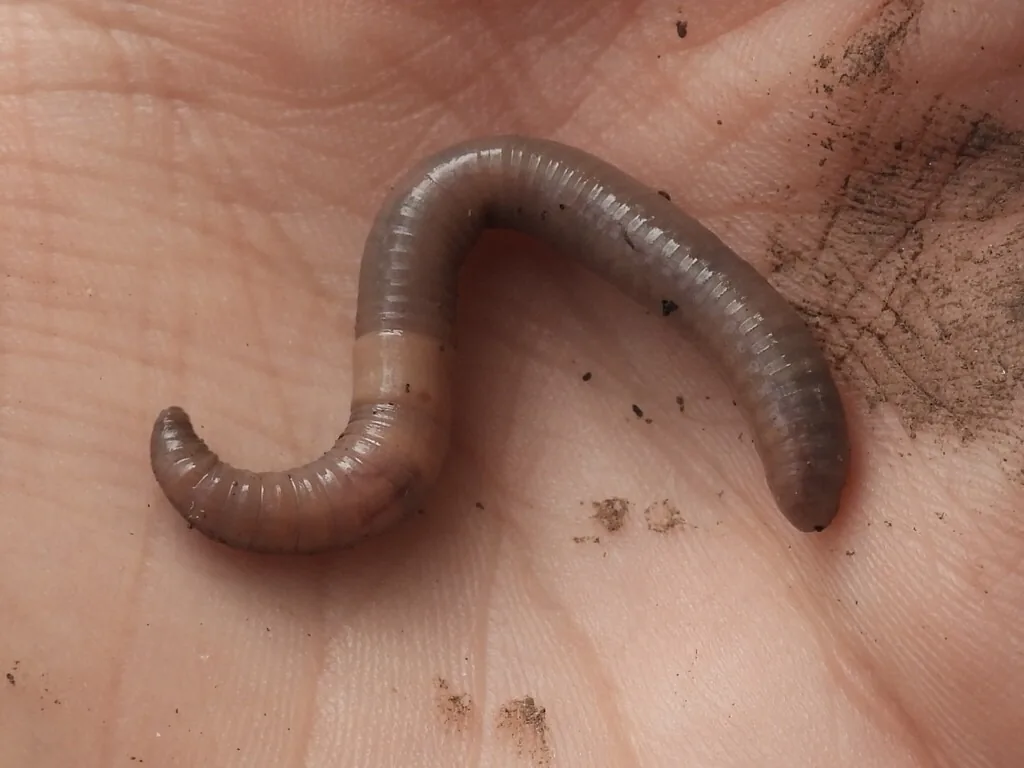
How to identify it
- When disturbed they thrash, flip and may spring into the air or shed their tails, and they can move across the ground in an S-shaped, snake-like way.[2][1][3]
- The clitellum, a band about a third of the way back from the head, is smooth, cloudy-white to gray, flush with the body and circles it completely.[1][2]
- Bodies are smooth, glossy, firm and gray to brown, not pink and slimy like European nightcrawlers.[2][3]
- They are usually 1 1/2 to 8 inches long, about the size of nightcrawlers.[1]
- Topsoil that looks like coarse coffee grounds, and many worms together: where there is one, there are usually more.[2][1]
Look-alikes
Where it lives
Native to eastern Asia, jumping worms arrived in North America in the late 1800s and are now widespread across much of the Midwest, Southeast and Northeast, with newer finds along the West Coast.[2]
Biology and life cycle
Unlike other earthworms in the region, they live only one season: young hatch from cocoons in spring, grow through summer, lay cocoons from about August, and adults die at the first freeze.[2][1]
They are parthenogenetic, so a single worm can start a new population without a mate.[2][3]
Cocoons are only about 2 to 3 millimeters across, hard to see in soil, and can be present year-round; some don't hatch until a later season.[2][1]
They live on the soil surface in leaf litter and mulch or within an inch or two of the topsoil, and they thrive in mulch and compost.[2][1]
Damage and signs
- Their hard, grainy castings change soil into loose pellets with poor structure and water retention, making it hard to grow seedlings or transplants.[2][3]
- They eat the organic matter that plants, fungi and soil microbes rely on for nutrients.[2][3]
- In forests, invasive earthworms reduce native plant diversity and can lead to soil moisture loss, erosion, exposed roots and more invasive plants.[2][1]
Health risk
The concern with jumping worms is environmental: they disturb forest ecosystems, damage soil structure and reduce plant growth in yards and gardens.[1][2]
Control
Prevention
Prevention is the only proven management: don't move soil, mulch, compost or plants from a site with jumping worms, and inspect potted plants or buy bare-root plants.[1][2]
Buy compost and mulch heated under a pathogen-reduction process; jumping worms and cocoons die after about three days at 104°F or above.[1][2]
Sanitation
Clean soil and debris off boots, tools, vehicles and equipment before moving between sites.[2][1]
Traps and physical control
Hand-pick worms, seal them in a bag and put them in the trash; removing adults over time cuts down the cocoons left in the soil.[2][1]
Covering sun-exposed garden soil with clear plastic can heat it enough to kill cocoons.[2]
Pesticides and home remedies
No pesticides are labeled for earthworms in the United States, and fertilizers such as tea seed pellets should not be used as pesticides.[1]
Earthworms are annelids, not insects, and an insecticide may only be used against the pests listed on its label.[1]
Reporting and regulations
Some states regulate jumping worms; Minnesota lists them as a prohibited invasive species, making it unlawful to possess, sell, transport or release them without a permit.[1]
Minnesota asks residents to report suspected jumping worms through EDDMapS or to the state DNR, with close-up photos showing the clitellum; check with your own state's invasive species program.[1]
Common questions
- Why does my garden soil look like coffee grounds?
- That loose, pelleted topsoil is the classic sign of jumping worms, which leave hard, grainy castings as they feed.[2][1]
- Can I kill jumping worms with a pesticide?
- No pesticide is labeled for earthworms in the U.S.; hand removal into the trash, heat and keeping them from spreading are the current options.[1][2]
- Should I share plants from a yard with jumping worms?
- It's safest not to move plants or soil off the site; if you must, wash all soil from the roots and repot in clean, bagged potting soil.[1]
Sources
- University of Minnesota Extension, “Jumping worms (reviewed 2026).” extension.umn.edu/natural-resources/forestry-and-wildlife/invasive-species/jumping-worms (accessed 2026-10-06)
- Wisconsin Department of Natural Resources, “Jumping worms (Amynthas spp.).” dnr.wisconsin.gov/topic/Invasives/fact/JumpingWorm (accessed 2026-10-06). Joint page of the Wisconsin DNR, UW-Madison Arboretum and UW-Madison Extension.
- University of Wisconsin-Madison Extension, Horticulture, “Jumping Worms (Wisconsin Yard & Garden).” hort.extension.wisc.edu/articles/jumping-worms/ (accessed 2026-10-06)
- iNaturalist, “Amynthas agrestis taxon page (order and family).” www.inaturalist.org/taxa/364093 (accessed 2026-10-06)