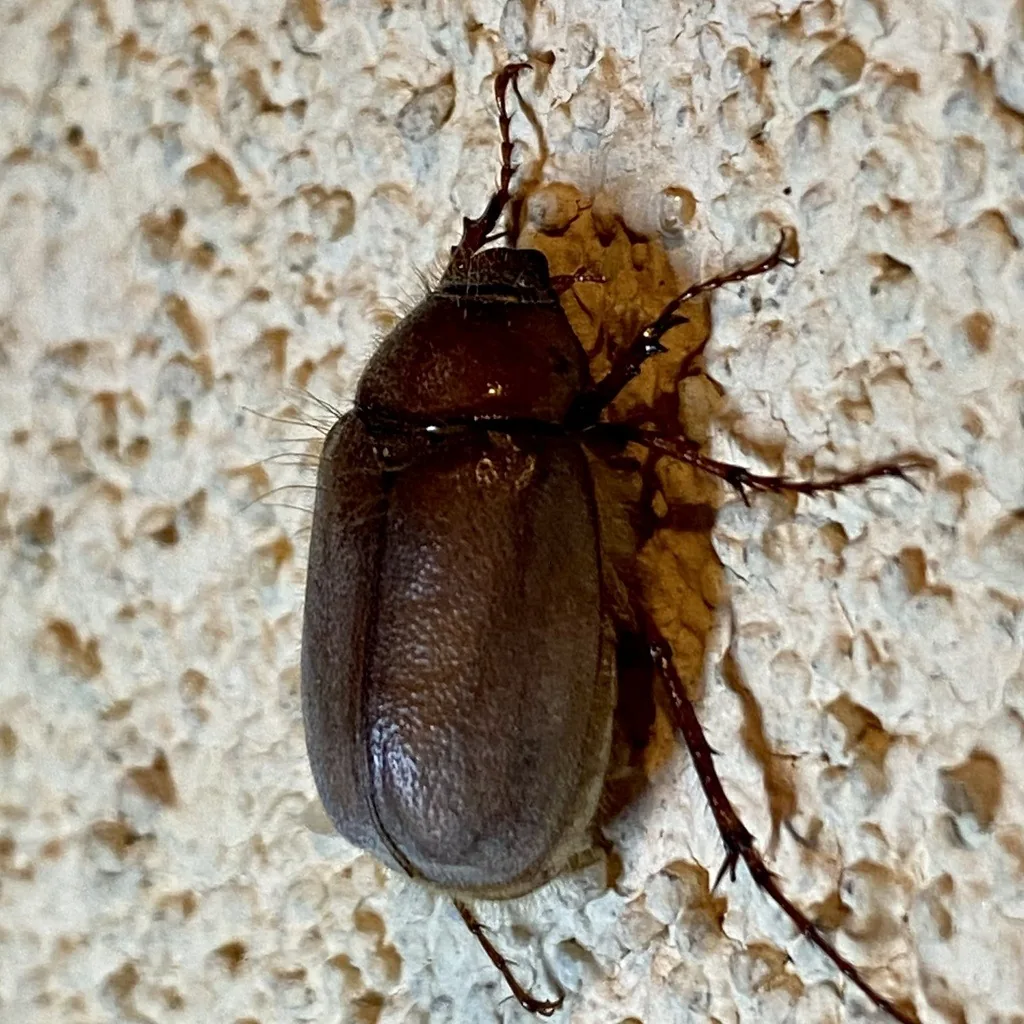
How to identify it
- Adults are stout, somewhat oval beetles about 1/2 to 1 inch long, ranging from light tan or reddish brown to almost black.[1][2][4]
- They fly after dusk, are drawn to lights, and are clumsy fliers that hit windows and cling to screens.[1]
- The grubs are cream-colored and C-shaped, with a reddish-brown or yellow-brown head and three pairs of legs, growing up to about 1 1/4 inches.[1][3]
- Under a hand lens, their grubs show two lengthwise rows of spines on the underside of the last segment, surrounded by scattered stouter spines.[2]
Look-alikes
| Look-alike | How to tell them apart |
|---|---|
| Japanese beetle | Smaller and metallic green with copper wing covers, and active by day rather than at night.[2] |
| Green June beetle | A different, day-flying beetle, 3/4 to 1 inch long and forest green; its grubs crawl on their backs and feed mostly on decaying organic matter.[2] |
Where it lives
Found throughout the United States; more than 200 species occur across North America.[2][1]
Biology and life cycle
Most species take two to three years to complete one generation, spending most of that time in the soil as grubs.[2][1]
Adults emerge in late spring and early summer, mate, and females burrow into the soil to lay eggs singly.[1][2][3]
Grubs grow larger and more destructive with each of three stages; second-year grubs cause most of the damage.[1][3]
Generations overlap, so adults appear every year, but some places see a much larger flight every third year.[1]
Damage and signs
- Grubs chew roots, so turf yellows and wilts like drought stress, then forms loose patches that peel up easily from the soil.[1][3]
- Populations above about seven grubs per square foot can strip turf of its roots completely.[2]
- Skunks, raccoons, turkeys and birds may dig up turf to eat the grubs.[1][3]
- Adults chew small irregular holes in tree and shrub leaves, such as oaks and maples, but this is usually minor and rarely needs control.[4][1]
Health risk
May and June beetles are plant pests. Their harm is root feeding in turf, ornamentals and some crops.[1]
Control
Prevention
Keep plants vigorous with proper watering and fertilizing to lessen the impact of grub damage.[1][3]
Before treating, cut and lift a square of sod and count grubs; the usual treatment threshold for these grubs is four to five per square foot.[2]
Biological control
Biopesticides containing insect-killing nematodes or Beauveria fungus spores can suppress grubs.[3]
Pesticides
If needed, a preventive neonicotinoid or anthranilic diamide insecticide applied in spring targets young grubs, which are easier to kill.[3][2]
Adult control is rarely warranted; where it is, contact insecticides such as carbaryl, cyfluthrin and lambda-cyhalothrin work.[1][4]
Why damage comes and goes
Populations tend to be local, and with a multi-year life cycle, a spot hit hard one year may not need treatment the next.[1]
Knowing the history of grub damage in your yard and checking the soil are the best ways to predict trouble.[1]
Common questions
- Are June bugs and May beetles the same thing?
- Yes. May beetles, June beetles and June bugs are common names for the same large genus of scarab beetles, Phyllophaga.[4]
- Should I spray the June bugs at my porch light?
- Usually not. Adult leaf feeding is minor, so control efforts focus on grubs in lawns with a history of damage.[4][1]
Sources
- University of Wisconsin-Madison Extension, “May/June Beetles (XHT1240).” hort.extension.wisc.edu/articles/mayjune-beetles/ (accessed 2026-10-06)
- Clemson Cooperative Extension Home & Garden Information Center, “White Grub Management in Turfgrass (HGIC).” hgic.clemson.edu/factsheet/white-grub-management-in-turfgrass/ (accessed 2026-10-06)
- Utah State University Extension, “May/June Beetles (IPM, turf pests).” extension.usu.edu/planthealth/ipm/notes_orn/list-turf/ar_may-june-beetles (accessed 2026-10-06)
- University of Maine Cooperative Extension, “May / June Beetles (Home and Garden IPM).” extension.umaine.edu/home-and-garden-ipm/common-name-listing/may-june-beetles/ (accessed 2026-10-06)
- iNaturalist, “Phyllophaga taxon page (order and family).” www.inaturalist.org/taxa/84629 (accessed 2026-10-06)