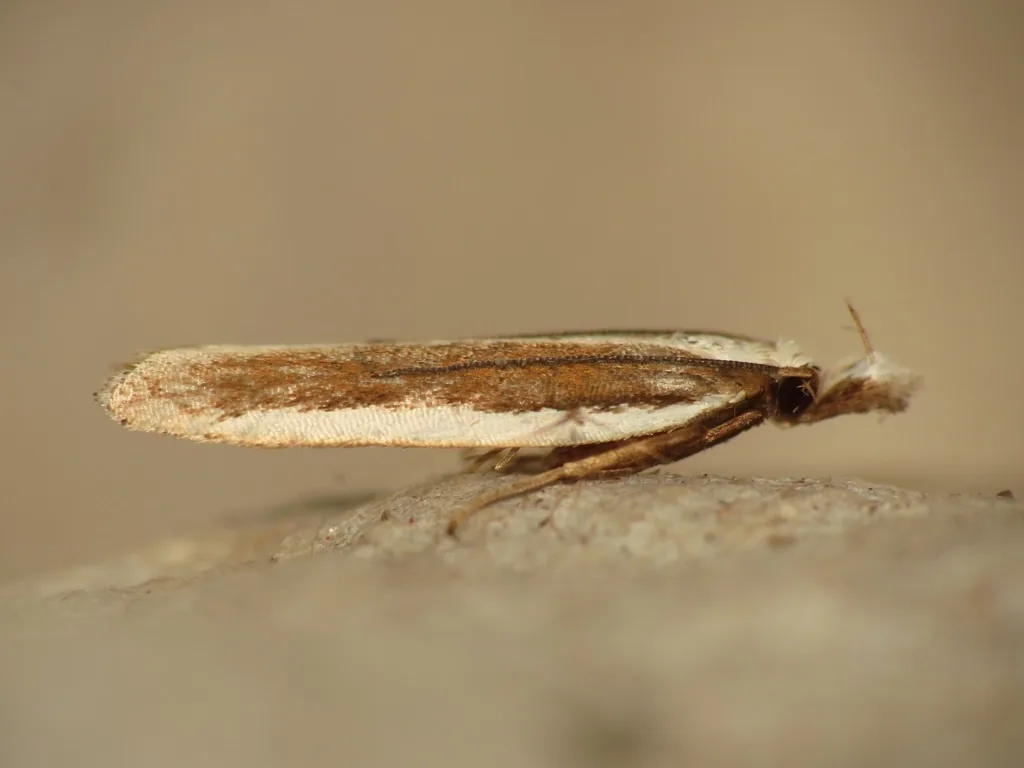
How to identify it
- Adults are copper-brown moths about 1/2 inch across, with white bands along the edges of the front wings.[1]
- Larvae are yellowish to brownish caterpillars with dark brown lines on the back and a dark head.[1]
- Damaged foliage turns brown and is covered with dirty webbing; small trees may be completely webbed.[1]
Where it lives
The PNW Insect Management Handbook covers it in Pacific Northwest landscapes; it infests only junipers.[1]
Biology and life cycle
Caterpillars overwinter in nests of webbed twigs and silk tubes, resume feeding in spring and pupate; moths fly in late spring.[1]
Eggs go on the current season's leaves; young larvae mine the leaves, then feed on the surface inside silk tubes.[1]
Irish juniper is the preferred host; Chinese juniper, red cedar and several common juniper varieties are also infested.[1]
There's one generation a year.[1]
Damage and signs
- Because larvae feed deep in the canopy, damage is often overlooked; it's frequently noticed from March to May.[1]
Health risk
It feeds on plants; the PNW Insect Management Handbook mentions no risk to people.[1]
Control
Prevention
Watch for the first signs of webbing; Juniperus procumbens and J. squamata are infested only occasionally.[1]
Traps and physical control
Hand-pick caterpillars and prune out infested growth.[1]
Common questions
Sources
- Pacific Northwest Pest Management Handbooks (OSU, WSU, University of Idaho), “Juniper (Juniperus): Juniper webworm (Insect Management Handbook).” pnwhandbooks.org/insect/hort/landscape/hosts-pests-landscape-plants/juniper-juniperus-juniper-webworm (accessed 2026-10-06)
- iNaturalist, “Dichomeris marginella taxon page (order and family).” www.inaturalist.org/taxa/951186 (accessed 2026-10-06)