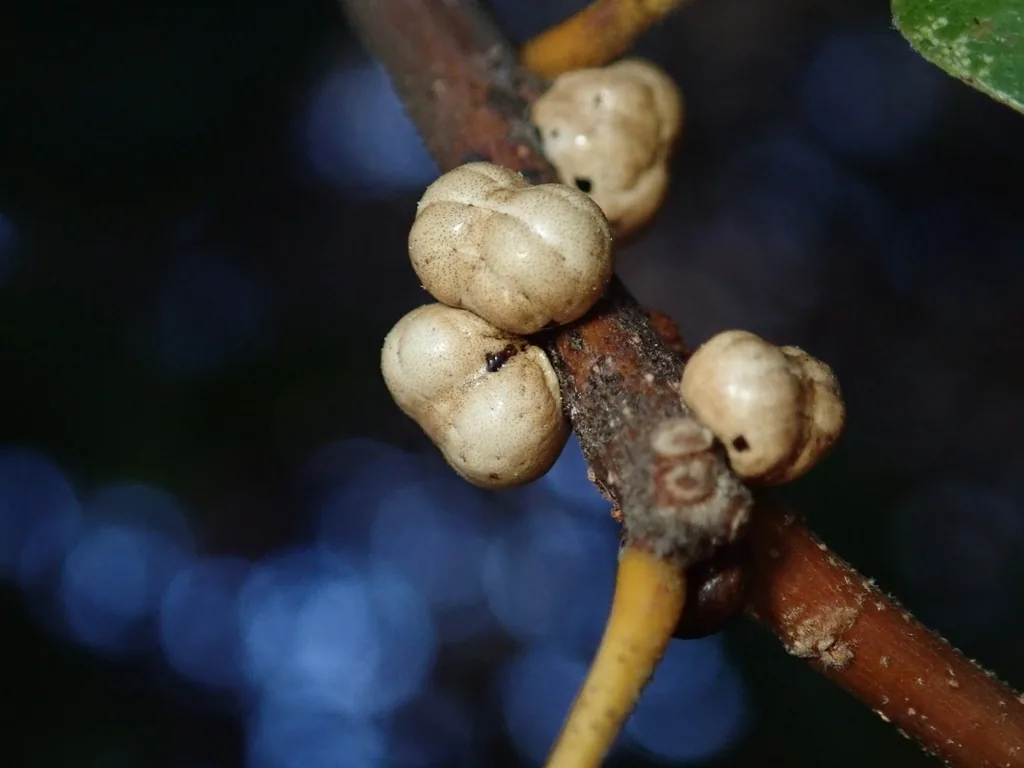
How to identify it
Where it lives
About nine species in four genera occur in the Northeast and at least 32 in North America; in Iowa, the one on bur oak causes the most damage.[1][2]
Biology and life cycle
Crawlers spend the winter in bark cracks, migrate to new twigs in spring and settle to feed on sap.[1][2]
For the best-studied species, females lay eggs over about a month starting in late June, and eggs hatch in early July.[2]
Damage and signs
- Large numbers on new branches and leaves cause deformed, stunted growth.[1]
Health risk
Control
Biological control
Predators and parasites help keep populations in check.[1]
Pesticides
If scales are a problem several years in a row, use a product labeled for kermes or soft scales: dormant oil before leaf-out, contact insecticides when crawlers are active in spring, or a systemic.[1]
Common questions
- What are the round brown bumps on my oak twigs?
- Possibly kermes scales; unlike buds or galls they come off the twig easily.[1]
- Do kermes scales hurt oaks?
- Heavy infestations deform and stunt new growth, especially on bur oak in Iowa.[1]
- When should kermes scale be treated?
- Only if it persists several years: dormant oil before leaf-out or contact sprays when spring crawlers are active.[1]
Sources
- Iowa State University Extension and Outreach (Yard and Garden), “Kermes Scale.” yardandgarden.extension.iastate.edu/encyclopedia/kermes-scale (accessed 2026-10-15)
- UMass Extension Landscape, Nursery and Urban Forestry Program (Landscape Insect & Mite Guide), “Allokermes spp. (Kermes Oak Scale).” www.umass.edu/agriculture-food-environment/landscape/publications-resources/insect-mite-guide/allokermes-spp (accessed 2026-10-15)
- iNaturalist, “Allokermes taxon page (order and family).” www.inaturalist.org/taxa/49029 (accessed 2026-10-06)