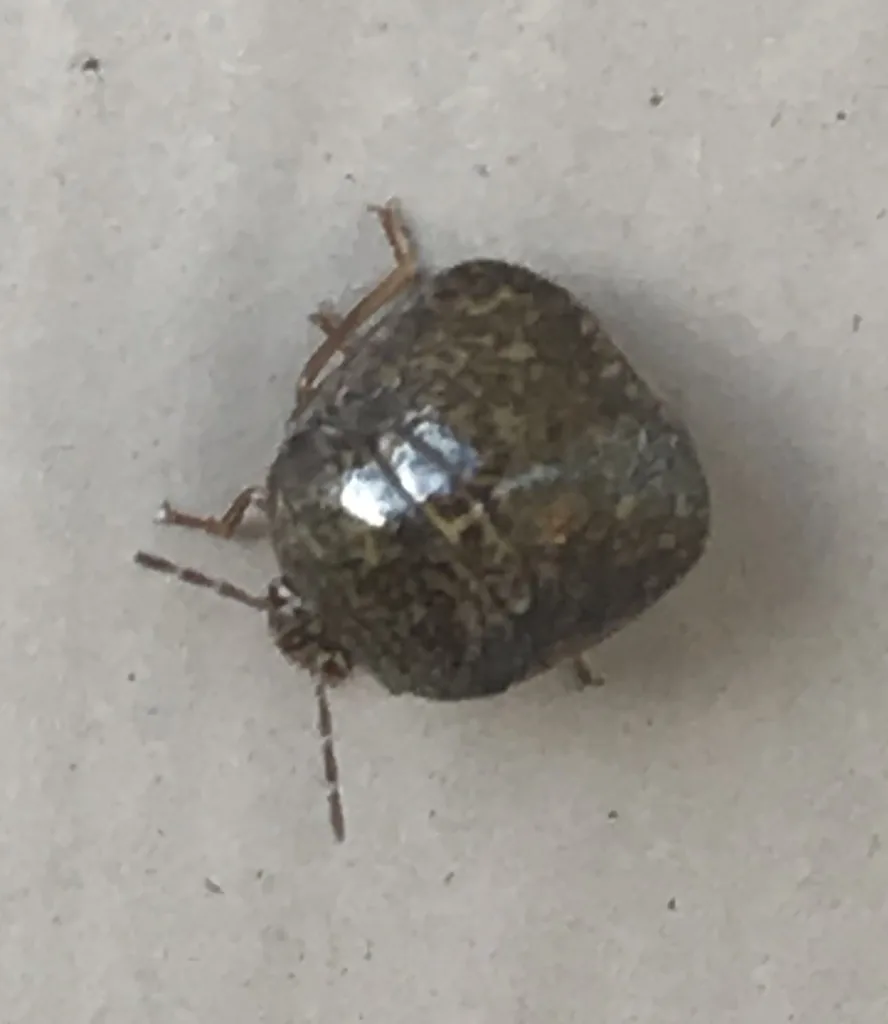
How to identify it
- Adults are small and almost square, about 1/4 inch long, light brown with an olive-green tint; they are close to the size of a lady beetle.[1]
- Despite the beetle-like shape it is a true bug, more closely related to stink bugs, and is also called the bean plataspid or globular stinkbug.[1][2]
- Nymphs have the same shape but are smaller and look very hairy.[1]
- Eggs are light tan, barrel-shaped and laid in two rows on plant leaves.[1]
Look-alikes
| Look-alike | How to tell them apart |
|---|---|
| Multicolored Asian lady beetle | Lady beetles are true beetles; the kudzu bug is about the same size but squarish and olive-brown, and it is related to stink bugs.[1] |
| Brown marmorated stink bug | Both give off a similar pungent odor when disturbed, but the kudzu bug is only about 1/4 inch long and almost square.[3][1] |
Where it lives
First found near Atlanta, Georgia, in fall 2009; by 2012 it had reached most of North Carolina plus Virginia, Alabama, Tennessee and Florida, and it occurs across South Carolina and other southern states.[2][1]
Biology and life cycle
It takes about six weeks to go from egg to adult, and there are two generations a year in the Southeast: the first mostly on kudzu or wisteria, the second on soybeans and other bean relatives.[1][2]
In fall, adults leave host plants for sheltered spots in leaf litter, under tree bark and in cracks and voids of homes and other buildings.[1][2]
They prefer light colors, particularly white, and gather around window trim, door frames, gutters and sunny walls.[1]
In spring they leave their winter shelter and fly back to plants; they are strong fliers that can come from well beyond your property.[1][3]
Damage and signs
- Around homes they are a nuisance; their secretions smell bad and can stain fabrics and wall coverings.[1]
- Dead bugs left in large numbers indoors produce odor and can attract carpet beetles and ants.[1]
- In fields it is a soybean pest, sucking plant fluids from stems and leaf stalks, though it hasn't been a major pest since 2015, likely because of a naturally occurring fungus.[2]
Health risk
Kudzu bugs are harmless to people, but handling them can stain the skin and, in some sensitive people, cause blistering and moderate discomfort.[1][3]
Control
Keep them out
Seal cracks and crevices, and make sure window, door, soffit and peak vents have good screens before fall.[1]
Sanitation
Cutting back kudzu or removable wisteria near the house before fall can reduce the numbers around your home.[1]
Traps and physical control
Vacuum bugs indoors instead of crushing or spraying them; a shop vacuum with soapy water in the canister kills them, or discard the bag afterward.[1]
Outdoors, shooing them away with a broom often works, since they fly off when disturbed; sprays leave dead bugs to sweep up.[3]
Pesticides
If you spray, use a product labeled for structural use on outdoor surfaces where bugs land, spot-treat small areas, and expect to reapply after rain or sun.[1]
When to call a professional
If numbers stay high and bugs keep getting into the house, consider hiring a pest management professional.[1]
Common questions
- Why are tiny brown bugs all over my white house?
- In the Southeast these are likely kudzu bugs, which prefer light colors and gather on sunny walls in late summer and fall looking for winter shelter.[1][3]
- Are kudzu bugs dangerous?
- They don't harm people, but crushed bugs stain skin and fabric, and handling them can irritate or blister sensitive skin.[3][1]
- Should I spray kudzu bugs on my house?
- Usually not. Sealing gaps and vacuuming or brushing them away works, and dead bugs from spraying have to be cleaned up.[3][1]
Sources
- Clemson Cooperative Extension Home & Garden Information Center, “Kudzu Bugs Around the Home (HGIC).” hgic.clemson.edu/factsheet/kudzu-bugs-around-the-home/ (accessed 2026-10-06)
- NC State Extension, “Kudzu Bug (Soybean Insect Factsheets, revised December 2024).” content.ces.ncsu.edu/kudzu-bug (accessed 2026-10-06)
- Alabama Cooperative Extension System, “Kudzu Bugs: Little Stinkers (August 2024).” www.aces.edu/blog/topics/home/kudzu-bugs-little-stinkers/ (accessed 2026-10-06)
- iNaturalist, “Megacopta cribraria taxon page (order and family).” www.inaturalist.org/taxa/209176 (accessed 2026-10-06)