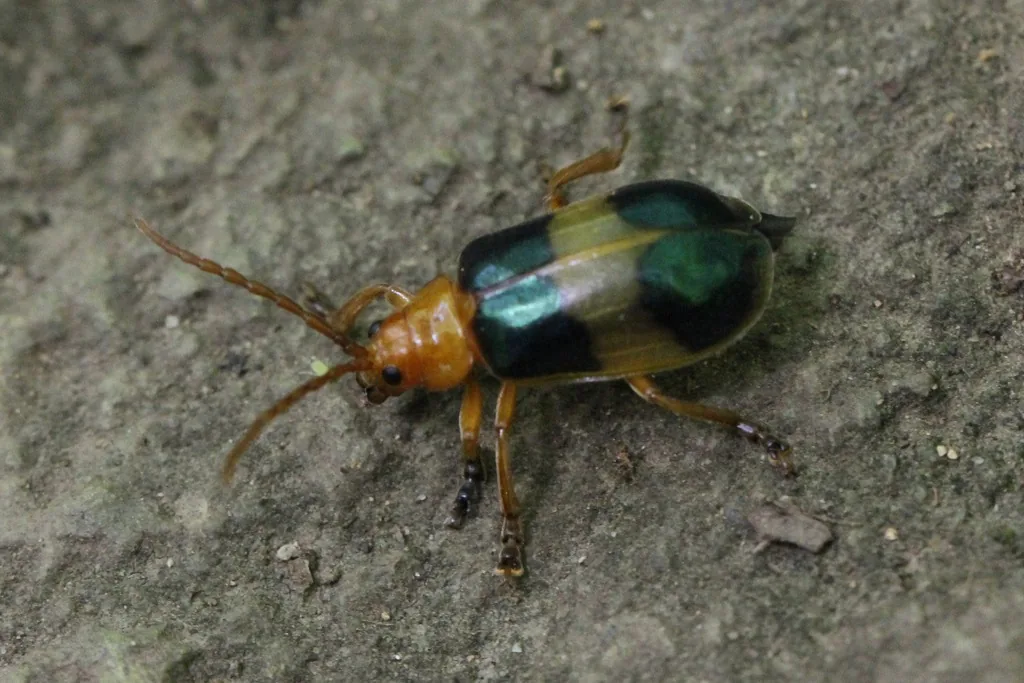
How to identify it
Look-alikes
| Look-alike | How to tell them apart |
|---|---|
| Elm leaf beetle | A much smaller elm pest, about 1/4 inch, with lengthwise stripes.[2] |
Where it lives
It occurs from Pennsylvania south to Florida and west to Kansas, though unevenly, and has spread into Ohio.[2]
Biology and life cycle
It overwinters as grubs in the soil, pupates in spring, and new adults emerge from April or May.[1][2]
Females lay masses of 24 to 58 eggs in hard, yellow, crusty clusters on leaf undersides; eggs hatch in about two weeks.[1][2]
Young larvae feed in groups for three or four days, then disperse; mature larvae crawl down the tree and wander before burrowing into the soil. There is one generation a year.[1][2]
Damage and signs
Health risk
Control
Biological control
A tachinid fly and other parasites usually keep it below noticeable levels; outbreaks collapse after a year or two.[1]
Pesticides
If severe defoliation hits early in the season on a small, valued tree, most residential landscape insecticides, including pyrethroids, give adequate control.[1]
Common questions
- What are the big orange beetles with blue spots on my elm?
- Likely larger elm leaf beetles, among the largest leaf beetles in the US.[1][2]
- Should I spray for larger elm leaf beetle?
- Only for severe early-season defoliation on a small, important tree; outbreaks usually end on their own.[1]
- Why are orange larvae crawling on the ground under my elm?
- Mature larvae crawl down and wander before burrowing into the soil to overwinter.[1][2]
Sources
- NC State Extension, “Larger Elm Leaf Beetle.” content.ces.ncsu.edu/larger-elm-leaf-beetle (accessed 2026-10-15)
- University of Florida IFAS Extension (Featured Creatures), “Larger Elm Leaf Beetle, Monocesta coryli (EENY-180).” ask.ifas.ufl.edu/publication/IN337 (accessed 2026-10-15)
- iNaturalist, “Monocesta coryli taxon page (order and family).” www.inaturalist.org/taxa/196775 (accessed 2026-10-06)