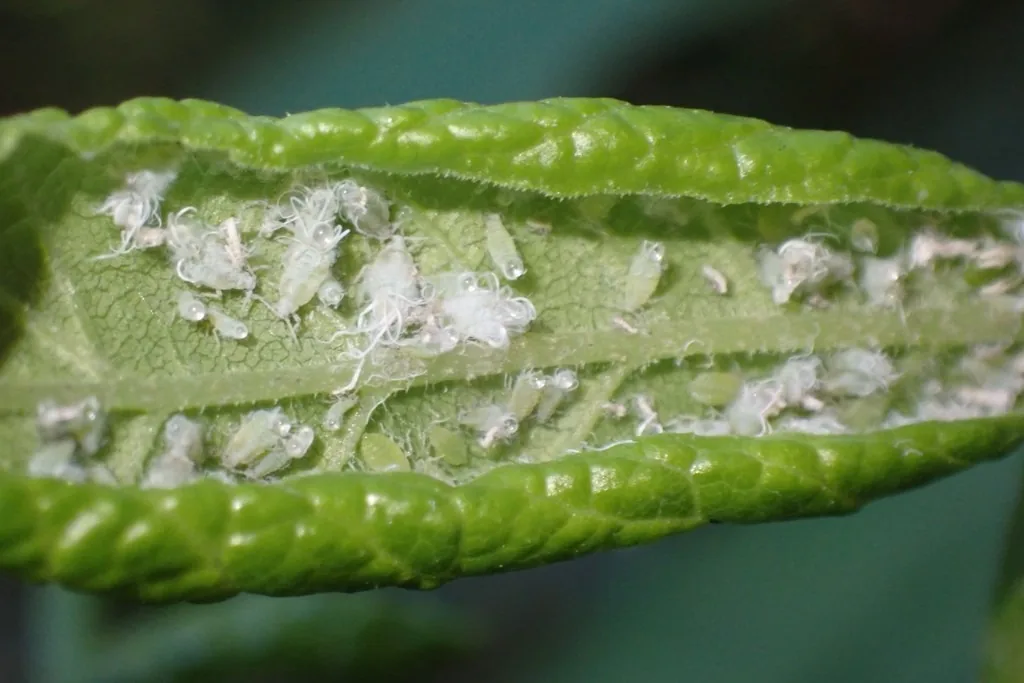
How to identify it
Where it lives
Iowa State calls it a consistent pest of green ash; Utah State covers it among woolly aphids of Utah landscapes.[1][2]
Biology and life cycle
Aphids arrive on new growth in mid to late May; only leaves that emerge after they arrive curl, so expanded leaves are not affected.[1]
Woolly aphids like this one may overwinter as eggs on bark or as immatures on roots, moving between parts of the plant or between hosts.[2]
Damage and signs
Health risk
Control
Traps and physical control
Prune off and discard the deformed tips if they bother you.[1]
Biological control
Syrphid fly larvae and lady beetle larvae are often abundant in the colonies and usually bring them under control.[1]
Pesticides
Spraying is generally not warranted: by the time curling shows it is too late, curled leaves won't flatten even if the aphids die, and sprays harm the natural enemies.[1]
Common questions
- Why are the leaves at my ash branch tips curled into knots?
- Leafcurl ash aphids feeding on new leaves cause tight coils at the twig tips in early summer.[1][2]
- Will the curled leaves recover?
- No, but the damage is cosmetic and limited to a small part of the tree.[1]
- Should I spray?
- Usually not; it's too late once leaves curl, and sprays kill the predators that control the aphids.[1]
Sources
- Iowa State University Extension and Outreach (Yard and Garden), “Leafcurl ash aphid.” yardandgarden.extension.iastate.edu/encyclopedia/leafcurl-ash-aphid (accessed 2026-10-15)
- Utah State University Extension, “Leafcurl Ash, Woolly Apple and Woolly Beech Aphids (Ornamental Pest Guide).” extension.usu.edu/planthealth/ipm/ornamental-pest-guide/arthopods/aphids-adelgids/leafcurl-ash-woolly-apple-woolly-beech-aphids.php (accessed 2026-10-15)
- iNaturalist, “Prociphilus fraxinifolii taxon page (order and family).” www.inaturalist.org/taxa/494593 (accessed 2026-10-06)