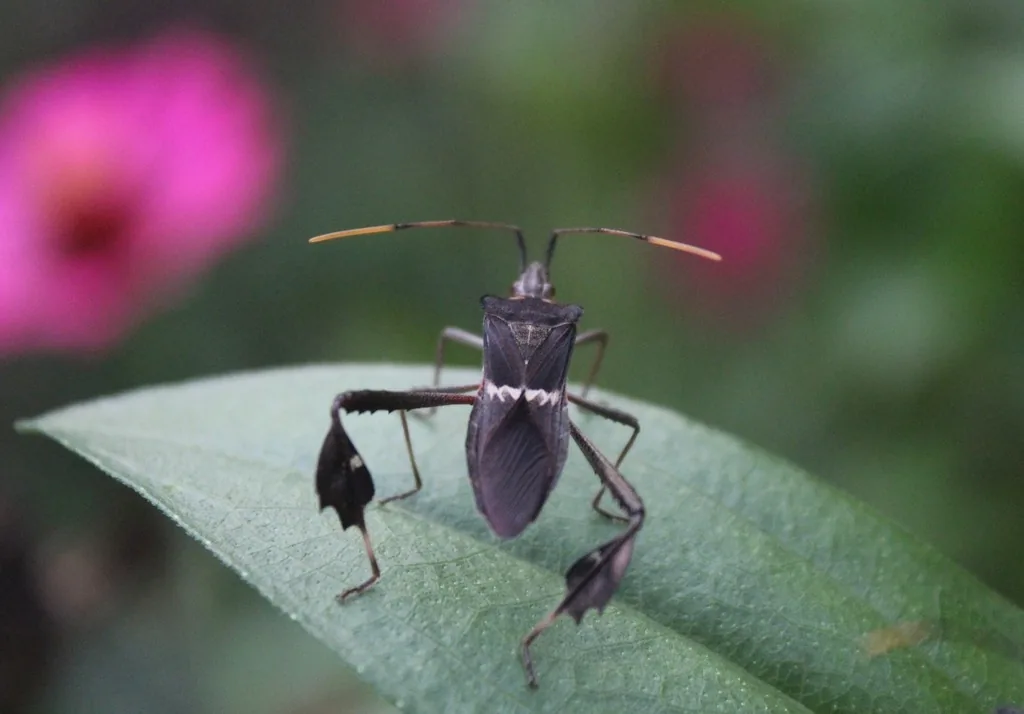
How to identify it
- Adults are narrow, brown bugs about 3/4 to 1 inch long, with flattened, leaf-like widenings on the lower part of the hind legs.[1][2]
- Most have a pale band across the middle of the wings; in Leptoglossus zonatus it is a bold white zigzag.[1][2]
- Leptoglossus zonatus, the species this page centers on, also has two yellow spots just behind the head; L. clypealis has a thorn-like point on the tip of the head.[1]
- Texas A&M AgriLife profiles Leptoglossus phyllopus, about 3/4 inch long and dark brown with a whitish to yellowish stripe across the back.[2]
- Eggs are brown cylinders laid end to end in a string along a stem or leaf midrib, and young nymphs are orange to reddish brown with dark heads and legs.[1]
Look-alikes
| Look-alike | How to tell them apart |
|---|---|
| Western conifer seed bug | The western conifer seed bug is itself a leaffooted bug, Leptoglossus occidentalis; it lacks the yellow spots, has only a faint zigzag and lives mainly on conifers.[1] |
| Squash bug | Squash bugs are flat, dark gray to grayish-brown cucurbit pests with orange-striped abdomen edges; leaffooted bugs are narrower and brown, with leaf-like flaps on the hind legs.[3][1] |
| Assassin bug nymphs | Young assassin bug nymphs, which are beneficial, have light-colored legs and antennae and hatch from grouped, barrel-shaped eggs rather than egg strands.[1][2] |
Where it lives
Three Leptoglossus species are native to California and the western United States, while Leptoglossus phyllopus feeds on fruit, vegetable and seed crops in Texas.[1][2]
Biology and life cycle
Adults spend the winter in groups in woodpiles, outbuildings, under loose bark, in palm fronds, citrus or juniper trees, and in leftover fruit.[1]
Cold winters kill many adults, so outbreaks are most likely after mild winters.[1]
In spring adults feed on thistles and other weeds, then move into gardens as fruit develops; a female can lay over 200 eggs in about two months.[1]
Eggs hatch in about a week and nymphs reach adulthood in 5 to 8 weeks; California sees two to three generations through spring and summer.[1]
Young nymphs cluster on the fruit where their egg mass was laid, and adults give off a distinctive odor when handled.[2][1]
Damage and signs
- Feeding on small tomatoes can make them drop, while feeding on mid-sized fruit leaves depressions or discolored spots as the fruit ripens.[1]
- On ripe tomatoes the marks are slight surface blemishes that need not concern home gardeners.[1]
- On pomegranates, late feeding can darken and shrivel the seeds inside without outward damage; on almonds and pistachios it can kill or stain kernels.[1]
- They also feed on peaches, cotton, beans, black-eyed peas, sorghum and the tender shoots of plants such as potatoes, with damage similar to stink bugs.[2]
- Feeding on leaves and shoots of most ornamentals and many garden plants causes no visible harm.[1]
Health risk
Leaffooted bugs feed on plants, not people. Their main nuisance is a distinctive odor when handled, so wear gloves when picking them off.[1][2]
Control
Keep them out
Row covers put on before bugs arrive prevent feeding, but they also block pollinators and beneficial insects from reaching the plants.[1]
Sanitation
Remove or inspect overwintering sites such as woodpiles and leftover fruit, and mow or remove nearby weeds that feed bugs in winter and spring.[1]
Traps and physical control
Check plants daily to several times a week, handpicking bugs or brushing them into soapy water; mornings work best, and crush the egg strands too.[1]
Remove bugs early in the season, while young nymphs are still clustered; a dedicated handheld vacuum used regularly can reduce numbers.[1]
Biological control
Tiny egg-parasite wasps, tachinid flies, birds, spiders and assassin bugs all attack leaffooted bugs; avoid persistent broad-spectrum sprays that harm them.[1]
Pesticides
Insecticides are rarely needed in gardens and work best on small nymphs; insecticidal soap, neem oil or pyrethrin give some control of young nymphs only.[1]
Pyrethroids such as permethrin are the most effective but are highly toxic to bees and beneficials, so treat them as a last resort and observe days-to-harvest.[1]
Common questions
- What are the brown bugs with flat back legs on my tomatoes?
- Those are likely leaffooted bugs, recognized by the leaf-like flaps on their hind legs; light feeding marks on ripe tomatoes are cosmetic.[1][2]
- Why are my pomegranate seeds dark and shriveled?
- Late-season leaffooted bug feeding can darken and wither pomegranate seeds even when the outside of the fruit looks fine.[1]
- Do I need to spray leaffooted bugs?
- Usually not. Populations are typically tolerable in gardens, and handpicking, weed control and removing overwintering spots come before any spray.[1]
Sources
- University of California Statewide IPM Program, “Pest Notes: Leaffooted Bug, Publication 74168.” ipm.ucanr.edu/home-and-landscape/leaffooted-bug/ (accessed 2026-10-06)
- Texas A&M AgriLife Extension, “Leaffooted Bug (Field Guide to Common Texas Insects).” texasinsects.tamu.edu/leaffooted-bug/ (accessed 2026-10-06)
- University of California Statewide IPM Program, “Squash Bugs (Pest Notes, Home and Landscape).” ipm.ucanr.edu/home-and-landscape/squash-bugs/ (accessed 2026-10-06)
- iNaturalist, “Leptoglossus zonatus taxon page (order and family).” www.inaturalist.org/taxa/154551 (accessed 2026-10-06)