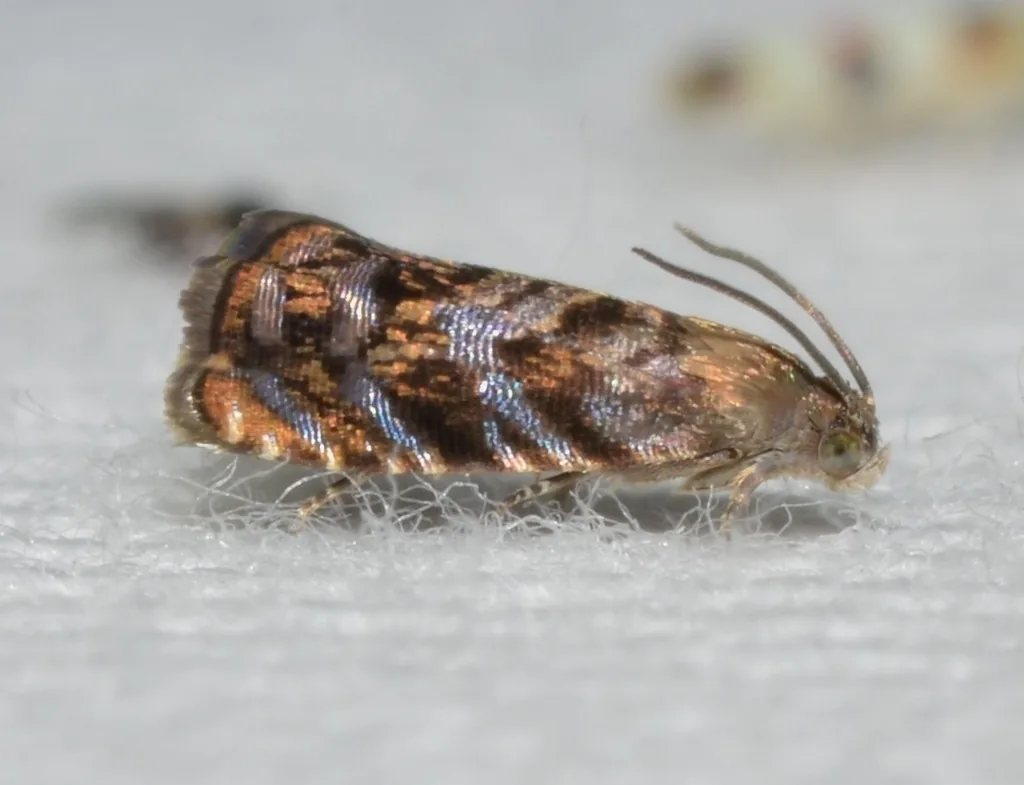
How to identify it
Where it lives
Penn State Extension covers it as a fruit pest in Pennsylvania.[1]
Biology and life cycle
There are two and possibly a partial third generation a year in Pennsylvania.[1]
Full-grown larvae overwinter in cocoons on the tree, under loose bark scales or in litter on the ground.[1]
Its life cycle closely overlaps the codling moth's.[1]
Damage and signs
Health risk
It feeds on plants; Penn State Extension mentions no risk to people.[1]
Control
Prevention
Oriental fruit moth pheromone lures attract it, and Oriental fruit moth mating disruption also disrupts its mating.[1]
Pesticides
Codling moth management also controls this pest, except mating disruption aimed only at codling moth.[1]
Common questions
- Does spraying for codling moth control lesser appleworm?
- Usually; Penn State says codling moth programs control it, except mating disruption that targets only codling moth.[1]
- How deep do lesser appleworm larvae tunnel?
- They mine shallowly under the skin and may go deeper as they grow, but not into the core.[1]
Sources
- Penn State Extension, “Tree Fruit Insect Pest: Lesser Appleworm.” extension.psu.edu/tree-fruit-insect-pest-lesser-appleworm (accessed 2026-10-06)
- iNaturalist, “Aspila prunivora taxon page (order and family).” www.inaturalist.org/taxa/1507295 (accessed 2026-10-06)