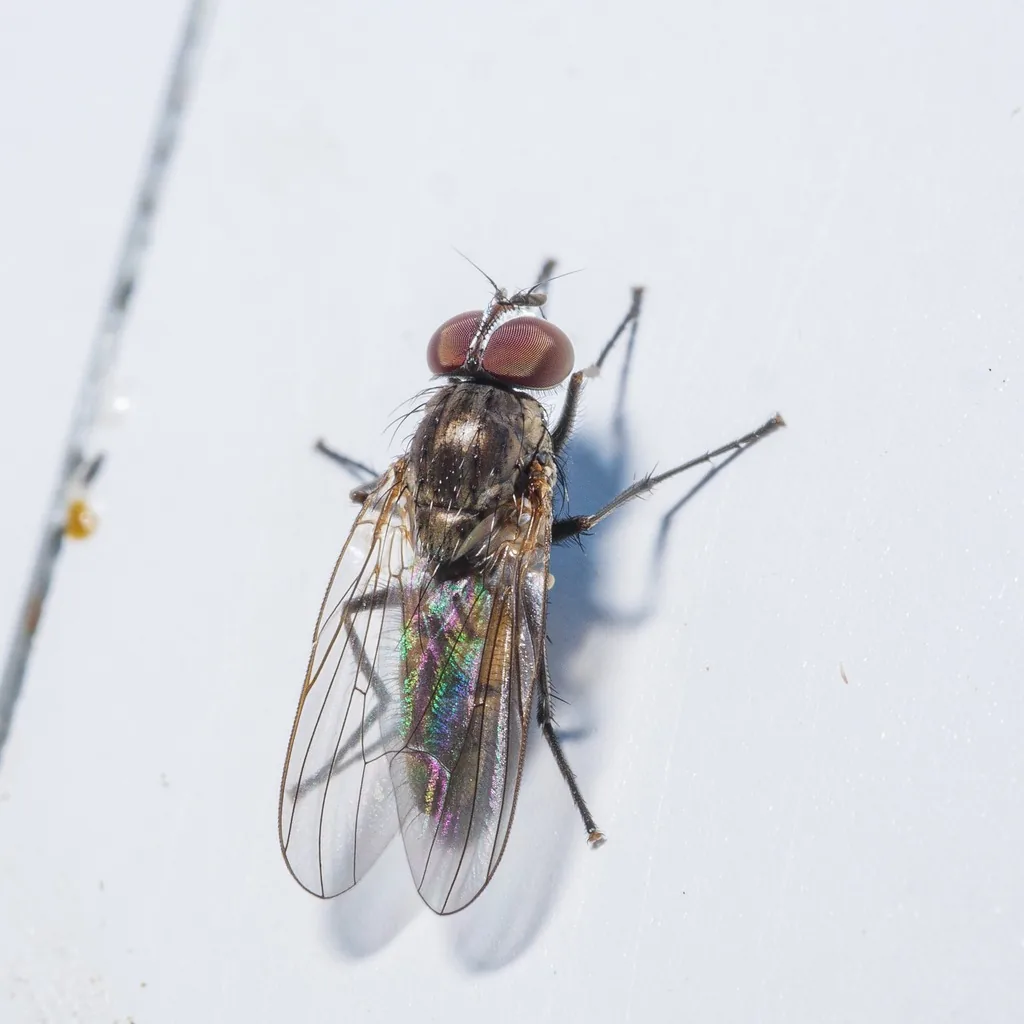
How to identify it
- Adults are about 3/16 to 1/4 inch (5 to 6 mm) long, roughly two-thirds the size of a house fly, and black to dull gray.[2][1][3]
- The gray thorax has three faint lengthwise stripes, while the house fly has four distinct dark stripes.[2][1]
- At rest it holds its wings overlapping straight back over the body instead of in the house fly's V shape.[1][2]
- Males have larger eyes that nearly meet on top of the head and a longer, yellowish abdomen than females.[2]
Look-alikes
| Look-alike | How to tell them apart |
|---|---|
| House fly | Larger, with four dark stripes on the thorax, wings held in a V, and a sharp bend in a wing vein near the tip that the lesser house fly lacks.[2][1] |
| Canyon flies | Close Fannia relatives in California hill and canyon areas; they have a three-spotted abdomen and yellow at the base of the antennae, and they persistently land on faces.[1] |
Where it lives
A common fly around poultry farms and homes; in California and the arid Southwest it is most numerous in the cool spring and fall months and declines in summer heat.[2][1][3]
Biology and life cycle
Females lay eggs in poultry manure and other animal waste, and in compost, fermenting grass clippings, damp feed and garbage-can food residue.[3][1]
The larvae are brown, flattened and covered with fleshy spines, unlike house fly maggots.[1]
Development takes about 2 to 4 weeks from egg to adult, somewhat longer than for the house fly.[3][1]
Males form mating swarms about 5 to 6 feet off the ground in still, shaded spots such as breezeways, porches, doorways and open garages, waiting for females.[1][2]
Damage and signs
Health risk
Lesser house flies seldom land on human food and aren't considered a significant carrier of human disease, though they can spread a virus among poultry.[1][2]
Control
Sanitation
Find and remove breeding material: manure, piles of fermenting grass clippings and wet organic debris should be removed, spread thin to dry, or properly hot-composted.[1][2]
Keep garbage cans clean of food residue and store animal feed dry.[3]
Traps and physical control
Strong fans where males swarm make the spot less attractive, because moving air breaks up the swarms.[1]
Pesticides
Ordinary house fly baits and traps don't attract these flies, so cleaning up breeding sites matters more than spraying.[1]
Why it seems worse in spring and fall
This fly does poorly in high daytime heat, so numbers drop in summer unless breeding sites are shaded or protected.[1][2]
In Southern California it is common into June, falls off from July, and can build up again in fall.[3]
As temperatures fall, adults look for shelter in buildings or dense plants.[1]
Common questions
- Why do small flies hover in circles under my porch roof?
- These are often male lesser house flies forming mating swarms in still, shaded air. They move aside when approached and rarely land on people.[1][2]
- Do fly baits work on lesser house flies?
- Not well. They aren't drawn to the same baits and traps as house flies, so removing manure, compost and grass clipping piles nearby works better.[1]
Sources
- University of California Statewide IPM Program, “Pest Notes: Flies (UC ANR Publication 7457), web edition.” ipm.ucanr.edu/home-and-landscape/flies/ (accessed 2026-10-06)
- Veterinary Entomology, University of California, Riverside, “Little House Fly (Fannia canicularis L.).” veterinaryentomology.org/little-house-fly (accessed 2026-10-06)
- Coachella Valley Mosquito and Vector Control District, “Little House Flies (Fannia canicularis).” cvmvcd.specialdistrict.org/little-house-flies-fannia-canicularis (accessed 2026-10-06)
- iNaturalist, “Fannia canicularis taxon page (order and family).” www.inaturalist.org/taxa/121213 (accessed 2026-10-06)