How to identify it
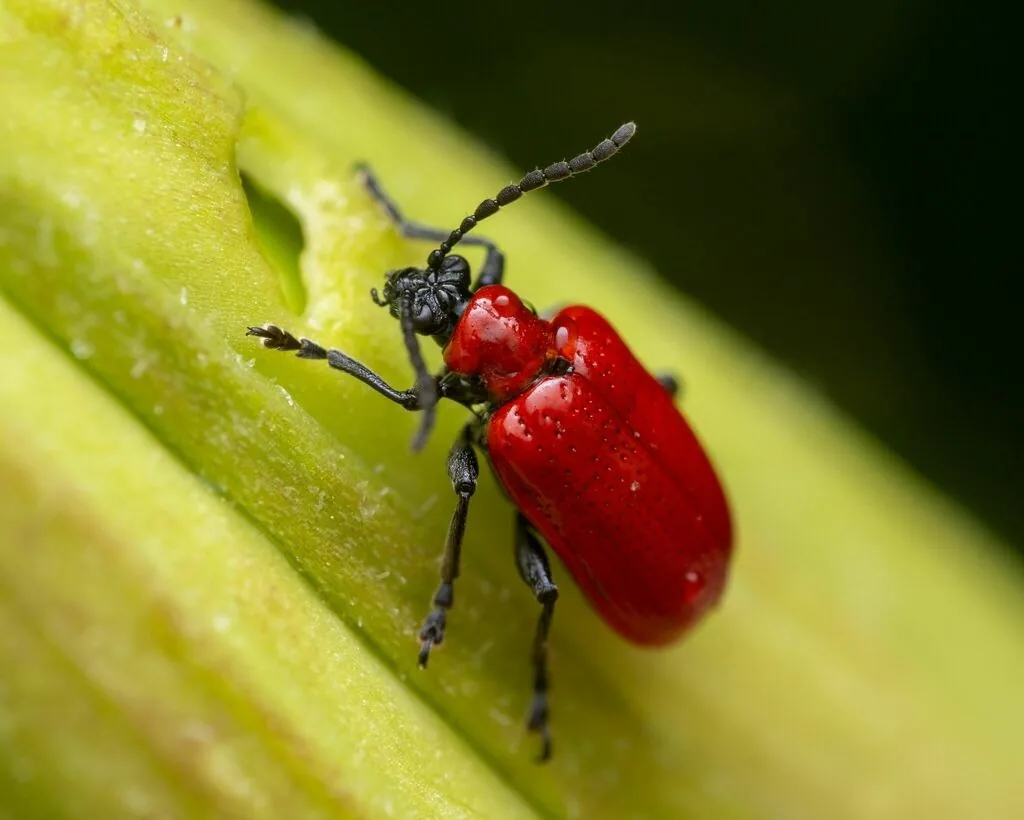
- Adults are about 1/2 inch long with a very bright, shiny red body and a black head, legs, antennae and underside.[1][2]
- Eggs are laid in rows of 2 to 16 on leaf undersides; they look like tan lines and turn orange, then deep red, just before hatching.[1]
- Larvae are soft, plump and slug-like, orange, brown, yellowish or greenish with black heads, and usually carry a pile of their own excrement on their backs.[1][2]
- Adults and larvae are often found feeding together on the same lily plant.[1]
Where it lives
Native to Europe; found near Montreal in 1943 and in Cambridge, Massachusetts, in 1992. It has spread through New England and New York and beyond, and is likely to establish across much of North America.[1][2]
Biology and life cycle
Adults spend the winter in sheltered spots such as soil or plant debris, often in shaded, cool, moist places that need not be near lilies.[1]
Overwintered adults start feeding as soon as lily shoots break the ground, in mid-April in warmer parts of Massachusetts, and lay eggs mostly in May.[1]
Each female lays 250 to 450 eggs, which hatch in 4 to 8 days; larvae feed for 16 to 24 days before dropping to the soil to pupate.[1]
New adults emerge 16 to 22 days later and feed for the rest of the season; there is one generation a year.[1]
It lays eggs and develops only on true lilies (Lilium) and fritillaria, though adults nibble lightly on plants like lily of the valley, Solomon's seal, potato, hollyhock and hosta.[1]
Damage and signs
Health risk
A garden pest only: it feeds on lilies and a few related plants and is not described as a threat to people or pets.[1]
Control
Prevention
University of Maine research suggests Asiatic hybrids are most susceptible, while some types, such as Lilium henryi, 'Black Beauty' and certain Oriental lilies, resist the beetle better.[1]
Traps and physical control
In small plantings, hand-pick adults, larvae and egg rows regularly from about April into early October.[1]
Biological control
Three tiny European parasitic wasps that attack only lily leaf beetle larvae were released in the Northeast and are now established and spreading through New England and New York.[1][2]
Pesticides
Neem oil kills very young larvae but must be reapplied every five to seven days after eggs hatch; spinosad may also work.[1]
Spinosad is toxic to pollinators until it dries, so don't spray it on lilies in bloom, and confirm the pest and plant are on any product label.[1]
Common questions
- Do lily leaf beetles eat daylilies?
- No. Daylilies aren't hosts; the beetle breeds only on true lilies and fritillaria.[1]
- Why do lily beetle larvae look like they're covered in dirt?
- They pile their own excrement on their backs, which may help deter predators and makes them unpleasant to hand-pick.[1]
- Is anything controlling lily leaf beetles naturally?
- Yes. Parasitic wasps released by University of Rhode Island researchers are established in New England, and reported lily damage has declined in parts of the region.[2]
Sources
- UMass Extension Landscape, Nursery and Urban Forestry Program, “Lily Leaf Beetle (fact sheet, last updated September 26, 2024).” www.umass.edu/agriculture-food-environment/landscape/fact-sheets/lily-leaf-beetle (accessed 2026-10-06)
- University of Rhode Island Biocontrol Lab, “Lily Leaf Beetle.” web.uri.edu/biocontrol/projects/lily-leaf-beetle/ (accessed 2026-10-06)
- iNaturalist, “Lilioceris lilii taxon page (order and family).” www.inaturalist.org/taxa/55761 (accessed 2026-10-06)