How to identify it
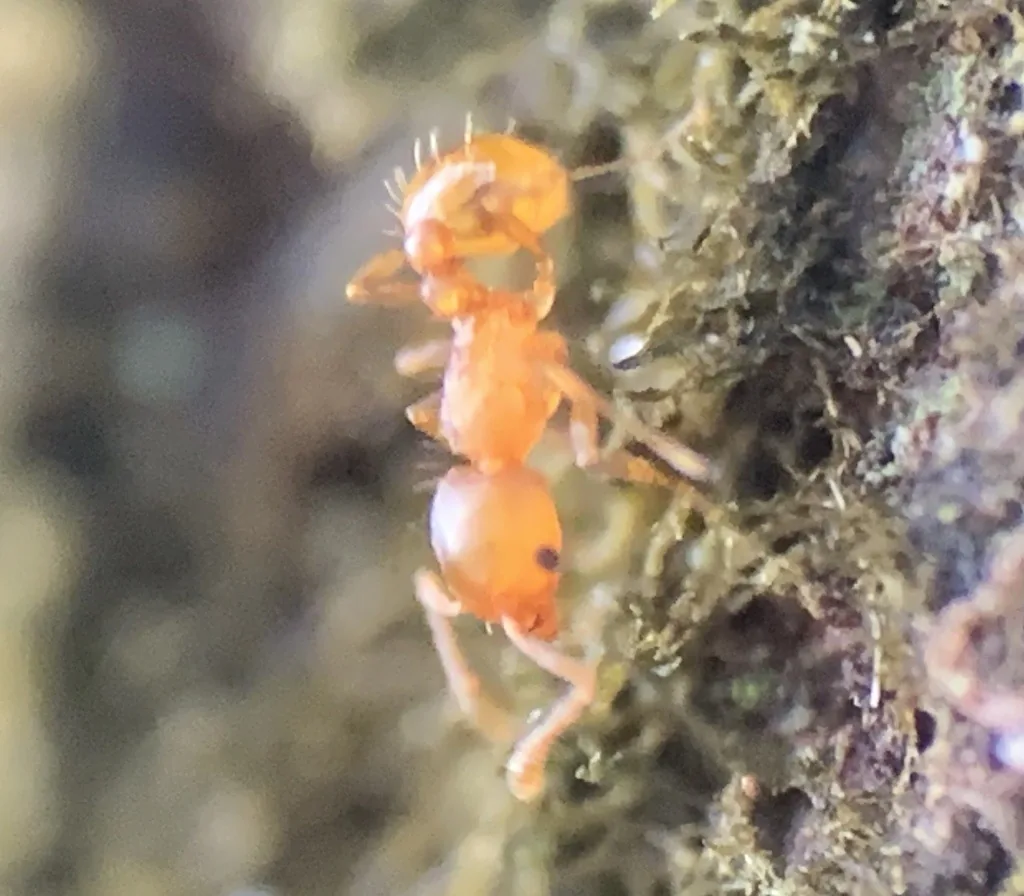
- Workers are tiny, about 1/16 inch long, or as long as a penny is thick, and pale orange to orange-red.[2][3]
- They move characteristically slowly.[2][3]
- Under magnification, workers show a pair of spines on the back of the thorax and antennae ending in a two-segmented club.[1]
- Queens are much larger, about 4.5 mm, and darker reddish brown; a sample with many queens among dense workers points to this species.[1]
- They don't build mounds, and their nests have no distinct openings.[3]
Look-alikes
| Look-alike | How to tell them apart |
|---|---|
| Tropical fire ant | A larger stinging ant that builds ground nests with distinct openings in sunny, dry areas, while little fire ants nest in moist, shady spots without mounds.[3] |
| Red imported fire ant | Despite the shared name, the little fire ant isn't closely related to the red imported fire ant; the two belong to different tribes of ants.[1] |
Where it lives
Native to Central and South America. In Florida it is established from the Keys north to Gainesville, mostly along highways and in residential areas; in Hawaii it was found in Puna in 1999 and later turned up on Oahu, Maui and Lanai.[1][3]
Biology and life cycle
Invasive populations form supercolonies with many queens and millions of workers, spread across many nests with no central one.[1]
Winged queens don't fly off to start colonies; colonies grow by budding, expanding the boundaries of the parent supercolony.[1][2]
Nests sit near the surface: under rocks, in logs, in plant material and compost, in hay bales, in leaf litter and in potted plants.[1][2]
Workers forage on the ground and in trees, eat dead insects and other small animals, and prefer honeydew from sap-sucking insects.[1][2]
It spreads mainly in infested plants, plant material and soil, and in Hawaii also in logs, green waste, gravel and vehicles.[1][3]
Damage and signs
- By tending sap-sucking insects for their honeydew, little fire ants can increase scales, aphids and mealybugs on crops and garden plants.[1]
- It can become a household pest that infests clothing, beds, furniture or food, and people have been stung inside homes in Hawaii.[2]
- Where it invades, it wipes out other ant species and harms native insects, spiders, reptiles and birds.[1][2]
Health risk
The sting causes pain and large red welts that can ache for days and then itch. Stings to the eyes can injure the cornea in people and pets, and pets can go blind.[2][1][3]
Control
Prevention
Inspect plants, soil and packing material before moving them, and quarantine and test new plants, cut flowers, mulch and soil.[1][3]
Test for them with a thin smear of peanut butter on disposable chopsticks set in shady, moist spots for an hour, then bag and freeze any sticks with tiny orange ants.[3]
Pesticides
Insecticide baits work best on small, isolated populations; large established infestations are very hard to eliminate.[1]
When to call a professional
In Hawaii, report suspected ants to the state's 643-PEST hotline and don't treat or disturb the area until they're identified, since that can scatter the nests.[3]
Suspected infestations should go to specialists to confirm the identification and plan control.[1]
Common questions
- Why do little fire ants sting me from above?
- They forage in trees and shrubs and drop onto people and animals below. Ants on the ground rarely sting, but they sting readily when trapped under clothing.[1][2]
- Can little fire ants blind my dog or cat?
- Yes. Repeated stings to the eyes can damage the cornea, and pets in infested areas have been blinded.[1][3]
- How do I check my yard for little fire ants?
- Use the peanut butter chopstick test in shady, moist areas and around potted plants, then send any suspicious ants for identification.[3]
Sources
- University of Florida/IFAS Extension (EDIS), “Little Fire Ant, Wasmannia auropunctata (Roger) (Featured Creatures, EENY publication IN1351).” edis.ifas.ufl.edu/publication/IN1351 (accessed 2026-10-06)
- Hawaii Department of Agriculture, Plant Pest Control Branch, “New Pest Advisory No. 99-02: Little Fire Ant, Wasmannia auropunctata (updated February 2007).” dab.hawaii.gov/pi/files/2014/05/Pest-Advisory-LFA.pdf (accessed 2026-10-06)
- University of Hawaii College of Tropical Agriculture and Human Resources, with the Hawaii Department of Agriculture, “Detect, Report, Stop the Little Fire Ant (2014).” www.ctahr.hawaii.edu/UHMG/downloads/2014LFA.pdf (accessed 2026-10-06)
- iNaturalist, “Allomerus auropunctatus taxon page (order and family).” www.inaturalist.org/taxa/1704594 (accessed 2026-10-06)