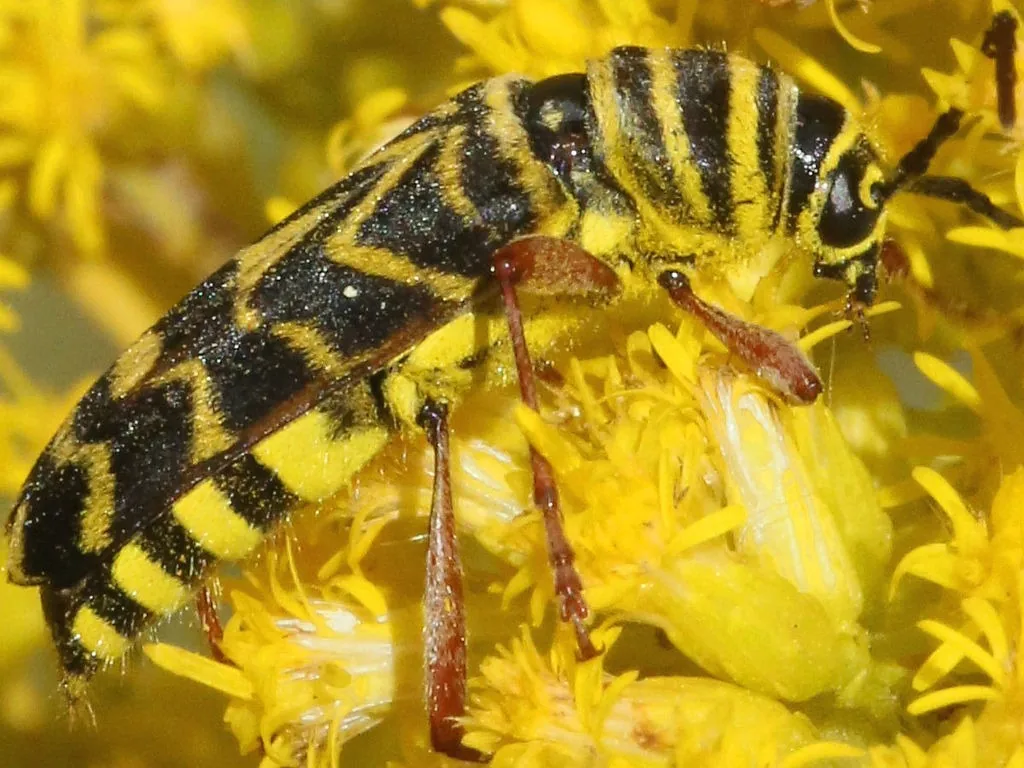
How to identify it
- Adults are 1/2 to 1 inch long, black with a series of yellow stripes on the head, thorax and wing covers.[2]
- Larvae are white, legless and cylindrical, about an inch long when mature.[2]
- Signs include yellow stains and oozing sap from borer holes, wet spots on the bark and coarse sawdust-like frass.[1][2]
Where it lives
It occurs wherever black locust grows, in eastern Canada and most of the United States; it is particularly damaging in the Northeast and central states and has damaged locusts in most northern Utah counties.[1][2]
Biology and life cycle
Adults appear in early September until frost, often feeding on goldenrod; peak egg laying is in late September.[1][2]
Females lay eggs in bark crevices and around wounds; eggs hatch in about a week, and young larvae spend the winter in the inner bark.[1][2]
In spring, larvae resume feeding and bore into the sapwood and heartwood, making tunnels 3 to 4 inches long.[1][2]
Damage and signs
Health risk
Control
Prevention
Keep trees healthy and vigorous; vigorous spring growth and sap flow kill many young larvae.[1]
Pesticides
If needed, wet the trunk and larger limbs thoroughly in mid to late August and repeat a month later to target egg-laying adults and newly hatched larvae.[1]
Common questions
- What is the black and yellow beetle on my goldenrod?
- In early fall it is often the locust borer, which feeds on goldenrod as an adult.[2]
- What is oozing from my black locust trunk?
- Sap and yellow stains around holes, with sawdust-like frass, point to locust borer larvae.[1][2]
- How do I protect a black locust?
- Keep it vigorous, and if needed spray the trunk in mid to late August and again a month later.[1]
Sources
- Utah State University Extension (IPM), “Locust Borer.” extension.usu.edu/planthealth/ipm/notes_orn/list-treeshrubs/locust-borer.php (accessed 2026-10-15)
- UMass Extension Landscape, Nursery and Urban Forestry Program (Landscape Insect & Mite Guide), “Megacyllene robiniae (Locust Borer).” www.umass.edu/agriculture-food-environment/landscape/publications-resources/insect-mite-guide/megacyllene-robiniae (accessed 2026-10-15)
- iNaturalist, “Megacyllene robiniae taxon page (order and family).” www.inaturalist.org/taxa/83802 (accessed 2026-10-06)