How to identify it
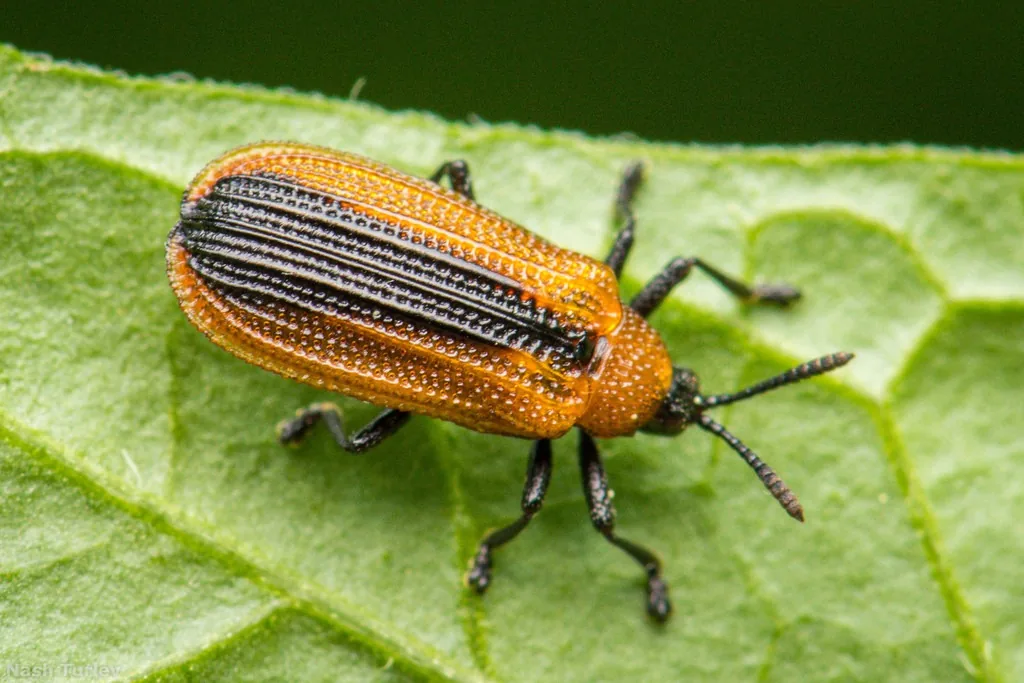
- Adults are flat, elongate beetles about 1/4 inch long with a black head and orange wing covers bearing a broad black stripe down the center.[1][2]
- The wing covers are deeply pitted with three long ridges each.[1]
- Larvae are flat and creamy yellow, slightly longer than adults, and live inside translucent mines that turn brown.[1][2]
Where it lives
Outbreaks occur almost every year throughout the range of black locust, including the Carolinas.[1][2]
Biology and life cycle
Adults overwinter in bark crevices and leaf litter and emerge in spring as leaves unfold to feed on leaf undersides and lay eggs.[1][2]
Eggs are laid in overlapping groups of three to five cemented with excrement; larvae mine between the leaf surfaces and may mine several leaflets.[1][2]
Larvae pupate in their mines and new adults appear in July; there are two generations a year.[1][2]
Damage and signs
- Black locust is preferred; honey locust, apple, beech, birch, cherry, elm, oak and hawthorn are occasionally attacked.[1][2]
- Damaged trees look frost- or drought-scorched, and whole stands can turn brown by midsummer; outbreaks seldom hit the same trees for more than a couple of years.[1][2]
- Severely defoliated trees under other stresses may die, but infested trees rarely die.[1][2]
Health risk
Control
Prevention
Water a valued locust during summer to help it withstand defoliation.[2]
Biological control
Several parasites and predators attack it, which may be why populations don't stay high in one area for long.[1]
Pesticides
For landscape trees, spray in late May or early June while adults are active and mines are under 1/4 inch long; a product with systemic activity works best.[1]
Common questions
- Why are the locust trees along the road brown in July?
- Usually locust leafminer larvae have mined the leaves.[1][2]
- Will my black locust die?
- Rarely; damage looks alarming, but infested trees usually recover, especially with summer watering.[2]
- When should locust leafminer be treated?
- In late May or early June, while mines are still small.[1]
Sources
- NC State Extension, “Locust Leafminer (PDIC Factsheet).” content.ces.ncsu.edu/locust-leafminer-1 (accessed 2026-10-15)
- Clemson Cooperative Extension, Home & Garden Information Center, “Locust Leafminer (Jul 12, 2021).” hgic.clemson.edu/locust-leafminer/ (accessed 2026-10-15)
- iNaturalist, “Odontota dorsalis taxon page (order and family).” www.inaturalist.org/taxa/132416 (accessed 2026-10-06)