How to identify it
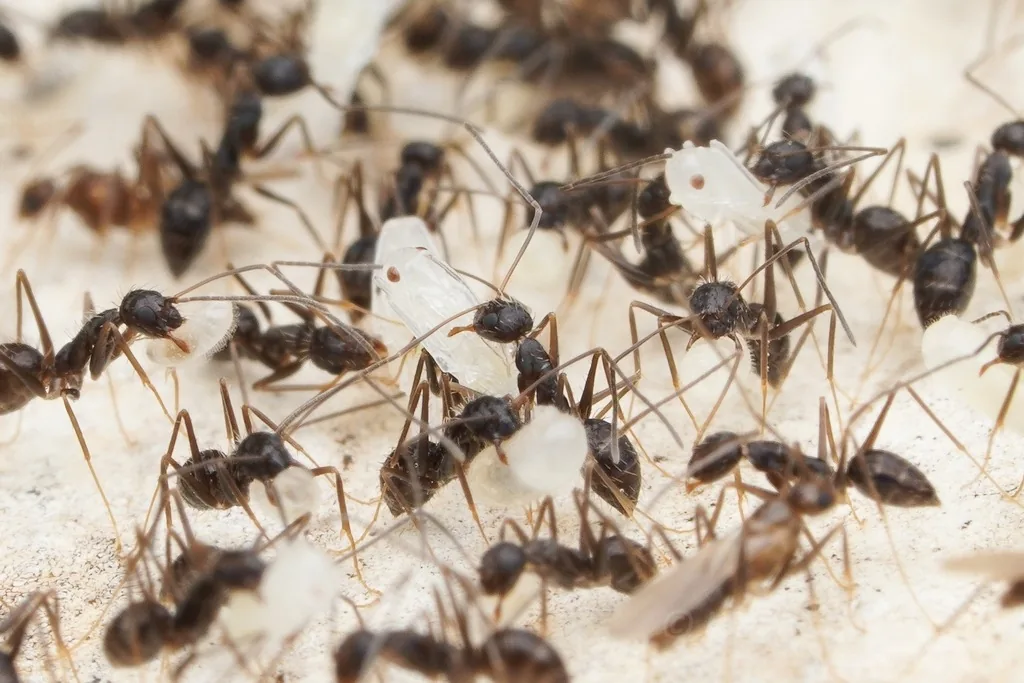
- Workers are all one size, roughly 1/16 to 1/8 inch long, and dark brown to grayish black, often with a faint bluish sheen.[1][2]
- Legs and antennae are extremely long; the first antennal segment reaches well past the back of the head.[1]
- The body carries long, coarse, scattered grayish or whitish hairs that show clearly under a hand lens.[1][2]
- Under magnification: 12-segmented antennae with no club, a single node in the waist, and a small circle of hairs at the abdomen tip instead of a stinger.[1][2]
- The quickest field clue is behavior: fast, jerky, seemingly random running.[1]
Look-alikes
| Look-alike | How to tell them apart |
|---|---|
| Tawny crazy ant | Tawny crazy ants are usually reddish brown, with shorter legs, antennae and thorax; the longhorn crazy ant is often jet black, though color alone is unreliable.[3] |
Where it lives
An introduced ant, likely from Southeast Asia or Melanesia, established from South Carolina to Florida and west to Texas, and in California and Arizona. Farther north it survives indoors in apartments, hotels and warehouses.[1][2]
Biology and life cycle
Colonies are small to moderate, with up to about 2,000 workers and as many as 40 queens; new colonies probably form by budding.[2]
In warm regions colonies can raise winged reproductives year-round; in north Florida that happens in the warm, rainy months of May through September.[1]
Outdoors they nest in rotten wood, logs, stumps, trash, soil under stones or boards, potted plants and mulched beds.[2][1]
Indoors they nest in wall voids and under floors, especially near hot-water pipes and heaters.[2]
Workers eat insects, seeds, honeydew, fruit and many household foods, and may favor protein in summer, sometimes ignoring sugar baits then.[1]
Colonies are highly mobile and move when conditions turn unfavorable; they tolerate both very dry and fairly moist sites.[2]
Damage and signs
Health risk
They have no stinger, but a worker may bite and spray formic acid from the abdomen tip onto the bite.[1]
Control
Prevention
They favor humid, wet conditions, so cut back irrigation, fix leaks and improve drainage around the home.[2]
Inspect potted plants and other items moved from an infested area so you don't carry the ants to a new site.[2]
Keep them out
Caulk openings in exterior walls and add weather-stripping to keep foragers out.[1][2]
Sanitation
Clear harborage near the house, such as fallen limbs, rocks and leaf litter, and manage aphids and other honeydew producers that feed them.[2]
Pesticides
Find nests by following workers carrying food home. Indoors, use baits, dusts and spot treatments; outdoors, baits, granules, dusts and sprays.[1]
Texas A&M reports granular baits with abamectin or hydramethylnon are effective, along with liquid sugar baits placed in busy ant areas.[2]
When to call a professional
Texas A&M recommends perimeter sprays (naming fipronil) and indoor crack-and-crevice treatment; professionals need access to the whole infestation, or ants rebound from untreated areas.[2]
Common questions
- Why are they called crazy ants?
- Because workers run fast and erratically and don't follow orderly trails the way most ants do.[1]
- Why don't ant baits always work on crazy ants?
- In summer they may prefer protein and refuse sugar baits, so try more than one bait type and keep fresh bait out.[1][2]
- Do longhorn crazy ants sting?
- No. They lack a stinger, but may bite and spray formic acid onto the bite.[1]
Sources
- University of Florida IFAS Extension, “Crazy Ant, Paratrechina longicornis (Featured Creatures, IN299).” ask.ifas.ufl.edu/publication/IN299 (accessed 2026-10-06)
- Texas A&M Center for Urban and Structural Entomology, “Crazy Ant.” urbanentomology.tamu.edu/urban-pests/ants/crazy/ (accessed 2026-10-06)
- Texas A&M Center for Urban and Structural Entomology, “Tawny Crazy Ant (formerly Rasberry crazy ant).” urbanentomology.tamu.edu/urban-pests/ants/rasberry/ (accessed 2026-10-06)
- iNaturalist, “Paratrechina longicornis taxon page (order and family).” www.inaturalist.org/taxa/69388 (accessed 2026-10-06)