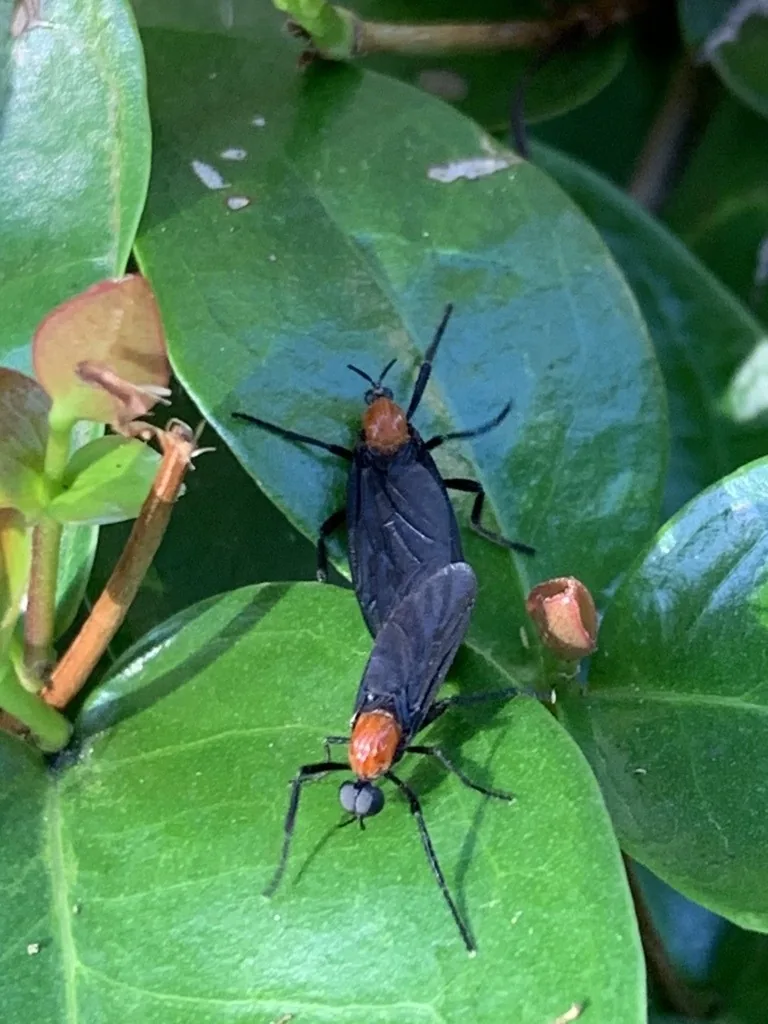
How to identify it
- Small, dull black flies with a velvety look and a red patch on top of the thorax, the section just behind the head.[1][2]
- Males are about a quarter inch long and females up to about a third of an inch; males have very large, round eyes.[1][2]
- Their best-known habit is flying and resting as joined male-female pairs, facing opposite directions.[2]
Look-alikes
| Look-alike | How to tell them apart |
|---|---|
| Dilophus sayi (a related March fly) | Smaller and completely black with no red on the thorax, much less abundant, and it doesn't gather on highways.[1][2] |
| Plecia americana | A woodland relative with an almost entirely red thorax that flies only in spring and isn't a highway nuisance; fall flights are always the lovebug.[1] |
Where it lives
Found from Central America through Mexico into the southeastern United States, including Texas, Louisiana, Mississippi, Alabama, Georgia, Florida and South Carolina, and reported as far north as Wilmington, North Carolina. It reached Florida in 1949 by spreading along the Gulf Coast.[1][2]
Biology and life cycle
Florida has two main flights a year, each lasting about four weeks, in April to May and in August to September, though a few adults turn up in most months.[1][2]
Females lay a few hundred eggs under decaying leaves and grass; the slate-gray larvae feed in groups on rotting plant material in moist, grassy spots such as pastures and roadsides.[2][1]
The pupal stage lasts 7 to 9 days, and adults live only about 3 to 4 days in the wild, long enough to mate, feed on nectar, disperse and lay eggs.[2]
Lovebugs fly only in daylight, starting once air temperatures reach about 68 degrees Fahrenheit, with mating swarms peaking mid-morning and again in early evening.[2]
Pairs are weak fliers that tend to stay within a few hundred yards of where they emerged unless wind carries them.[2]
Damage and signs
- Splattered lovebugs coat windshields, headlights and hoods, can clog radiators and cause engines to overheat, and reduce visibility.[1]
- Remains baked on by the sun for a day or more can damage car paint; fresh remains are about neutral but become acidic within a day.[2][1]
- Adults collect on light-colored surfaces, especially freshly painted buildings.[1][2]
Health risk
None: lovebugs do not bite, sting or spread disease and are not poisonous. Their larvae are actually beneficial, helping break down dead plant material.[2][1]
Control
Prevention
A coat of car wax, a hood air deflector or a nylon screen over the front of the vehicle reduces splatter and keeps them out of the radiator.[1][2]
Keep them out
Screen windows and doors, especially on the windward side, and screen decks and pool areas; a fan blowing outdoors keeps them away from work or seating areas.[2]
Traps and physical control
Wash lovebugs off vehicles promptly; soak the surface with water for about five minutes, then scrub, before remains bake in the sun.[1][2]
Vacuum up the few that get indoors; positive air pressure from an air-conditioning fan helps keep these poor fliers out.[2]
Pesticides
UF/IFAS advises against insecticides: they kill lovebugs, but more drift in almost at once, and sprays put people, pets and beneficial insects at risk.[2][1]
Common questions
- Did University of Florida scientists create or release lovebugs?
- No. That is a common myth; lovebugs spread on their own along the Gulf Coast from Central America and were already established in Florida before UF studied them.[2][1]
- Why do lovebugs gather on highways and my house?
- They are drawn to sunlight-exposed exhaust fumes, heat and light-colored or freshly painted surfaces, and wind piles them against objects downwind.[1][2]
- Are lovebugs dangerous?
- No. They don't bite, sting or carry disease. They are a seasonal nuisance that usually lasts only a few weeks at a time.[2]
Sources
- University of Florida IFAS Extension (EDIS), “Lovebug, Plecia nearctica Hardy (Featured Creatures, IN204).” edis.ifas.ufl.edu/publication/IN204 (accessed 2026-10-06)
- University of Florida IFAS Extension (EDIS), “Living with Lovebugs (IN694).” edis.ifas.ufl.edu/publication/IN694 (accessed 2026-10-06)
- iNaturalist, “Plecia nearctica taxon page (order and family).” www.inaturalist.org/taxa/127635 (accessed 2026-10-06)