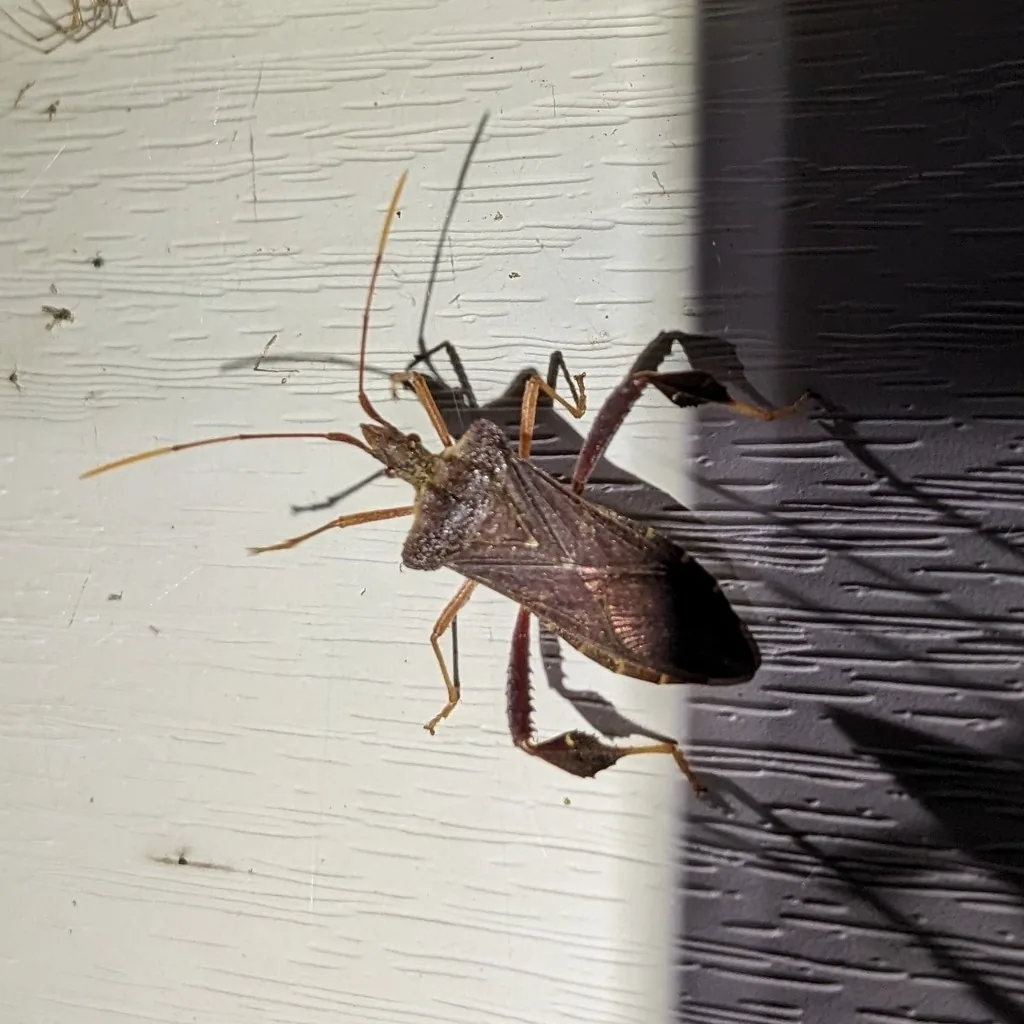
How to identify it
Look-alikes
| Look-alike | How to tell them apart |
|---|---|
| Western conifer seed bug | Has a transverse white stripe that the magnolia leaf-footed bug lacks.[1] |
| Leptoglossus oppositus | Also uniformly dark brown, but with smaller 'shoulders' and more scalloped flanges on the hind legs.[1] |
| Squash bug | Lacks the wide, leaf-like flanges on the hind legs entirely.[1] |
Where it lives
It's found in eastern North America from Ontario and Massachusetts to Florida and west to Arkansas and Texas, most commonly in the South.[1]
Biology and life cycle
Adults overwinter in leaf litter at the base of magnolias and become active when small fruits appear, mid-June to early July in Pennsylvania.[1]
Eggs are laid in chains, usually along the midrib under a leaf, about 20 to 27 to a clutch.[1]
Hosts include southern, star, saucer and sweetbay magnolias and cucumber tree; it rarely turns up on other trees.[1]
Damage and signs
Health risk
They feed only on magnolia and won't bite people; the one recorded accidental bite from a related seed bug caused intense pain and a slow-fading welt.[1]
Control
Sanitation
Removing leaf litter under magnolias in fall and spring takes out overwintering adults before they emerge.[1]
Traps and physical control
If you want control anyway, knock flightless young nymphs off the leaves with a strong jet of water.[1]
Biological control
Parasitic wasps attack the eggs; one study found 77 percent of egg masses parasitized.[1]
Common questions
Sources
- Penn State Extension, “Magnolia Leaf-Footed Bug.” extension.psu.edu/magnolia-leaf-footed-bug (accessed 2026-10-06)
- iNaturalist, “Leptoglossus fulvicornis taxon page (order and family).” www.inaturalist.org/taxa/129430 (accessed 2026-10-06)