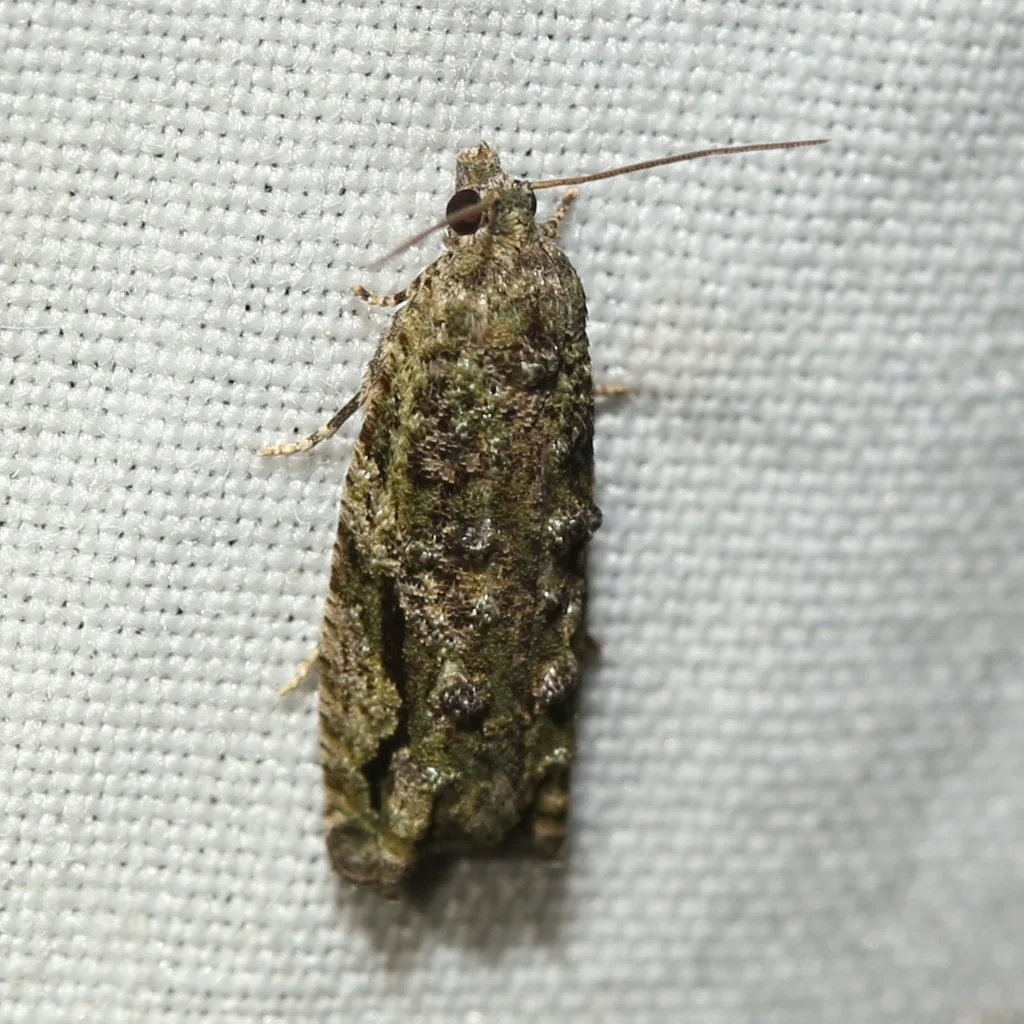
How to identify it
Where it lives
It occurs from Oregon and southern Alberta to the East Coast, and south through Kentucky and Tennessee to Mississippi.[1]
Biology and life cycle
Moths fly from mid-March to early May and likely lay eggs near opening buds; larvae bore into new shoots until late May or early June.[1]
Red and Freeman maples are the main hosts, and sugar maple is fairly common.[1]
Damage and signs
Health risk
It feeds on plants; UK Extension mentions no risk to people.[1]
Control
Traps and physical control
Through May, slicing open a flagged shoot reveals the tunneling larva, which confirms the cause.[1]
Biological control
Parasitoid wasps in the families Braconidae and Eulophidae attack it.[1]
Pesticides
In nurseries, one pyrethroid spray from just before bud break until shoots have two pairs of small leaves gave as much as 96 to 100 percent control.[1]
Common questions
- Why did the top shoot of my young maple wilt in spring?
- Maple shoot borer larvae tunneling in new shoots cause wilting and dieback from late April into May.[1]
- Did my nursery tree come with the pest?
- UK research found dormant liners aren't infested before shipping; eggs are laid shortly before bud break.[1]
Sources
- University of Kentucky Entomology (ENTFACT), “Maple Shoot Borer (ENTFACT-455).” entomology.mgcafe.uky.edu/ef455 (accessed 2026-10-06)
- iNaturalist, “Proteoteras aesculana taxon page (order and family).” www.inaturalist.org/taxa/228844 (accessed 2026-10-06)