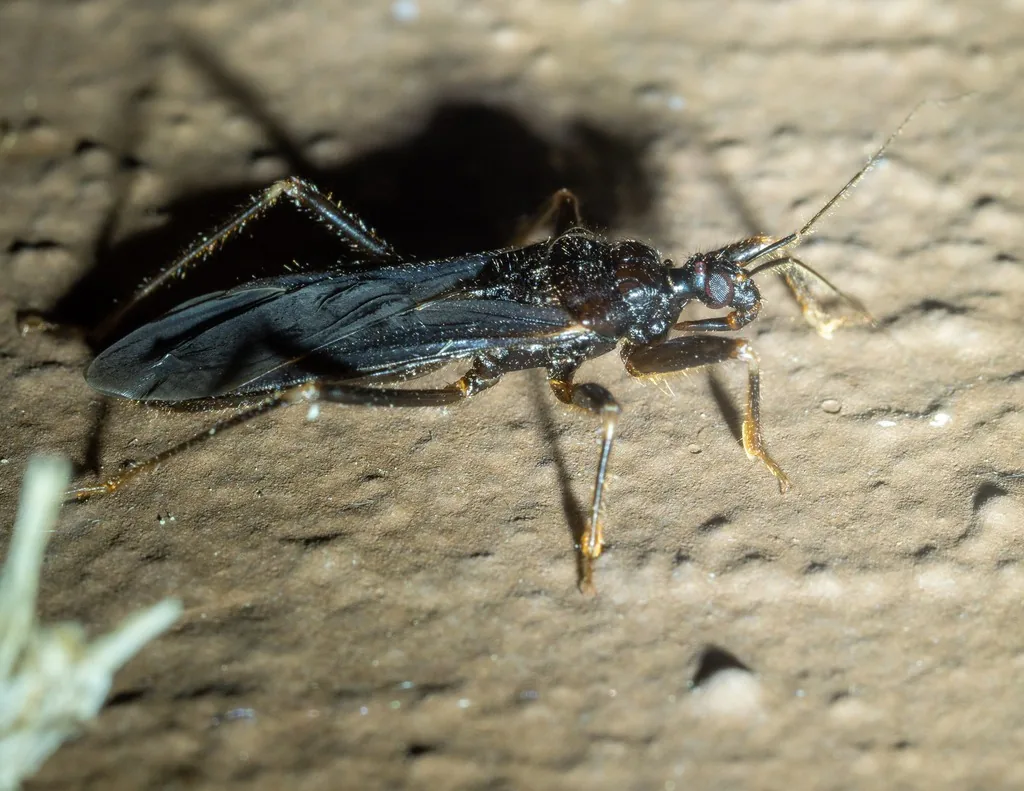
How to identify it
- Adults are elongate, glossy black or very dark brown, and about 3/4 inch (17 to 22 mm) long, with wings folded flat over the back.[1][4][2]
- The head is small with wide-set eyes and a narrow neck, and a short, stout, curved beak tucks into a groove between the front legs.[1][2]
- Nymphs coat themselves in dust, lint, sand and insect fragments held on by sticky hairs, so they look like little walking balls of fluff.[1][2][5]
- A nymph without its debris coating is smaller than an adult, lacks full wings and is light brown.[2][4]
Look-alikes
| Look-alike | How to tell them apart |
|---|---|
| Kissing bug (conenose bug) | Kissing bugs feed on blood and most have an orange- or red-striped band around the body edge; masked hunters are plain dark, don't take blood meals and don't spread Chagas disease.[7][1][2] |
| Wheel bug | A larger gray assassin bug, about 1 1/4 inches long, with a cog-like crest on top of the thorax; the masked hunter is about 3/4 inch, dark brown to black and has no crest.[6][2] |
Where it lives
Native to Europe and western Asia, it now ranges across the United States and southern Canada; in colder northern areas it survives only indoors.[1]
Biology and life cycle
Masked hunters hunt at night and spend the day in dry hiding places such as under heat registers and cabinets, inside wall voids and in attics.[1][4]
Indoors they prey on silverfish, booklice, house centipedes, carpet beetles, bed bugs and overwintering insects such as lady beetles and cluster flies.[1]
Eggs are laid in small masses in crevices; first-stage nymphs start by hunting small flies, springtails and other prey they can overpower.[5]
There may be one or two generations a year, and Colorado State suggests a two-year cycle there; adults are seen mostly in summer but also in winter.[1][4][5]
Adults have working wings, fly, and are attracted to lights, which is one way they end up indoors.[5][2]
Adults usually live 65 to 90 days, though one was recorded living 217 days.[1]
Damage and signs
Health risk
Masked hunters bite only in self-defense, for example when picked up or trapped inside a shoe. The bite feels about like a bee sting, may swell for several days, and has not been linked to disease.[1][2][5]
Control
Keep them out
Caulk, screen and seal openings, add door sweeps to outside and garage doors, and consider switching outdoor lights to sodium vapor bulbs.[4][3]
Sanitation
Find and get rid of the indoor insects they feed on; once that prey is gone, masked hunters die out from hunger or old age.[1][4]
Traps and physical control
When only one or a few appear, trap each one in a jar and release it outdoors, or vacuum it up, taking care not to touch it barehanded.[2]
Vacuum cracks and crevices regularly, and set sticky glue boards in corners and under furniture to catch insects that get inside.[4][3]
Pesticides
Insecticides usually aren't necessary. Where an underlying pest is being treated, broad-spectrum products such as pyrethroids may also reduce masked hunters; follow the label.[2][1][4]
Common questions
- What should I do if a masked hunter bites me?
- Wash the bite and apply an antiseptic; aspirin or ibuprofen may ease pain. Get medical help right away for hives, widespread swelling or trouble breathing.[5]
- Can a masked hunter give me Chagas disease?
- No. Masked hunters are related to kissing bugs, which can carry Chagas disease, but they don't feed on blood and don't transmit any disease.[2][3][1]
- Does finding a masked hunter mean I have bed bugs?
- Not necessarily. It is sometimes nicknamed the bed bug hunter, but it eats many kinds of insects, so it simply means some indoor prey is available.[5][1]
Sources
- Penn State Extension, “Masked Hunter (updated January 19, 2026).” extension.psu.edu/masked-hunter (accessed 2026-10-06)
- University of Minnesota Extension, “Masked hunters (reviewed 2024).” extension.umn.edu/household-insects/masked-hunters (accessed 2026-10-06)
- Utah State University Extension, “Masked Hunter (IPM nuisance pest notes).” extension.usu.edu/planthealth/ipm/notes_nuisance/masked-hunter (accessed 2026-10-06)
- University of Wisconsin-Madison Extension, Wisconsin Horticulture, “Masked Hunter Bug (XHT1184, revised January 20, 2009).” hort.extension.wisc.edu/articles/masked-hunter-bug/ (accessed 2026-10-06)
- Colorado State University, Department of Agricultural Biology, “Masked Hunter (Colorado Insect of Interest, revised 2017).” webdoc.agsci.colostate.edu/bspm/Hexapoda%20(Insects)/MaskedHunterRevised2017.pdf (accessed 2026-10-06)
- Texas A&M AgriLife Extension Service, “Wheel bugs and other assassin bugs (Insects in the City, ENT-1003).” citybugs.tamu.edu/factsheets/landscape/others/ent-1003/ (accessed 2026-10-06)
- Texas A&M University Kissing Bug Community Science Program, “Kissing Bugs: Frequently Asked Questions.” kissingbug.tamu.edu/faq/ (accessed 2026-10-06)
- iNaturalist, “Reduvius personatus taxon page (order and family).” www.inaturalist.org/taxa/56521 (accessed 2026-10-06)