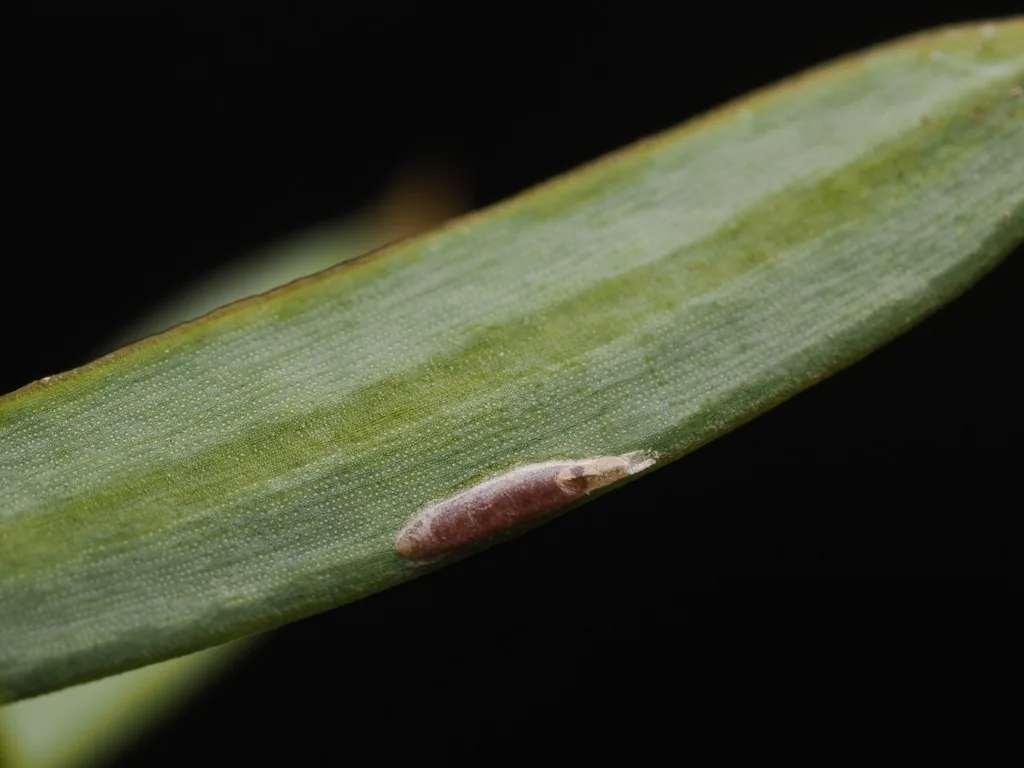
How to identify it
- Female armor is brown, up to 1/16 inch long and oystershell-shaped; male armor is smaller and slender.[1][2]
- Young scales' armor is pale brown and almost translucent; crawlers are flat and yellow.[1]
- In established populations many scales are dead, because the armor stays on the plant long after the insect dies.[1]
Where it lives
UMass reports it in New Jersey, New York, Delaware, Pennsylvania and at least seven more states, and probably more widely; NC State covers it in North Carolina.[1][2]
Biology and life cycle
Eggs laid under the female's armor hatch in one to three weeks, and crawlers settle on needles and build pale armor.[1]
About two months later, females begin laying eggs for a new generation.[1]
Winged males find females to mate and soon die; they lack mouthparts.[1]
Damage and signs
- Junipers are the most frequently reported hosts; it also attacks arborvitae, Chamaecyparis, Cryptomeria, cypress, deodar cedar, umbrella pine, yew and others, more than 21 plant genera in all.[1][2]
- On Cryptomeria it can cause browning and twig dieback, and it can become a serious pest of junipers.[1][2]
Health risk
Control
Prevention
Scout in early spring for crawler activity.[1]
Biological control
Tiny parasitic wasps often heavily parasitize it, though populations occasionally escape them.[1]
Pesticides
Treat infested plants with horticultural oil, at the maximum label rate in cold weather and the growing-season rate in summer.[1]
Common questions
- What are the tiny brown specks on my juniper needles?
- Possibly Maskell scale, a 1/16-inch oystershell-shaped armored scale.[1][2]
- Are the scales alive?
- Not necessarily; armor stays on the plant long after the scale dies, so check for live insects before treating.[1]
- How do I treat Maskell scale?
- Horticultural oil at the label's dormant rate in cold weather or growing-season rate in summer.[1]
Sources
- NC State Extension, “Maskell Scale (PDIC Factsheet).” content.ces.ncsu.edu/maskell-scale (accessed 2026-10-15)
- UMass Extension Landscape, Nursery and Urban Forestry Program (Landscape Insect & Mite Guide), “Lepidosaphes pallida (Maskell Scale).” www.umass.edu/agriculture-food-environment/landscape/publications-resources/insect-mite-guide/lepidosaphes-pallida (accessed 2026-10-15)
- iNaturalist, “Lepidosaphes pallida taxon page (order and family).” www.inaturalist.org/taxa/391463 (accessed 2026-10-06)