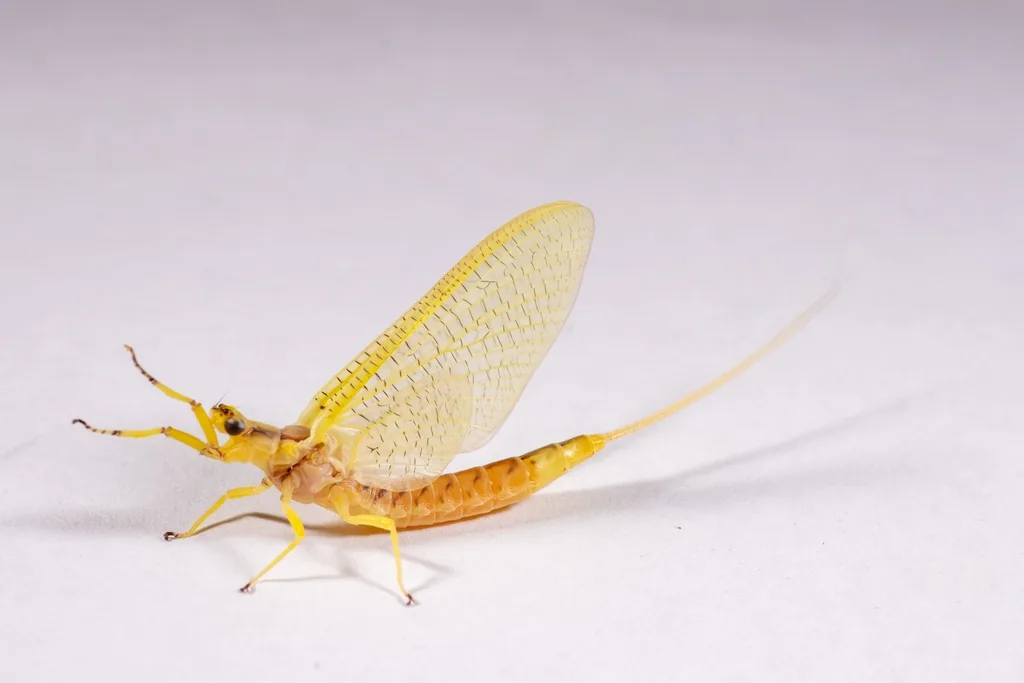
How to identify it
- Winged mayflies hold their large, triangular front wings upright and together over the body; the hind wings are much smaller or missing.[1]
- The body is delicate, bare and often shiny, and the front legs are the longest and are held forward at rest.[1]
- Nymphs, called naiads, have long legs, short antennae, plate-like gills along the abdomen and usually three long, thin tails.[1]
- Colors vary by species, including yellow, green, white and black; the giant mayfly, Hexagenia limbata, is yellow or yellow-green and nearly an inch long without its tails.[1]
Where it lives
Thousands of species occur worldwide near streams, rivers, lakes and ponds; big emergences are typical of large lakes and reservoirs, where burrowing species like Hexagenia live in the mud.[1][2]
Biology and life cycle
Nymphs live in water, breathe through plate-like gills on the abdomen and feed on algae and bits of organic matter.[1][2]
Most species take about a year to develop, and a few take several years, so a mayfly that lives only a day as an adult may be a year old.[2][1]
Mature nymphs rise to the surface and molt into a dull-winged pre-adult, which flies to nearby plants and molts again into the clear-winged adult.[1]
Mayflies are the only insects that molt again after they have wings.[1]
Adults have non-working mouthparts and do not feed; they mate in swarms, lay eggs on or in the water and die within one or two nights.[1][2]
Damage and signs
Health risk
Mayflies are medically harmless, and the adults have non-working mouthparts, so they cannot feed.[1]
Control
Prevention
Managing lights is the main defense, since most problems start when adults are drawn to electric lights at night.[2][1]
Keep them out
Physical exclusion, such as keeping mayflies out of buildings and screened areas, is more effective than insecticides during a mass emergence.[2]
Traps and physical control
Clear piles with leaf blowers, vacuums, or brooms and dust pans; these physical methods usually work better than spraying.[2]
Common questions
- How long does a mayfly hatch last?
- Mass emergences are short-lived and usually last about a week. They happen every year, but some years produce far more mayflies than others.[2]
- Do mayflies bite?
- No. Adult mayflies have mouthparts that don't work, so they can't feed or bite, and they are medically harmless.[1]
- Are lots of mayflies a bad sign for the lake?
- Usually the opposite. Mayfly nymphs are an important food for fish, and healthy mayfly populations are a sign of a healthy aquatic ecosystem.[2][1]
Sources
- Texas A&M AgriLife Extension, Department of Entomology, “Mayfly (Field Guide to Common Texas Insects).” texasinsects.tamu.edu/mayfly/ (accessed 2026-10-06)
- Mississippi State University Extension Service, “Mayfly (Bug's Eye View, Vol. 4, No. 11).” extension.msstate.edu/newsletters/bugs-eye-view/2018/mayfly-vol-4-no-11 (accessed 2026-10-06)
- iNaturalist, “Hexagenia limbata taxon page (order and family).” www.inaturalist.org/taxa/51116 (accessed 2026-10-06)