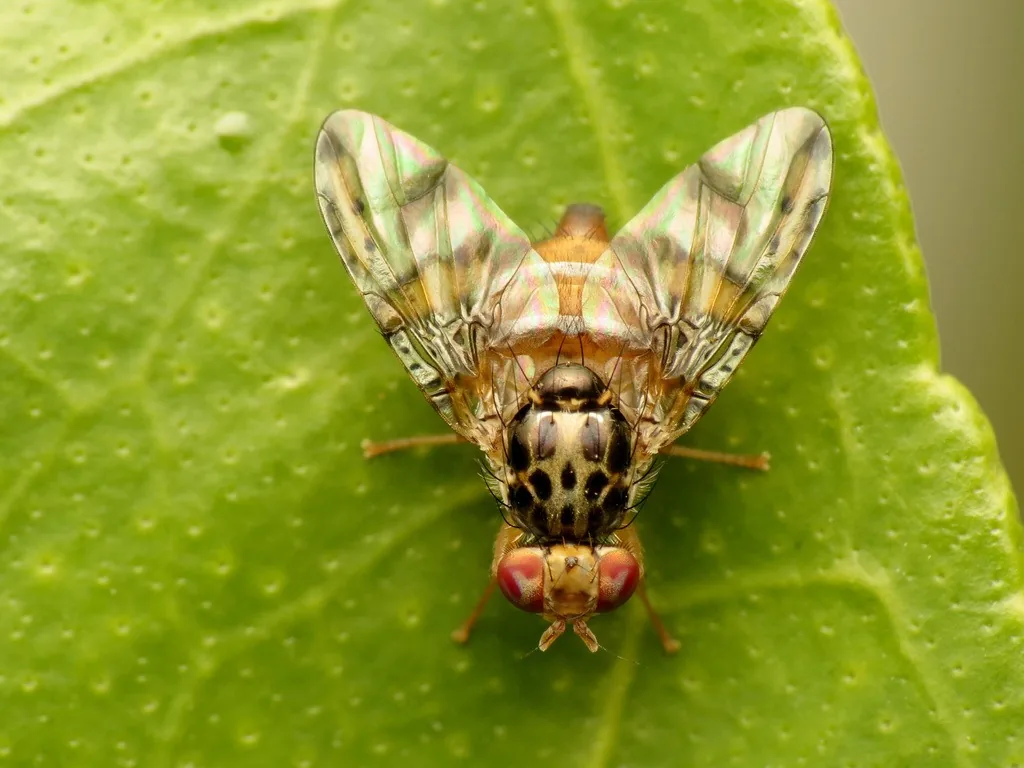
How to identify it
- Adults are 3.5 to 5 mm long, slightly smaller than a house fly, yellowish with a brown tinge and reddish-purple eyes.[1]
- Broad wings, usually held drooping, carry black, brown and brownish-yellow markings with a wide yellowish band across the middle.[1]
- Larvae are white maggots, usually 7 to 9 mm long when grown.[1]
Where it lives
It has no near relatives in the Western Hemisphere; UF/IFAS describes the treatments used against Florida's 2010 infestation.[1]
Biology and life cycle
Thin-skinned, ripe, succulent fruits are preferred, and host preferences vary by region.[1]
Eggs are slender, curved and shiny white, about 1 mm long.[1]
Damage and signs
- It attacks more than 260 kinds of fruits, flowers, vegetables and nuts.[1]
Health risk
It infests fruit; UF/IFAS mentions no risk to people.[1]
Control
When to call a professional
Florida infestations are managed by state agriculture regulators, so UF/IFAS gives no homeowner recommendations.[1]
In the 2010 Florida infestation, agencies spot-sprayed spinosad fruit fly bait, drenched soil under infested trees and stripped fruit from nearby host trees.[1]
Common questions
Sources
- University of Florida IFAS Extension (Featured Creatures), “Mediterranean Fruit Fly, Ceratitis capitata (EENY-214).” edis.ifas.ufl.edu/publication/IN371 (accessed 2026-10-06)
- iNaturalist, “Ceratitis capitata taxon page (order and family).” www.inaturalist.org/taxa/199404 (accessed 2026-10-06)