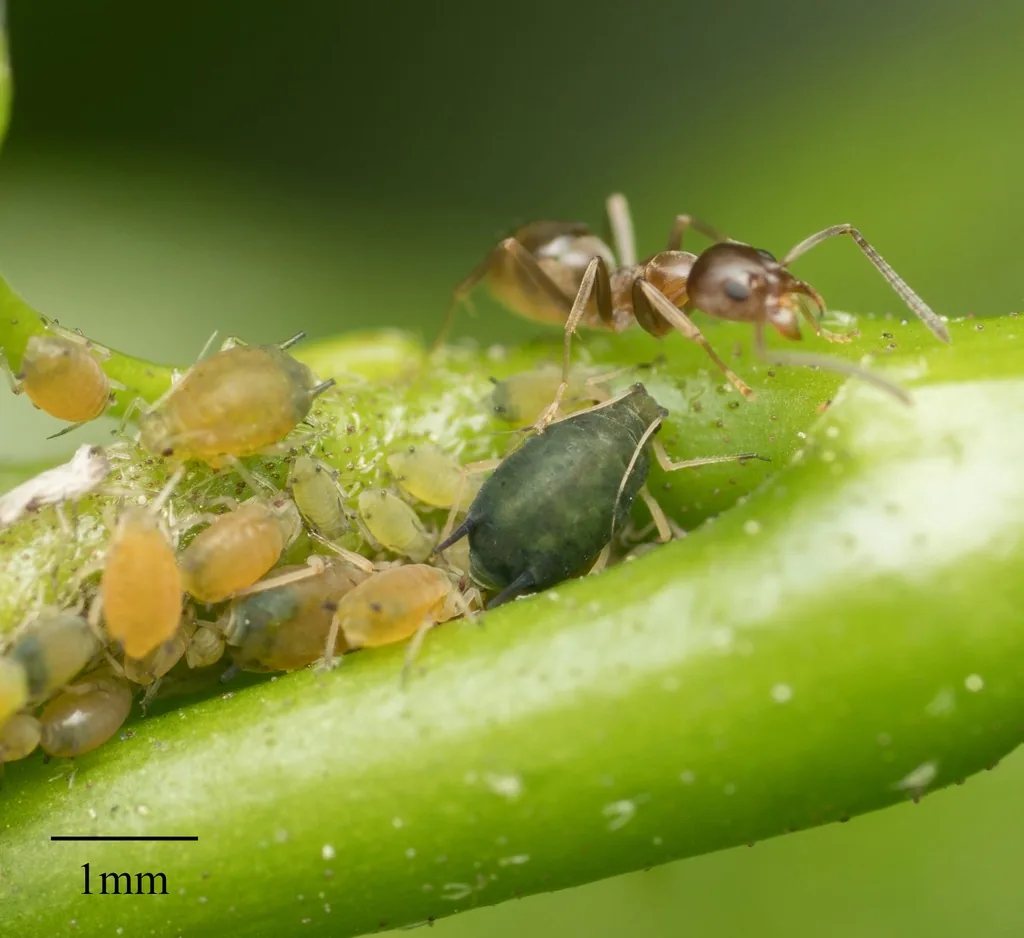
How to identify it
Look-alikes
| Look-alike | How to tell them apart |
|---|---|
| Spirea aphid | Its tail-like cauda is dark brown to black; the melon aphid's is pale to dusky.[1] |
Where it lives
It occurs in tropical and temperate regions worldwide; in the U.S. it's a regular pest in the Southeast and Southwest.[1]
Biology and life cycle
In the South, females keep producing young without mating as long as weather allows, and hot weather doesn't slow them.[1]
A generation can take as little as about a week, so numbers climb fast.[1]
Damage and signs
Health risk
It feeds on plants; UF/IFAS mentions no risk to people.[1]
Control
Prevention
Row covers and reflective silver or white mulches reduce aphid numbers.[1]
Biological control
Lady beetles, flower flies and braconid wasps attack it; the wasp Lysiphlebus testaceipes can parasitize up to 99%.[1]
Pesticides
If spraying, cover foliage thoroughly and avoid unneeded insecticides; resistance to pyrethroids and organophosphates is widespread.[1]
Common questions
Sources
- University of Florida IFAS Extension (Featured Creatures), “Melon Aphid or Cotton Aphid, Aphis gossypii (EENY-173).” edis.ifas.ufl.edu/publication/IN330 (accessed 2026-10-06)
- iNaturalist, “Aphis gossypii taxon page (order and family).” www.inaturalist.org/taxa/309466 (accessed 2026-10-06)