How to identify it
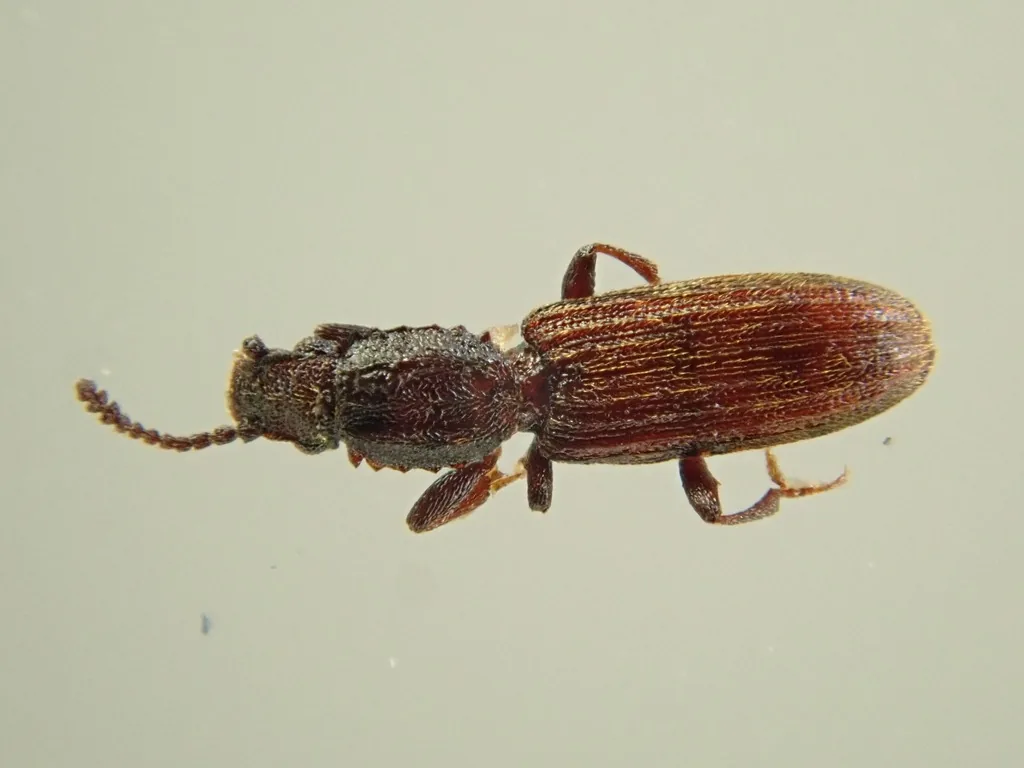
- Adults have a flattened, dark brown body about 1/10 inch (3 mm) long.[3][4]
- Six saw-like teeth line each edge of the thorax, a trait it shares with the sawtoothed grain beetle.[3][4]
- The eyes are large, bigger across than the temple area behind them, and the head looks rectangular from above.[4][3]
- Larvae are yellowish with a brown head and stay under 1/8 inch (3 mm) long.[3]
Look-alikes
| Look-alike | How to tell them apart |
|---|---|
| Sawtoothed grain beetle | Has smaller eyes, a more triangular head and a wider area behind the eyes, and the adults cannot fly.[4][1] |
| Red flour beetle | A shiny reddish-brown oval beetle with a three-segment antennal club and no teeth along the thorax.[1] |
Where it lives
Found worldwide; usually carried into homes in infested food, though flying adults can also arrive from elsewhere.[3][4]
Biology and life cycle
A female lays up to about 190 eggs, singly or in small groups.[3]
Under good conditions the life cycle takes about 30 to 40 days, and there can be six or seven generations a year.[3]
Adults typically live around seven months.[3]
Compared with the sawtoothed grain beetle, it handles cold less well and lays only one-half to two-thirds as many eggs.[4]
Damage and signs
- Its preferred foods are oilseed products such as nuts and sunflower seeds, plus coconut and candy bars made with nuts.[4][3]
- It also infests rolled oats, rice, flour, cake mixes, macaroni and puffed cereals.[3]
- Pet food, bird seed and rodent bait are also common places to find these beetles.[1]
- Infested food is fouled by the insects' bodies and by-products, and some beetle larvae give food a bad odor and taste.[1]
Health risk
It doesn't bite people or pets; the risk is contaminated food, and UC IPM notes pantry pests may introduce microbes that can produce mycotoxins in warm, humid storage.[1]
Control
Prevention
Keep nuts, seeds, oats and mixes in glass or other containers with tight-fitting lids; plastic bags don't keep pantry beetles out.[1][2]
Don't pour new food on top of old, and wash containers before refilling them.[1]
Sanitation
Search nut, seed and cereal products first, discard anything with live beetles, and keep checking other packages, since adults spread to new food.[2][4][1]
Vacuum cabinet shelves, corners and cracks with a crevice tool, and wash shelving with soap and water before restocking.[1][2]
Traps and physical control
Bird feed or decorative items can be heated at 155 degrees F for about 20 minutes or held at 0 degrees F in a freezer for 4 days.[2]
Pesticides
Insecticides aren't recommended against pantry pests in the home; removing infested food and cleaning is what works.[1]
Common questions
- Is a merchant grain beetle different from a sawtoothed grain beetle?
- Yes, but only slightly. The merchant grain beetle has bigger eyes and a squarer head, flies, and prefers nuts and seeds; both are managed the same way.[4][3][1]
- Why are there grain beetles in my trail mix or nuts?
- Nuts and other oilseed products are this beetle's favorite foods, so check them first when you find small, flat brown beetles.[4][3]
Sources
- University of California Statewide IPM Program, “Pest Notes: Pantry Pests, Publication 7452.” ipm.ucanr.edu/home-and-landscape/pantry-pests/ (accessed 2026-10-06)
- University of Kentucky Entomology, “ENTFACT-612: Stored Product Pests in the Pantry.” entomology.mgcafe.uky.edu/ef612 (accessed 2026-10-06)
- University of Florida, Entomology and Nematology Department, “Merchant grain beetle, Oryzaephilus mercator (stored product pests image gallery).” entnemdept.ufl.edu/projex/gallery/dl/stored_product_pests/text/merchant_grain_beetle.htm (accessed 2026-10-06)
- Penn State Extension, “Sawtoothed and Merchant Grain Beetle (updated August 3, 2026).” extension.psu.edu/sawtoothed-and-merchant-grain-beetle (accessed 2026-10-06)
- iNaturalist, “Oryzaephilus mercator taxon page (order and family).” www.inaturalist.org/taxa/210455 (accessed 2026-10-06)